
A labor movement that doesn’t have its own songs and culture isn’t a labor movement. Historically, a union the understood that and took ‘recreation’ and education as seriously as health and safety was the International Ladies Garment Workers Union. Below a report on a varied performance by its members and a showing of ‘Marching On’ at New York’s Hippodrome in front of thousands.
‘6,000 See Dress Makers Groups Dance and Sing’ from Socialist Call. Vol. 1 No. 13. June 15, 1935.
NEW YORK CITY. More than 6,000 workers packed the huge Hippodrome to overflowing last Sunday afternoon to witness the exciting spectacle of labor culture by the recreational and athletic groups of the International Ladies’ Garment Workers’ Union.
The event was the climax of the first season of the union’s renewed endeavor in the field of workers’ culture and education, for which $60,000 was spent last year.
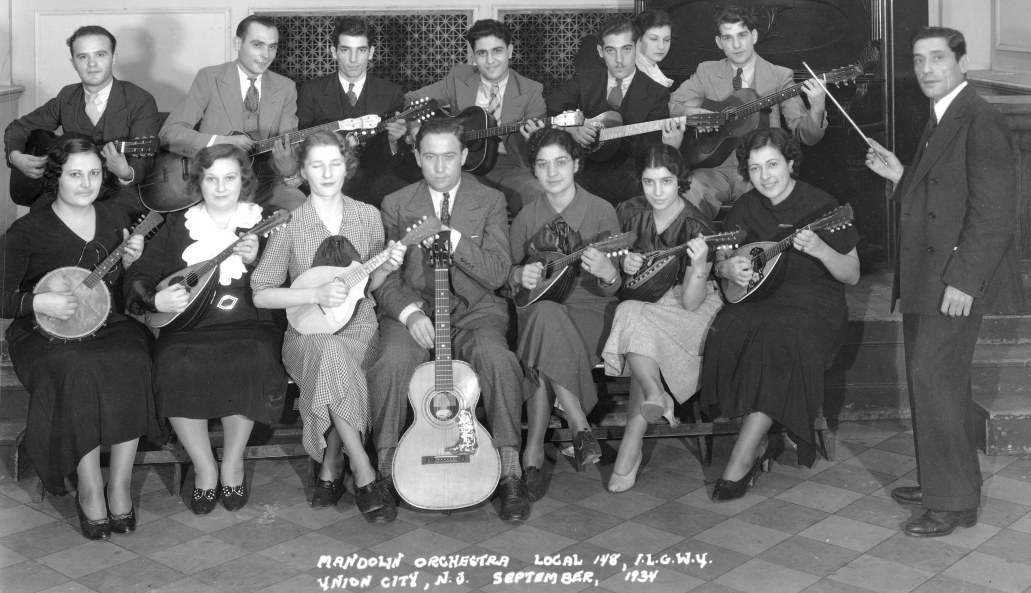
As the program note by Louis Schaffer, supervisor of Recreational Activities, explained: “The boys and girls whom you will see on the huge Hippodrome stage today singing in choruses, moving rhythmically in the dance ensemble, strumming their mandolins or playing their parts in the mass recitation–remember, these are all shop workers, a typical cross-section of the International Ladies Garment Workers’ Union.”
“MARCHING ON!”
The entire program of song, dance, instrumental playing and mass recitations was set as a bright jewel in a background of colorful history, presented through the medium of the talking picture, “Marching On!” the history of the ILGWU.
The meeting opened with the playing of a mandolin orchestra, consisting of about 200 players, conducted by Luigi Paparello.
The showing of the movie, “Marching On!” followed—it depicted in brief and graphic form the high points in the history of the union. Pictures of past leaders, Schlesinger, London, Hillquit, Baroff, Rosenberg, as well as pictures of present leaders, were greeted with enthusiasm. The great strikes of 1907, of 1910, of 1933 were thrown upon the screen.
LABOR SONGS
A program of labor songs by the International Chorus, made up of voices from nine locals was a source of artistic enjoyment and working class spirit. The direction was by Lazar Weiner.
The second half of the program was taken up by the dance group of the dress makers union, as well as by a mass recital, directed by Mark Schweid.
A speech of major importance–in the matter of creating a real workers’ cultural movement was given during the intermission by David Dubinsky, president of the ILGWU.
“The union stands for more than a one dollar increase in wages,” he stated.
“The time may come,” he said, “when the union cannot win wage increases. It will then have to fall back upon the intelligent understanding of its membership, trained in the ideals of the labor movement.”
EDUCATE
He declared that to educate the great mass of new members who have come to the union in the last few years it is necessary to utilize every method and means of modern enlightenment, The radio, the arts, athletics, the class room should all be harnessed in the interest of the labor movement. In building the labor movement, he stated, the union must see to it that the worker does not look upon the union as a mere service station. He or she must look upon the union as a place to sing, to dance, to play, to live, as his or her life, and home, and hope. Julius Hochman, chairman of the educational committee of the union and manager of the joint dress board, presented a scholarly sketch of the history of workers’ education in America.
It was really a worker’s day. Just two speeches both to the point and then rank-and-file expression.
When Louis Schaffer was introduced to the membership, as the man who was responsible for the presentation of the performance, he wisely merely saluted the audience and–let the events of the afternoon speak for themselves. And they did!
Socialist Call began as a weekly newspaper in New York in early 1935 by supporters of the Socialist Party’s Militant Faction Samuel DeWitt, Herbert Zam, Max Delson, Amicus Most, and Haim Kantorovitch, with others to rival the Old Guard’s ‘New Leader’. The Call Education Institute was also inaugurated as a rival to the right’s Rand School. In 1937, the Call as the Militant voice would fall victim to Party turmoil, becoming a paper of the Socialist Party leading bodies as it moved to Chicago in 1938, to Milwaukee in 1939, where it was renamed “The Call” and back to New York in 1940 where it eventually resumed the “Socialist Call” name and was published until 1954.
PDF of full issue: https://www.marxists.org/history/usa/pubs/socialist-call/v1n13-jun-15-1935.pdf
 Revolution's Newsstand