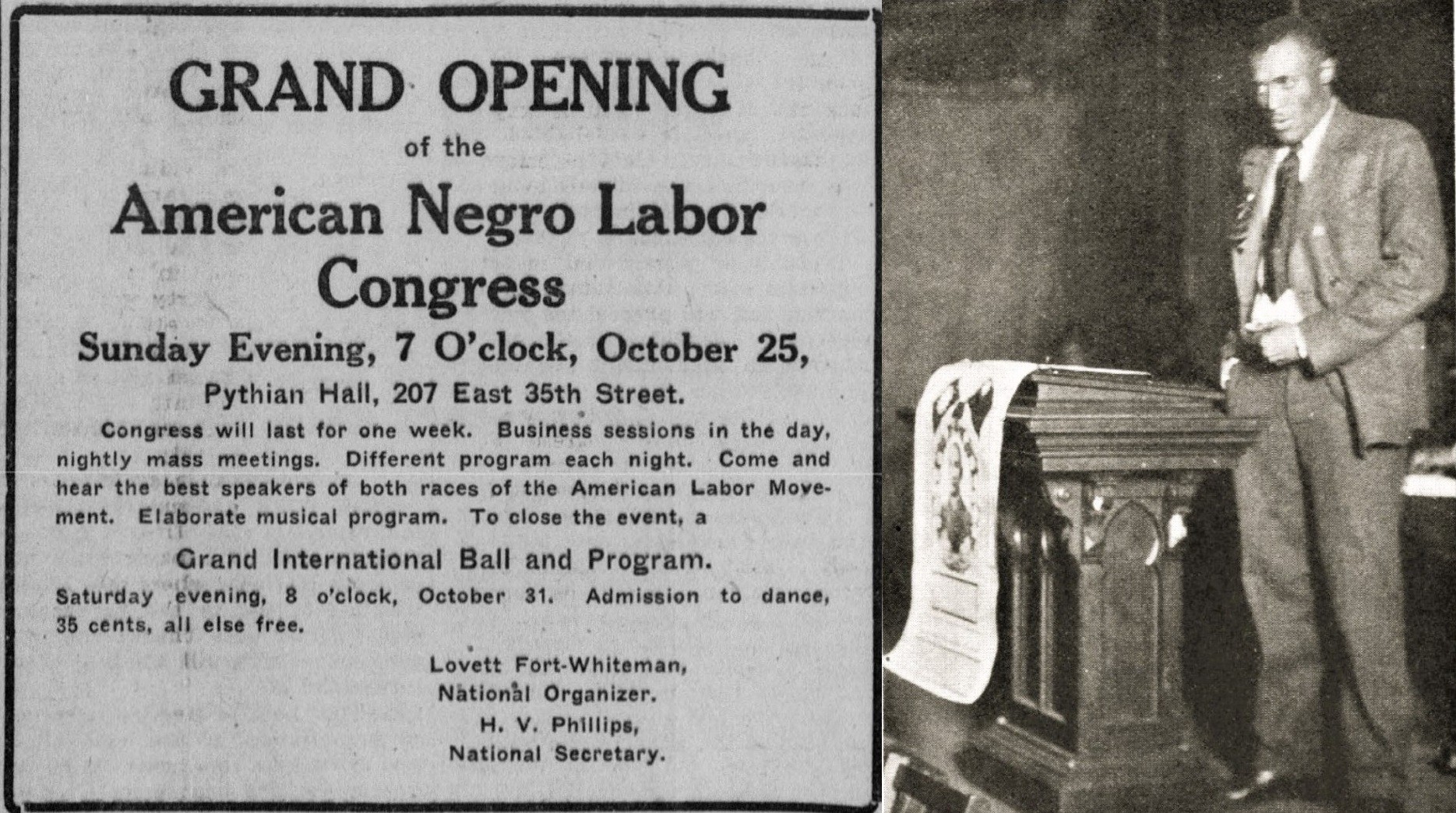
The Communist Party gained its original Black cadre, figures such as Cyril V. Briggs, Otto Huiswoud and Lovett Fort-Whiteman, largely through the merger of the African Blood Brotherhood with the Workers Party in 1922. However, it would be several years (and continued Comintern insistence) until the Party attempted to specifically organize Black workers. The first such organization was the American Negro Labor Congress founded during a week-long meeting in Chicago from Sunday October 25th to Saturday the 31st, 1925. The Congress was covered extensively by the Daily Worker, below are reports from the opening day. Each day of the Congress to follow.
‘Day One: Opening of the American Negro Labor Congress’ from The Daily Worker. Vol. 2 No. 245. October 27, 1925.
‘Negro Workers Gather Here’ from The Daily Worker. Vol. 2 No. 244. October 25, 1925.
NEGRO LABOR MEET OPENS SUNDAY NIGHT
Many Delegates Arrive From South and East
Delegates are arriving from many of the large industrial centers of the south and east to attend the sessions of the American Negro Labor Congress which opens Sunday night, Oct. 25 with a grand celebration at the Metropolitan Community Center, 3118 Giles Ave., corner East 31st St. Delegates from the mining districts of West Virginia, the steel mills of Pennsylvania and the pottery works of Ohio have already arrived.
Telegrams from the union organizations in Louisiana, Texas and Florida have arrived notifying the congress arrangements committee that delegates are on the way.
All delegates to the congress are being registered at the American Negro Labor Congress headquarters, 3456 Indiana Ave. and then they are quartered in a nearby hotel.
“The workers and farmers of Texas, Oklahoma, Louisiana, Mississippi and Alabama are looking forward to the opening of the American Negro Labor Congress in Chicago as a new epoch in the life of the Negro in the South,” declared Norval Allen, southern organizer for the American Negro Labor Congress, in an interview with the representative of The DAILY WORKER upon his arrival in Chicago. “The organized and unorganized workers and farmers of the South are sending delegates to this congress.”
The sessions of the congress which will take place during the day will be open to the public and the representatives of all the newspapers.
During the evening there will be large mass meetings at which speakers of the different races will talk on the work before the Negro workers and farmers in America. Bishop William Montgomery Brown, expelled by the house of bishops from the church for his labor views, has sent a telegram to the American Negro Labor Congress informing them he will be able to speak before the Tuesday evening mass meeting.
‘AMERICAN NEGRO LABOR MEET OPENS WITH GIGANTIC MASS DEMONSTRATION IN CHICAGO’ from The Daily Worker. Vol. 2 No. 245. October 27, 1925.
The American Negro Labor Congress, the first of its kind to be held in the United States, opened its sessions yesterday at the Metropolitan Community Center, 3118 Giles Avenue, with a gigantic mass meeting with workers of all races participating.
The persecution of the Negro in America has become one of the most paramount issues among Negro workers. In Detroit and Cleveland, attempts have been made to keep the Negroes in segregated districts. In Philadelphia and Cleveland Negro children are forced to attend Jim Crow schools. In Chicago a Negro church was bombed in an attempt to scare Negroes from residing in the district.
Discuss Race Bars.
The American Federation of Labor continues its passive opposition to the anti-Negro bars raised by Our International unions. Negro workers are unable to join hands with the white workers in a common struggle against the class that exploits them both. The Negro in American industry is the most underpaid and overworked and is often used by the bosses in strikes to crush the struggle for better conditions.
These are some of the problems that face the first gathering of Negro workers and working farmers in America. Last year, the Sanhedrin met, but there the Negro worker received but little consideration. The Negro worker has now decided to act for himself.
Delegates Arrive.
All day long delegates that had been sent by the organized and unorganized longshoremen, cotton and sugar cane farmers, steel, pottery, and turpentine workers, kept arriving at the headquarters of the American Negro Labor Congress at 3456 Indiana Ave., where they registered, received their badges and were then taken to a nearby hotel where delegates are being quartered.
Real Work Starts Monday.
The real work of the congress will start today with a discussion on the American Negro and the trade unions. In the evening a mass meeting will be held at which speakers of both races will speak on the theme which occupied the day’s session.
On Tuesday, racial persecution, Jim Crowism and racial segregation will be discussed and acted upon.
On Wednesday, the relation of the Negro to American political life will be discussed.
On Thursday, the task of the American Negro in the anti-imperialist movement taking place In Egypt, India, Morocco, Syria and other sections of the world will be discussed.
Abolish Peonage System.
On Friday, the task of organizing and educating the Negro farmer will be discussed. The peonage system which exists in the south Is the important issue for the farmer delegates to the congress and its discussion, will result in strong action being taken by the congress to abolish this system.
International Ball Saturday.
Saturday will be the day when workers of all races will mingle at the International ball arranged by the American Negro Labor Congress as the windup of the congress and as the means to raise funds to carry out the program adopted by the delegates at the congress.
The congress has also arranged for musical numbers and other artistic talent to participate at the open evening session meetings.

‘Send Delegates to the Negro Labor Congress’ from The Daily Worker. Vol. 2 No. 245. October 27, 1925.
Typical of the organizations which have sent representatives to American Negro Labor Congress here are the Hod Carriers, Building and Common Labor Union, Local 1,143, of Topeka, Kansas, the Workingmen’s Association of Cincinnati, and the Cigar Makers’ Union of Philadelphia. There is a delegate representing the unorganized steel workers of Brownsville, Pennsylvania. The African Blood Brotherhood and the International Negro Alliance, have also sent delegates. Many more labor organizations have sent telegrams to the national office of the congress, at 3456 Indiana Ave., saying that delegates are on the way. Over one hundred delegates are expected to arrive before Tuesday’s session, according to Lovett Fort-Whiteman, national organizer of the congress.
The hall is decorated with large paintings representing leaders of the Negroes and other oppressed peoples in their many splendid revolts against their masters. Directly above the platform is a picture six feet wide, showing a Negro worker and a Negro farmer clasping hands, To the right is a picture of Saklatvala, Communist Hindu leader, Sun Yat Sen, leader of the Chinese workers in their revolt against foreign imperialism, and Abdel-Krim, chief of the Moroccan tribes fighting for their independence from the robbers of France. To the left is a picture of Nat Turner and Denmark Vesey, each the leader of a slave uprising that took place in the United States before the Civil War and Toussaint L’Ouverture, who lead the revolt of the Haitians in 1871 [sic].
‘The American Negro Labor Congress’ Editorial from The Daily Worker. Vol. 2 No. 245. October 27, 1925.
The Daily Worker hails the American Negro Labor Congress opening today in the city of Chicago. The convening of this congress is significant in the history of the labor movement. It is the first time that an effort has been made to bring together representatives of Negro workers from all parts of the country.
Like every other advance in the labor movement, this congress convenes after a hard struggle against groat odds. When it became known that work toward such a congress was under way every agency of reaction began to assail it. The ku kluxers naturally viewed it as a diabolical attempt against white, protestant, nordic, native-born, 100 per cent, etc., etc. Those faithful scullions of the capitalist class, the officialdom of the American Federation of Labor, denounced it as a bolshevik conspiracy. The campaign raged in order to terrorize the organizers and supporters of the congress.
But the workers who did the organization work were made of sterner stuff than estimated by their craven enemies, and as a result the congress is here.
Great tasks lie before those colored workers striving to bring their race into the American labor movement. They not only have the same class problems of other workers, but they have a special struggle to resist the efforts of the capitalist enemies within as well as without their own ranks seeking to arouse antagonism between them and the white wage slaves.
The congress was made possible by the untiring efforts of its organizers and by the fact that during and since the war the industrial capitalists have encouraged a mass movement of Negro workers from the southern agricultural regions into the industrial centers.
As Communists we hail this congress as the beginning of a movement with far-reaching implications. Not merely can it be the means of starting to mobilize the Negro workers for a struggle against the degrading restrictions imposed upon them as a race, but as American workers, speaking the common language of the country, they can become a power in the labor movement. Furthermore, by being brought into the struggle against imperialism in the United States, they will receive training that will enable them to play an effective part in the world mobilization of the oppressed colonial peoples against capitalism.
The Daily Worker began in 1924 and was published in New York City by the Communist Party US and its predecessor organizations. Among the most long-lasting and important left publications in US history, it had a circulation of 35,000 at its peak. The Daily Worker came from The Ohio Socialist, published by the Left Wing-dominated Socialist Party of Ohio in Cleveland from 1917 to November 1919, when it became became The Toiler, paper of the Communist Labor Party. In December 1921 the above-ground Workers Party of America merged the Toiler with the paper Workers Council to found The Worker, which became The Daily Worker beginning January 13, 1924.
PDF of full issue: https://www.marxists.org/history/usa/pubs/dailyworker/1925/1925-ny/v02b-n245-NYE-oct-27-1925-DW-LOC.pdf
 Revolution's Newsstand