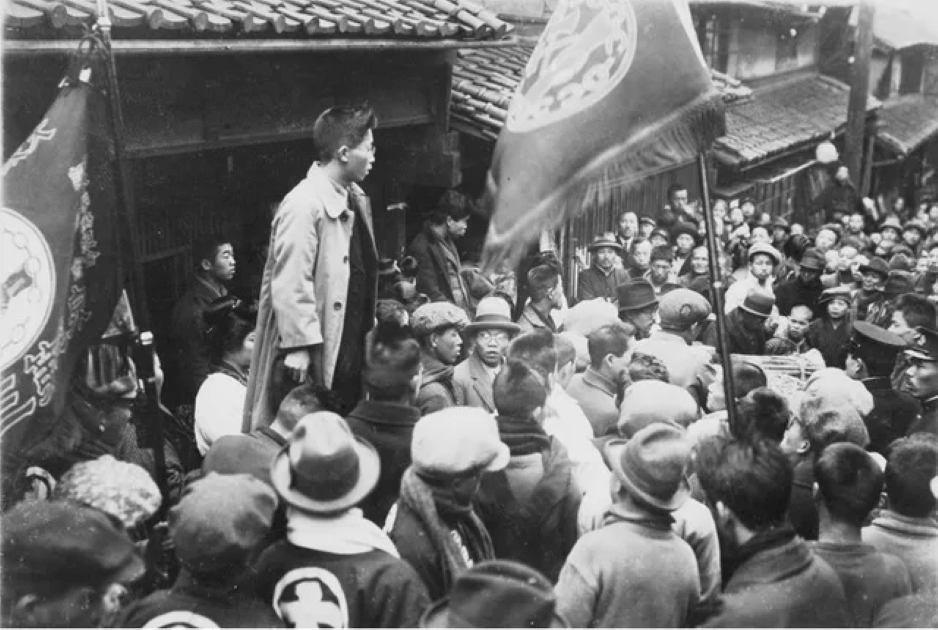
A resolution on work in the ‘East’ from the Third World Congress of the Red International of Labor Unions (the Profintern), held in Moscow in July, 1924
‘Resolution of the Eastern Commission’ from the Third Word Congress of the Red International of Labor Unions published by the Trade Union Educational League, Chicago, 1924.
1. SINCE the time of the second congress of the R.I.L.U., the situation of the working class and the condition of the labor union movements in all the countries of the East has become materially worse.
2. Notwithstanding the variety of the economic and political situation in the Eastern countries certain general causes of this worsening may be observed.
Those causes are as follows:
a. The crisis in the chief industrial countries in Europe continues and the flow of European, especially English, capital into the colonies and semi-colonies has been intensified, which in turn connotes an intensification of imperialistic spoliation.
b. There has been demonstrated in the last few years of world crisis the financial, technical and organizational weakness of the precocious native industrialism (India, China, even partially Japan,) which is not able to stand the competition of the old industrial countries of Europe, and often perishes in the struggle with foreign capital.
c. Therefore there is a tendency for a certain part of the native industrial bourgeoisie to seek a rapprochement with foreign capital and jointly with it to fight against the young native proletariat, endeavoring by a further worsening of its conditions of labor to raise the falling dividends, (India, China).
d. Therefore also there is a weakening of the national-revolutionary movement within the native bourgeoisie and a sharpening of its struggle with the proletariat and its economic organization. Against these is directed the most relentless repression, both in the countries where the native bourgeoisie has gained certain political successes (Turkey, Egypt, and partly India) and also where imperialism still reigns alone. (Dutch-Indies, China).
As a result of the economic depression and the unemployment connected with it on the one hand, and the brutal repression on the other, the young labor union organizations of the East which often developed spontaneously in the years of national-revolutionary uplift following on the end of the war and the Russian October Revolution (1918-1920), and which are only now being born and have not yet consolidated themselves, cannot withstand the double attack and easily break up.
3. The tasks that face the labor movement of the East, except Japan, remain the same as heretofore: a) struggle with imperialism jointly with the national-revolutionary elements of the respective country, and b) struggle for the class interests of the workers.
Being numerically weak, the working class in all countries of the East must seek the fighting co-operation of the most proletarianized, conscious, and revolutionary elements of the peasants, (farmers’ and artisans, in order to help in the fulfilment of these two fundamental tasks. The formation of workers’ and peasants parties, leagues, committees of action, and other forms of co-operative action of the workers and peasants’ parties are the best means of struggle in the fight of the working classes of the East for their national and class emancipation.
4. Concrete and understandable slogans that are near to the heart of the people, and a wise combination of legal and illegal work, are the fundamental methods of work in the East.
The comprehensible slogans, around which the work of organizing the strength of the proletariat must be circled, are: the right of coalition, the freedom of unions, meetings, and press, the right to strike, and social legislation, existing in practice almost nowhere in the East. These demands must be won by all means even by that of a general strike.
5. In view of the limitations of strength and the small number of functionaries it is expedient not to scatter the available forces over all industry, but to select at one time the industries that are most important politically and economically, such as transport, mining, and metal industries and to concentrate all organizational work there in the first case.
The elemental organizational forms which must lead to the formation of stable unions capable of action are: nuclei in the factories, in crafts, shops, mines, in the railway sections, on the ships, and the organization of delegates’ meetings, shop committees, and representatives of tens, according to circumstance.
It will often happen that cooperatives, evening schools, union technical courses, clubs and other cultural and educational institutions will under the conditions of persecution of any union activity, be the centers around which the union work will be organized.
6. The adherents of the R.I.L.U. in the large centers of imperialism are obliged to give assistance by all means at their disposal to the union movement in the colonies, maintaining the closest associations with them, assisting them with literature, with organizers and agitators, keeping alive the interest for the colonial problem, by means of the press, parliament, and public meetings, struggling with the imperialist and racial prejudices of the working class in the metropolis, and organizing demonstrations and systematic strikes. A special means of assistance may be the formation of labor unions of colonial workers in the metropolis in cases where governmental repression makes the formation of unions in the colonies themselves absolutely impossible. This especially applies to sailors.
This is all the more necessary since recently the imperialist and native capitalists have, together with their cruel methods of oppression, began to ply other “positive” methods of holding down the labor union movement, namely to form patriotic governmental workers’ organizations (Turkey, Japan, China), and bringing in Amsterdam to neutralize the revolutionary workers’ movement (Japan, India).
8. Connections of the labor union movement of Eastern countries with R.I.L.U. must be no less close.
The Bureau formed in Canton must serve as an organizational link uniting the various countries of the East among themselves on one hand, and with the R.I.L.U. on the other. But the Bureau in Canton is not sufficient. The R.I.L.U. must form new support bases in the chief ports of the Near and Far East in the immediate future. All these bases must be furnished with the necessary literature in suitable languages.
9. Periodical conferences of Near and Far Eastern countries called by the R.I.L.U. must also have the same end of linking and coordinating the activities in the labor union movements of the East.
10. From the viewpoint of the labor union movement the negro question has its own peculiarities, demanding special study. A special commission is to be appointed for this purpose, which, on the foundation of a detailed acquaintance with the question, must put concrete proposals before the next congress of the R.I.L.U. But without waiting for this the adherents of the R.I.L.U. in America, South Africa, and in other countries where there are negro workers, must immediately commence work among the negro working masses, endeavoring to secure the fusion of parallel organizations of whites and negroes, wherever such exist.
Resolutions and Decisions of the Third World Congress of the Red International of Labor Unions Held in Moscow July, 1924. Labor Herald Library No. 12. Published by the Trade Union Educational League, Chicago. 1924.
PDF of full pamphlet: https://www.marxists.org/history/usa/pubs/tuel/12-3rd%20World%20Congress%20Red%20Labor%20Us.pdf
 Revolution's Newsstand