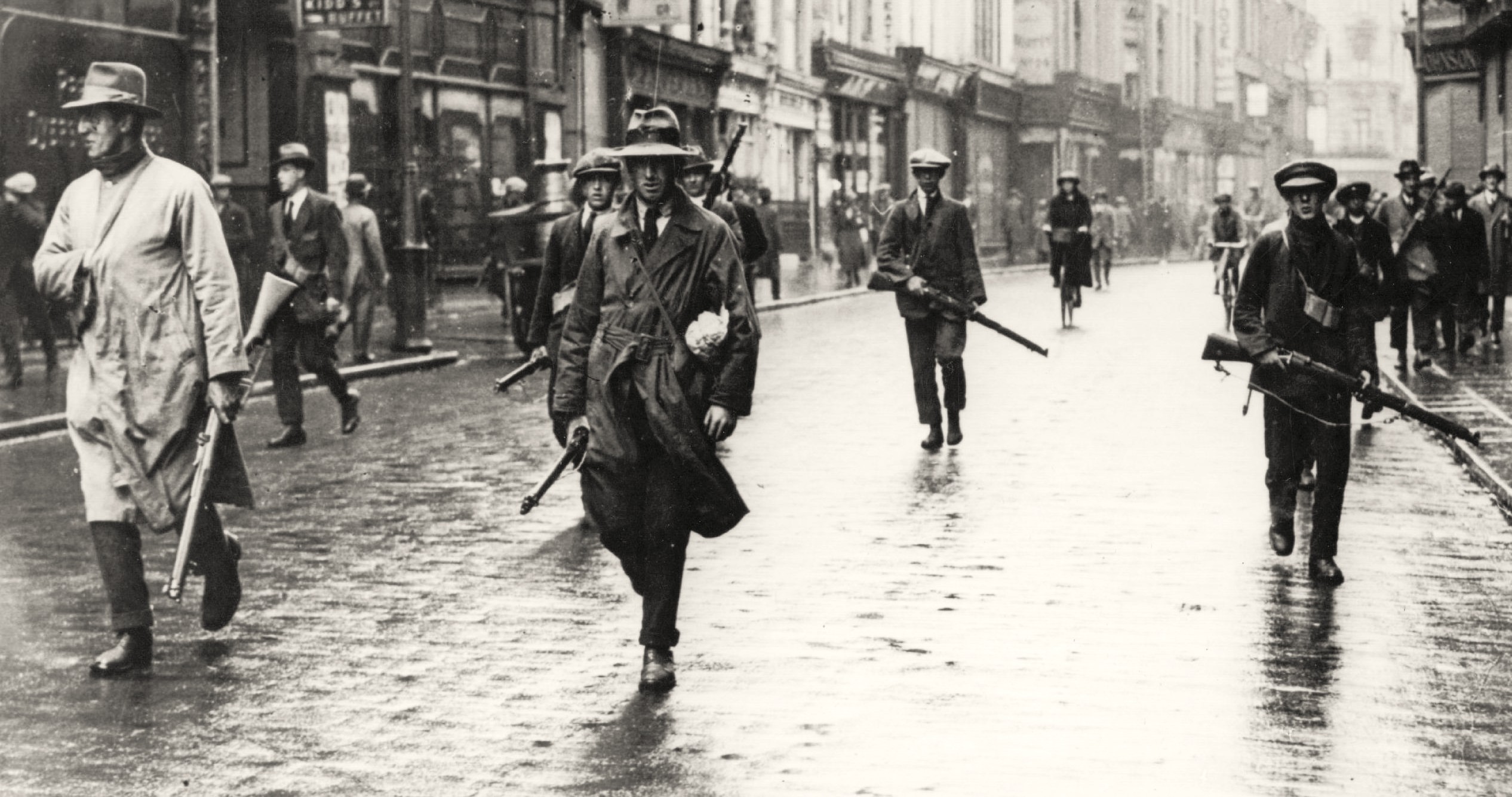
Ralph Fox visits Dublin on the verge of Civil War and compares the look and mood of the city to just-visited Moscow in this wonderful vignette of a moment from Ireland’s Revolution.
‘Dublin and Moscow: An Impression’ by Ralph M. Fox from Truth (Duluth). Vol. 6 No. 38. September 22, 1922.
Last autumn I was in Moscow and now l am in Dublin. Both have the indefinable but easily felt atmosphere of revolutionary cities and as I walk through Dublin, points of contrasts and comparison leap unbidden to the eye.
There is always a corner in the journalist’s heart for the revolutionary city, in spite of Its many drawbacks; it has colour and interest, it is warm and human and perhaps this is why we can always find journalists who are tender towards it.
In Moscow, posters and papers are pasted everywhere, the walls are turned into picture galleries and public libraries. The art of propaganda is likewise practised in Dublin if not quite on the same lines. Appeals and counter appeals abound though the pictorial side is not so prominent Separatists, Republicans, Free-Staters, “loyal” and “disloyal” sections of the I.R.A. all shout at one, their urgent and clamorous calls from boardings and walls of public buildings. And nobody seems to know exactly who is ruling now.
The shadow of military dictatorship is looming over Dublin. The “Freeman’s Journal” has had its machinery smashed up by armed men who take full and official responsibility for the action. The paper is making a great fight. The day after the smash-up they issued a single leaflet like a handbill in which they jeered at those who were “sledging their way to freedom.” The “Sledgers” is the nick-name which they have given to those who smashed the machinery. The second day, another single leaflet, slightly larger, came out and since then, the “Freeman” has chortled over its enemies, because it has actually produced seven foolscap pages of typewritten matter daily. Of course there are no advertisements and it does not look like a newspaper. These specimens are now fronting the world in a glass case outside the “Freeman’s” office in Westmoreland Pt., Dublin.
In countless ways the late military struggles have influenced the life and thought of Dublin. Militarism pervades the place. The town is like a powder magazine with bodies of men armed and drilled. On Sunday there was a review of the Dublin Brigade, organized by the rebels against the Free State. Appeals were made by the government to the men not to turn out, but about 2,500 did so. The Dublin Brigade in these crucial days seems to be playing much the same part as the Petrograd Garrison just prior to the break up of the Constituent Assembly.
I talked with a young man of the “Citizen Army”—a labour force— and I was surprised at his military turn of mind. His conversation bristled with muzzles of rifles and over all the conversation drifted the smoke of battle. He was only interested in the Red Army in Russia.
I suggested that the Russian educational experiments were useful. “It doesn’t matter about education,” he said, “I should like to go and study the Red Army organization in Russia.”
“In England,” he said, “the unemployed are no good. They don’t drill, they can’t even keep in step!”
His point of view was significant of the situation here. Everybody drills in Dublin. Civilian bands of young men may be seen on the march. Children in groups of twenty or so go through their exercises in the streets. They have company officers who line them and call upon them to “shun” or “stand easy” in the throaty military style. In London when the children play at soldiers they frankly burlesque the whole thing, but here they do it with an air of grave earnestness. Little toddlers (who can hardly walk) march solemnly in the rear trying to keep in step.
In Moscow I saw bands of soldiers marching out of the Kremlin gates. This had a picturesque effect. With their songs and accoutrements there was something reminiscent of the “Chocolate Soldier” musical comedy about them and even a kind of grandeur. But the impish militarism of the Dublin children is quite as impressive. Something has left a mark on the minds and souls of the people in this city.
Things seem to be drifting towards chaos. In place of a strong man it appears as if there were small men with large gestures and they are all adopting the Micawber-like policy of waiting for something to turn up.
Here in Bray, a small seaside town, there is lying against the Town Cross just by the I.R.A. barracks, a placard containing a revolutionary appeal against the Free State issued by the Army Council in Dublin.
There is an incongruity about it all, but it is a dangerous incongruity out of which something pretentious may come.
By R.M. FOX.
Truth emerged from the The Duluth Labor Leader, a weekly English language publication of the Scandinavian local of the Socialist Party in Duluth, Minnesota and began on May Day, 1917 as a Left Wing alternative to the Duluth Labor World. The paper was aligned to both the SP and the IWW leading to the paper being closed down in the first big anti-IWW raids in September, 1917. The paper was reborn as Truth, with the Duluth Scandinavian Socialists joining the Communist Labor Party of America in 1919. Shortly after the editor, Jack Carney, was arrested and convicted of espionage in 1920. Truth continued to publish with a new editor JO Bentall until 1923 as an unofficial paper of the CP.
PDF of full issue: https://www.mnhs.org/newspapers/lccn/sn89081142/1922-09-22/ed-1/seq-1
 Revolution's Newsstand