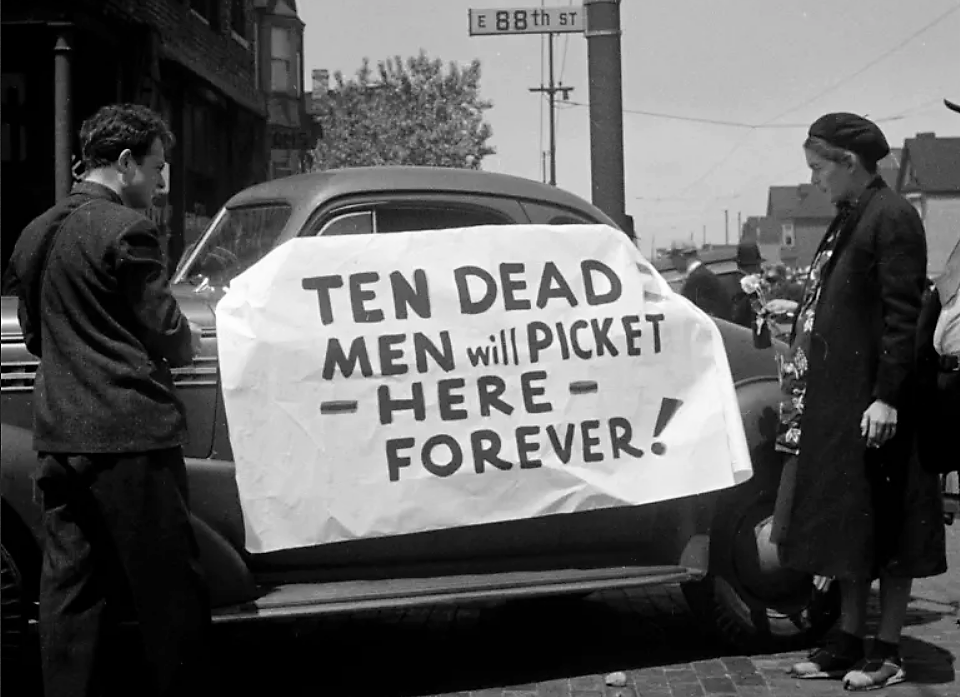
One of the worst acts of police violence against strikers during the 1930s was the Chicago cops’ massacre of unarmed strikers during the Steel Workers Organizing Committee drive at Little Steel on Memorial Day, 1937. Ten would die, over one hundred were wounded in the hail of bullets and billy clubs. Those who fell 85 years ago today were Hilding Anderson, 27, (USW Local 65); Alfred Causey, 43, (USW Local 1010); Leo Francisco, 17; Earl Handley, 37, (USW Local 1010); Otis Jones, 33, (USW Local 1033); Sam Popovich, 45, (USW Local 1010); Kenneth Reed, 23, (USW Local 1010); Joseph Rothmund, 48, (WPA); Anthony Tagliori, 26, (USW Local 1033); Lee Tisdale, 50 (USW Local 1011). George Robbins reports in the immediate aftermath of the event.
‘Chicago’s Memorial Day Massacre’ by George Robbins from New Masses. Vol. 23 No. 12 June 15, 1937.
Mayor Kelly’s cops killed seven Republic Steel strikers for attempting to assert their right of peaceful picketing.
”WE went out carrying two American flags and we came back with them, both wet with our own blood,” a picket of the South Chicago Women’s Steel Workers’ Auxiliary said.
A midsummer sun, hot and blistering, hung over Chicago on Memorial Day. People deserted their homes, crowded public parks and beaches, motored to the Indiana sand dunes. American flags decorated public buildings. Colorful processions of marchers goose-stepped along Michigan Boulevard. You felt the holiday spirit as you filed out of the narrow, crowded street-car on Avenue O in South Chicago, and strolled across the prairie-land to strike headquarters with workers in shirt sleeves and summer garments. Passing the dingy frame homes of steel workers, you noticed that the neighborhood was deserted and that families had already walked over to Sam’s place, formerly a dine-and-dance resort, now used as headquarters by the strikers of Republic Steel.
Thousands of men, women, and children were congregated at the south end of the dance resort, waiting for the speakers to ascend the improvised platform. Vendors were doing a good business in ice-cream bars and popsicles. A long line of strikers filed into Sam’s place, where members of the Women’s Steel Auxiliary had set up a food kitchen. A group of young strikers gathered under a tree and sang, “Solidarity forever-the union makes us strong!” Joe Weber, field representative of the Steel Workers’ Organizing Committee and chairman of the meeting, announced that the gathering had assembled to protest police interference with peaceful picketing at the Republic plant, six blocks away from strike headquarters. He reviewed the events that led up to the meeting.
More than 25,000 workers, native Americans, Negro and white, Slavs and Mexicans, had walked out on strike in the Chicago area on May 26 when Republic Steel, Youngstown Sheet & Tube, and Inland Steel refused to sign a collective-bargaining contract with the S.W.O.C. Several hundred scabs remained in the Republic plant, but the other two companies stopped almost all operations. Under a pre-strike agreement, a small number of men wearing special badges were permitted entrance into the two mills so as to keep Chicago supplied with gas. Violence at the Republic plant had flared up the first day of the walkout. Chicago police commanded by Captain James Mooney, had roughed up a mass picket line, arrested forty strikers, including John Riffe, field director of the S.W.O.C. Supervising Captain Prendergast had canceled all leaves for the day at twenty-three police stations. Police clubs had smashed a strikers’ sound truck.
A charge by Van A. Bittner, regional C.I.O. director, that Republic Steel had “enlisted the support of captains and other high officers of the Chicago police department,” and had violated the National Labor Relations Act, was met by Mayor Kelly’s statement that “there should be no interference with peaceful picketing.” The mayor had added that he believed that “every union right should be observed.” But several days later, more than one hundred cops again assaulted a mass picket line several blocks away from the steel mill, fired revolvers into the air, clubbed men and women marchers senseless, and arrested half a dozen strikers on charges of conspiracy to invade the plant.
The Chicago chapter of the National Lawyers’ Guild wired a sharp protest to President Roosevelt, charging the Chicago police with violence against the strikers, preventing peaceful picketing, and illegal and discriminatory arrests of strikers and sympathizers. The Chicago Tribune lauded the police for preserving “life and property, the business with which it is entrusted by the community.” The Tribune also assailed the C.I.O. contribution to the Democratic campaign fund last fall, and raged that John L. Lewis and his associates “have come to believe that, having paid their money, they need no longer respect the rights of anyone, whether employer, worker, bystander, or property owner.” Many state and local governments, the Tribune went on, have supported the labor policy of Washington, but “Chicagoans can take pride in the fact that in this jurisdiction the law is not for sale, the rights of citizens are safeguarded, and the police recognize that their primary duty is to preserve the peace.”
Swarthy Leo Krzycki, regional director of the S.W.O.C., stood before the microphone on the improvised platform at Sam’s place and said, “Violence against peaceful picketing must stop. Republic Steel must abide by the Wagner act. We don’t want fascism in America.”

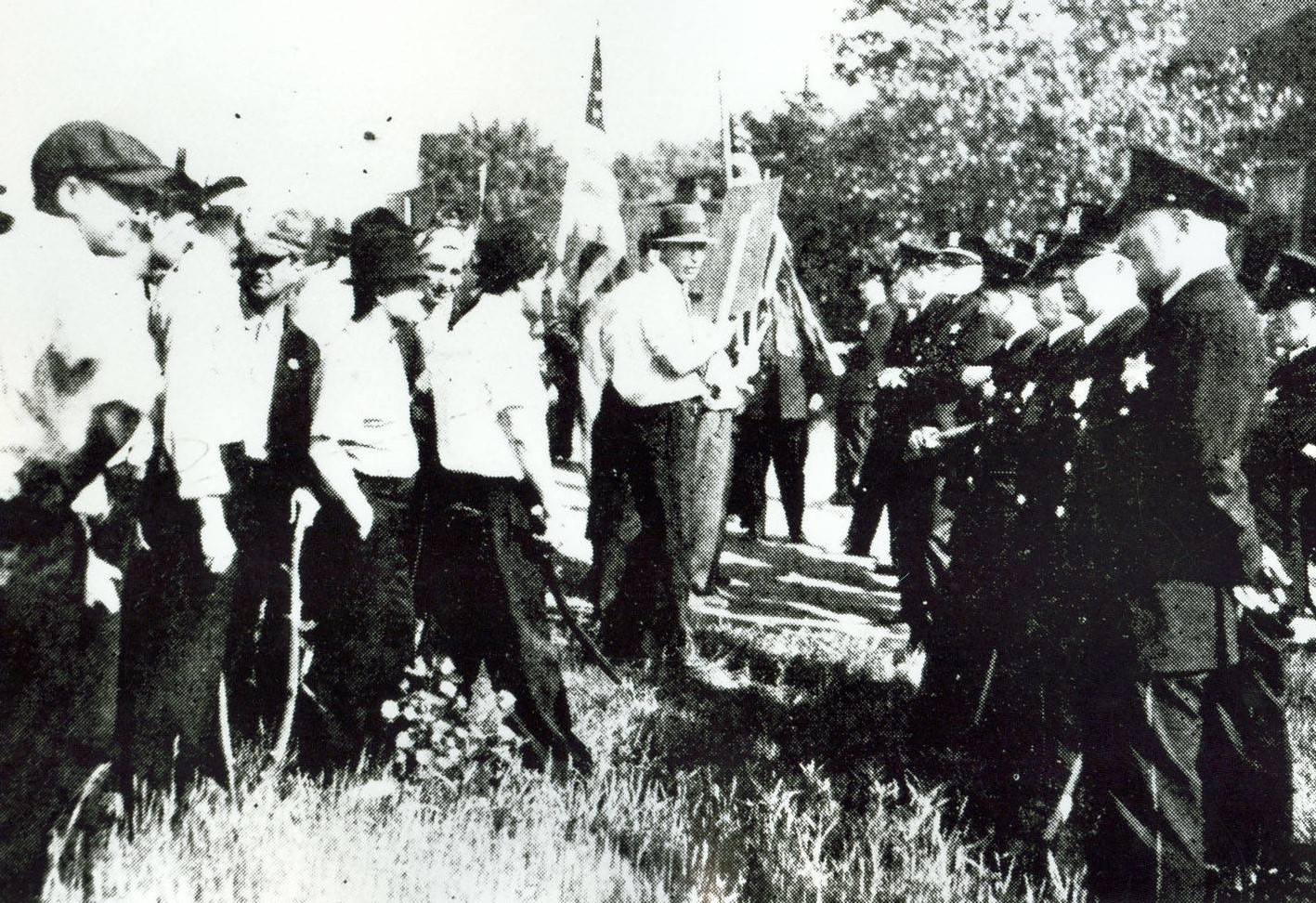
At the close of the meeting, men and women fell into a marching line on Green Bay Avenue. There was a good deal of laughter and camaraderie; several strikers joked with news photographers. Marchers held up a forest of placards: “Republic Steel shall sign a union contract,” “Win with the C.I.O.” Some of the women took their children on the line. At the head of the parade two young men carried huge American flags. Slowly, the parade moved up the road and turned sharply into the vast stretch of prairie facing the Republic steel plant, a bleak structure. Thin, pencil-line wisps of smoke oozed out of two stacks in the distance.
“They’re not making steel in there,” one striker said, pointing to the smoke-stacks; “they’re burning paper.”
DEEP into the prairie they marched. You could see the blue-coated policemen, five hundred of them, their badges glistening in the sun. When the marchers came within two blocks of the Republic gates, the police closed ranks, halted the picket line with menacing clubs. One cop whipped his revolver out, fingered it gingerly, and slid it back into its holster. Police captains and picket leaders exchanged words. A group of cops began to prod the strikers’ front line and, when the workers refused to move, the police billies began to swing relentlessly. “Hold your ranks,” strikers shouted to each other. “We’ve got the right to peaceful picketing.”
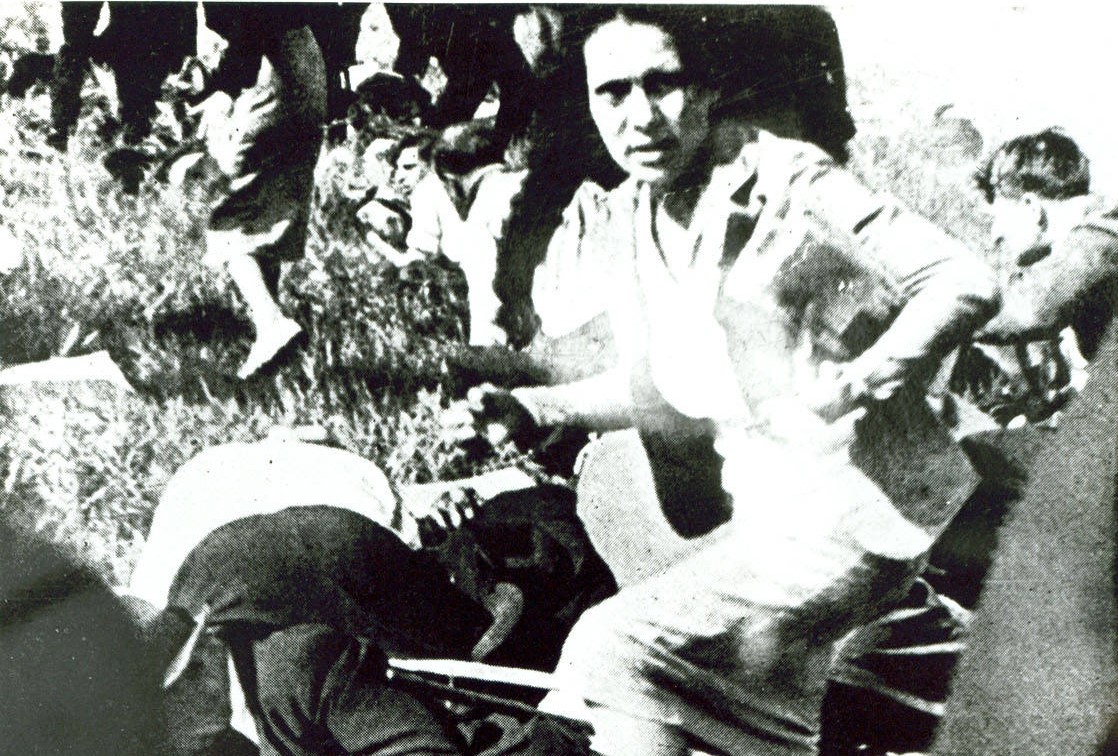
Tear-gas grenades sailed into the crowd, enveloping the strikers in a thick, yellowish-blue cloud. The marchers quickly retreated, coughing and sputtering, and scattered in all directions on the rough and swampy prairie-land. There was a crackle of pistol shots, followed by a rapid volley of gunfire. The bullets danced in the field like grasshoppers. A greyhaired woman retreating ahead of me stopped suddenly. Her legs buckled under her and I could see the blood gushing from a leg wound. “I’m shot! I’m shot!” she cried hysterically.
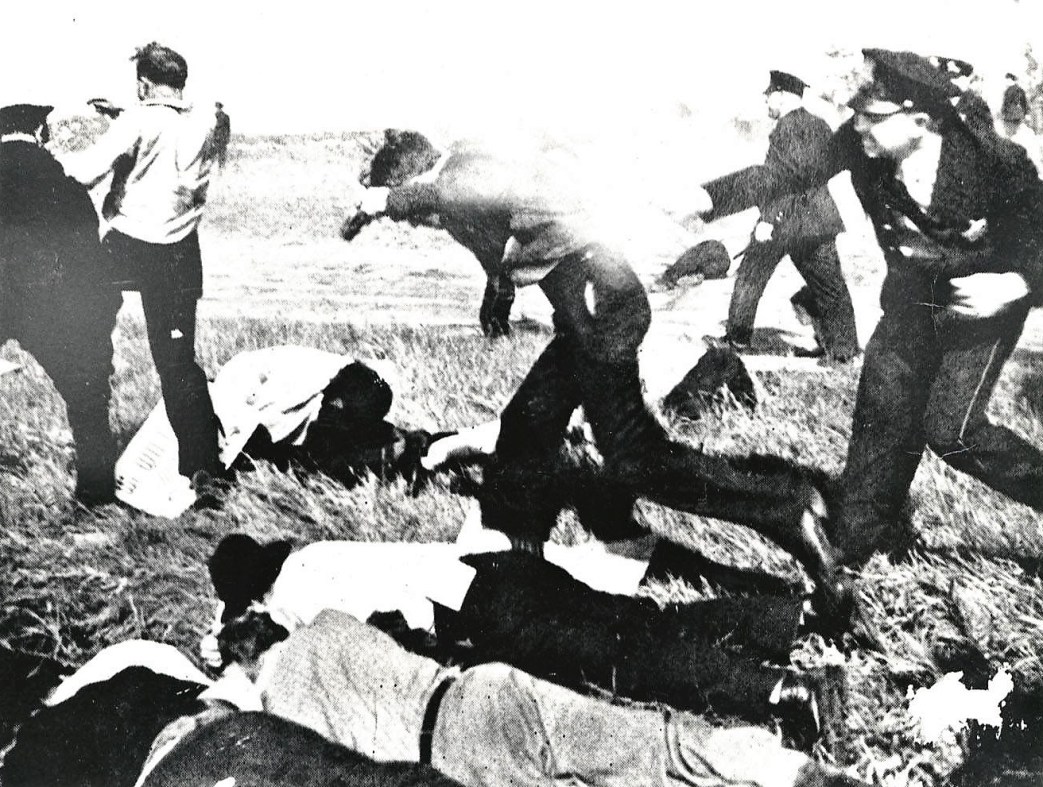
The field was strewn with dead and wounded. Police swept over the prairie, pummeling half-conscious men and women, hauling them into patrol wagons. Half a dozen private cars from strike headquarters, red cross signs on window shields, raced into the prairie to carry away the injured. Five hospitals in the South Chicago area were taxed beyond capacity. Dr. Nickamin, staff physician at the South Side Hospital, said; “The wounded looked as if they had come from a virtual massacre.” The most seriously wounded were taken by police to the Bridewell Hospital, attached to the criminal jail, at least thirty miles from the scene of the shooting. Two of the wounded pickets bled to death in the patrol wagon for lack of attention. Scores of the injured were treated in Sam’s place, converted into a hospital by the Women’s Auxiliary.
At a hearing conducted by the Citizens’ Emergency Committee on Industrial Relations, composed of university professors, social workers, ministers, and doctors, eye-witnesses to the massacre told of brutal treatment by the police. One man engaged in first-aid work drove to the prairie after the shooting had ended, but police, despite the lack of ambulance accommodations, refused to allow him to take wounded strikers to a hospital. Many of the injured who escaped the police shunned treatment at hospitals when they learned they would be placed under arrest. Reverend Fisk of the South Shore Community Church, an eye-witness to the shooting, told how police had held him incommunicado for nineteen hours after he was arrested near the plant.
“Policemen were shooting wildly,” declared the Reverend Fisk. “A fellow one hundred feet from the line of march was struck down by a bullet. I saw two policemen chase an unarmed worker who was fleeing and begging for mercy. He fell into a ditch and they clubbed him without mercy.” The Reverend Fisk had taken pictures of the scene, but the police confiscated his films.
One of the most vivid accounts of the shooting was given by a Republic striker, a World War veteran. “I was in the war and fought in France,” he said, “but I never heard so many bullets as those coppers fired. Women and children were screaming. They were like a herd of panic-stricken cattle. I fled until they got me. I saw a woman shot down and dragged away by a policeman. That’s what we got for trying to establish peaceful picketing, which was all we wanted to do.”
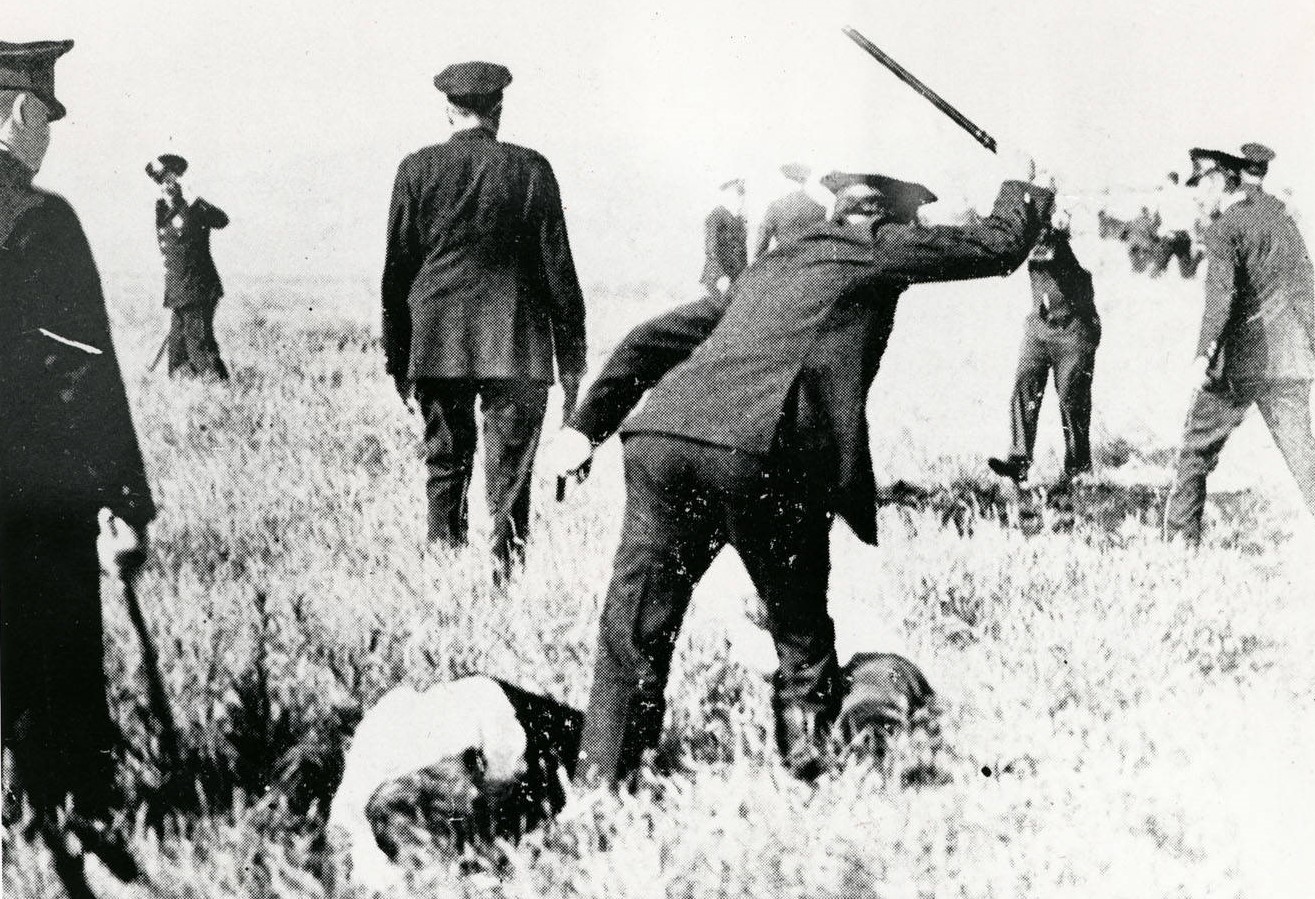
More than one hundred people were wounded in the massacre. Three strikers were killed on the spot, one was clubbed to death, three more succumbed to their wounds within the week. The seventy-five persons who were jailed were booked forty-eight hours later and charged with conspiracy to commit an illegal act, which carries a maximum sentence of five years and a $2000 fine.
Police officials and the Chicago Tribune were quick to place blame for the massacre on the C.I.O. leaders and the Communist Party. The speed with which the Cook County Communist Party issued a mimeographed leaflet condemning the shooting was cited by a police captain as evidence that “they knew in advance the workers were going to be led into attacking the police, and they encouraged the attack.” When it was discovered that one of the slain marchers, a cook in the pickets’ soup kitchen, was a Communist, the Tribune unearthed the “Red” scare.
Defending the murdered worker, the local Communist Party replied: “Comrade Rothmund was a useful worker, a member of the bakers’ union, a citizen of Chicago, and far more valuable than Colonel McCormick of the Chicago Tribune, or Tom Girdler, the parasite exploiter of steel workers and other tax dodgers who live off the sweat and blood of Chicago men, women, and children.”
In reply to Mayor Kelly, who stated from his summer home in Wisconsin that Chicago police have “the duty of protecting life and property,” and to the raving charges of the Tribune that the marchers, “lusting for blood,” and encouraged by the Communists, were prepared to seize the Republic mill, Van A. Bittner declared:
“The purpose of the Sunday parade was to peacefully demonstrate the strength of the strike, and persuade those inside to come out. The Republic Steel is using the Chicago police as a buffer between itself and the strikers. They know that if we have peaceful picketing the men will come out of the plant. This so-called ‘Red scare’ of the Republic Steel is nothing more than vicious propaganda. Tom Girdler, president of Republic Steel, and those who are supporting this company in the strike, last fall just as viciously heralded the propaganda throughout the nation that President Roosevelt was a Communist and that if he were reelected, there would be civil war in this country. The American people answered this challenge of Republic Steel by electing President Roosevelt by the largest majority any candidate has ever received, and the American people will answer this challenge of the Republic Steel in the same manner.”
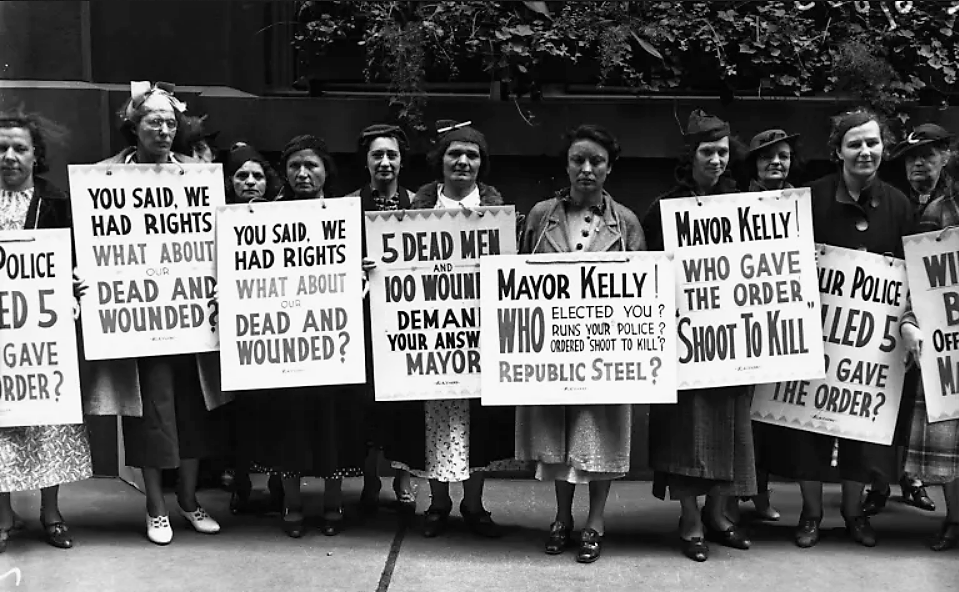
Not since the Haymarket affair has Chicago labor been so aroused. Wives of steel workers picket the city hall with placards: “Mayor Kelly- you have blood on your hands.” “Who gave the order shoot to kill?” Trade unions, professional groups, cultural and fraternal organizations have come to realize, after the Memorial Day massacre, that a semi-fascist regime rules Chicago today, and that only a 100-percent union town, now on the way, will throttle it.
The New Masses was the continuation of Workers Monthly which began publishing in 1924 as a merger of the ‘Liberator’, the Trade Union Educational League magazine ‘Labor Herald’, and Friends of Soviet Russia’s monthly ‘Soviet Russia Pictorial’ as an explicitly Communist Party publication, but drawing in a wide range of contributors and sympathizers. In 1927 Workers Monthly ceased and The New Masses began. A major left cultural magazine of the late 1920s and early 1940s, the early editors of The New Masses included Hugo Gellert, John F. Sloan, Max Eastman, Mike Gold, and Joseph Freeman. Writers included William Carlos Williams, Theodore Dreiser, John Dos Passos, Upton Sinclair, Richard Wright, Ralph Ellison, Dorothy Parker, Dorothy Day, John Breecher, Langston Hughes, Eugene O’Neill, Rex Stout and Ernest Hemingway. Artists included Hugo Gellert, Stuart Davis, Boardman Robinson, Wanda Gag, William Gropper and Otto Soglow. Over time, the New Masses became narrower politically and the articles more commentary than comment. However, particularly in it first years, New Masses was the epitome of the era’s finest revolutionary cultural and artistic traditions.
PDF of full issue: https://www.marxists.org/history/usa/pubs/new-masses/1937/v23n11-jun-08-1937-NM.pdf
 Revolution's Newsstand