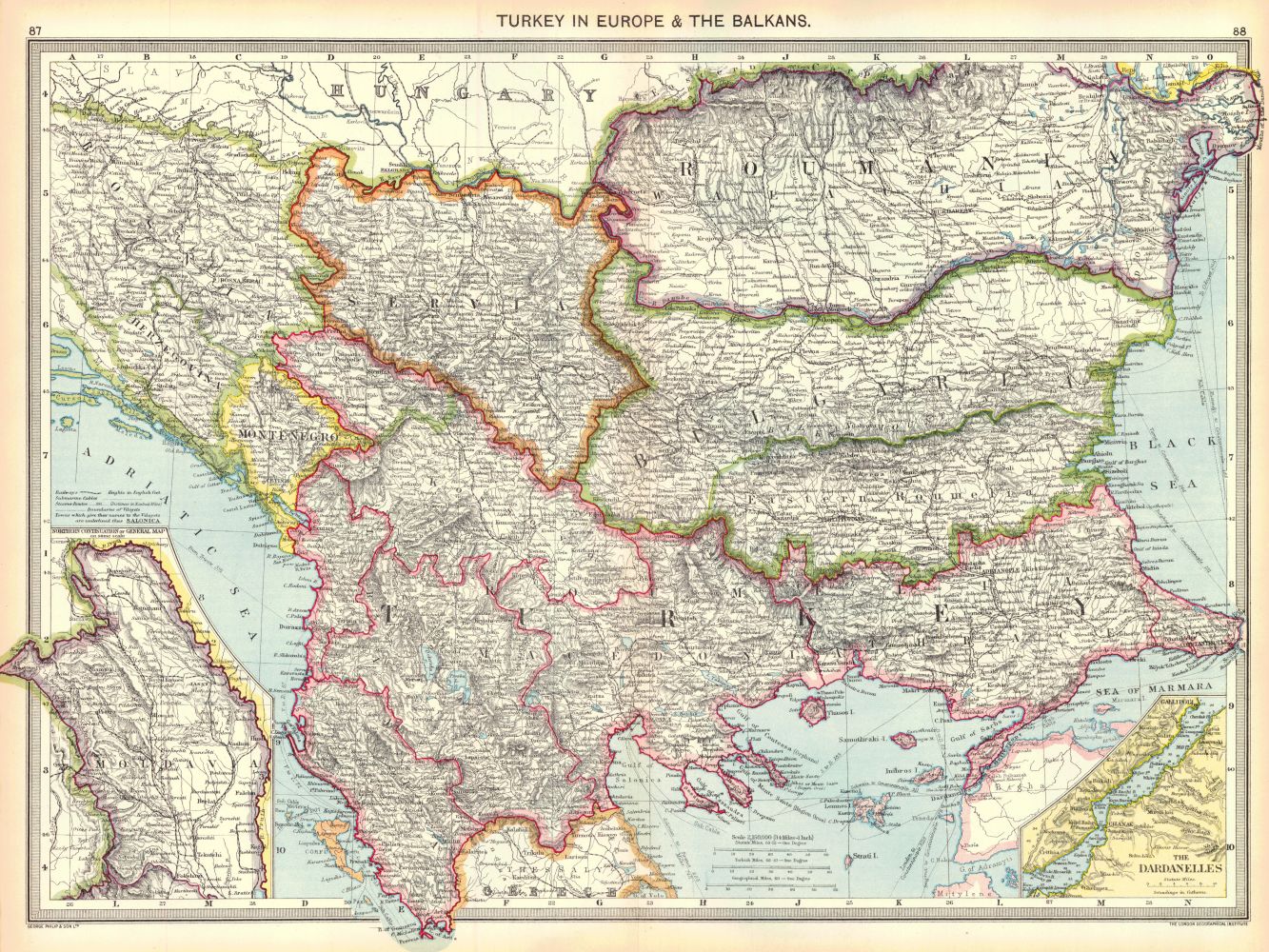
Dimitrov gets out a communication during the First Balkan War to members of the International on the war-time conditions of Bulgarian workers.
‘The Balkan War and the Bulgarian Labor Movement’ by Georgi Dimitrov from International Socialist Review. Vol. 13 No. 9. March, 1913.
First place among the items brought to the notice of the public by the new publication must be given to a letter with regard to present conditions in Bulgaria. One of the incidental results of war is the almost certain destruction of labor organizations in the countries involved. The trades unions of Bulgaria are nearly wiped out. To put them on their feet again is a work of international importance. In order to place the demands of the situation before the working-class of the world, Mr. Dimitroff, secretary of the Bulgarian central organization, has sent out the following letter:
“Owing to the strict censorship in this country, which affects even private correspondence, I regret very much that I am unable to present to my foreign comrades a clear picture of the situation here. I can not give all the facts necessary to this end. Nor can I inform them definitely of the probable consequences of the war so far as they will affect the fighting proletariat.
“On September 30th the order was given for the mobilization of all the armed forces throughout the land, and on October 18th military operations against the Turks were begun. All who had served in the army and had not on the issue of the order completed their 46th year were called to the colors. All recruits who would have been called up in 1913 were enlisted. Orders were given that those who were under obligation to serve in 1914 should be summoned before the attestation committee and attested for service. Macedonians living in Bulgaria were compelled to serve in the Macedonian Volunteer Corps. Only those who had not reached the age of 18 were free from compulsory military service. To the elder men fell the duty of guarding magazines, some being attached to the Red Cross contingents. Employes in the postal and telegraph services, likewise workers in the state-owned collieries and railways, were placed under military control so as to ensure the continuation of their work during the time of war.
“The effect on industry was immediate. Goods were turned out exclusively for the army. All tailors, shoemakers, carpenters, blacksmiths and factory employes were obliged to work for the Army Purveyors Commission with no pay except their keep.
“The workmen’s clubs and meeting rooms were turned into workshops for the military authorities or into magazines and hospitals.
“The entire country was placed under military law, and the strictest censorship of the press and correspondence was established. Public meetings were forbidden, and even private talks in public places were placed under the ban. And in order that the labor press might not be able to disturb the efforts of the bourgeois press to engineer an outburst of patriotism, the authorities suspended all working-class publications.
“Under such circumstances all activity of our organizations has been suspended. It has become impossible for them to do their work. Out of 10,000 Socialist trades union members only 500 at the most—not counting the railway, telegraph and post-office employes—remain at home. And these are either out of work or expect to become so at any moment.
“To the Bulgarian Trades Unions falls the task of providing for their members and, especially, of saving from misery the families of members who are on the field of battle. The desperate state of the workers and their families is indescribable. The cost of food is constantly rising and the cold weather of the winter season adds greatly to the suffering.
“From the following few details one will be able to picture the inhuman way in which the families of the workers, whose bread-winners pour out their blood upon the field of battle, are being plundered.
“A sack of grain which before the mobilization cost 25 francs now costs 40. In the same way all the necessaries of life, including coal, have risen in price. The Socialist representatives on the municipal boards have been successful in some cases in obtaining money relief for needy families. In Sofia 500,000 francs were voted; in Varna, 50,000, etc. But one can easily imagine that this assistance is not enough; to make matters worse, a good part of the money goes to persons not entitled to it.
“The trades unions are, therefore, compelled to support their own members and their families. Out of the 30,000 francs in the union treasury at the beginning of the war only a very small amount remains. Should the present state of affairs continue much longer the unions will not be able to do anything without help from comrades in other lands. The burden becomes constantly worse as those wounded on the battlefield are brought back to be cared for by their families and friends.
“Whatever may be the outcome of the war, one thing is certain; the labor movement of Bulgaria will experience a period of extraordinary difficulty. In these troublous times we have but one consolation and hope, and that is that we may reckon on the support of the international proletariat.
The International Socialist Review (ISR) was published monthly in Chicago from 1900 until 1918 by Charles H. Kerr and critically loyal to the Socialist Party of America. It is one of the essential publications in U.S. left history. During the editorship of A.M. Simons it was largely theoretical and moderate. In 1908, Charles H. Kerr took over as editor with strong influence from Mary E Marcy. The magazine became the foremost proponent of the SP’s left wing growing to tens of thousands of subscribers. It remained revolutionary in outlook and anti-militarist during World War One. It liberally used photographs and images, with news, theory, arts and organizing in its pages. It articles, reports and essays are an invaluable record of the U.S. class struggle and the development of Marxism in the decades before the Soviet experience. It was closed down in government repression in 1918.
PDF of full issue: https://www.marxists.org/history/usa/pubs/isr/v13n09-mar-1913-ISR-riaz-ocr.pdf
 Revolution's Newsstand