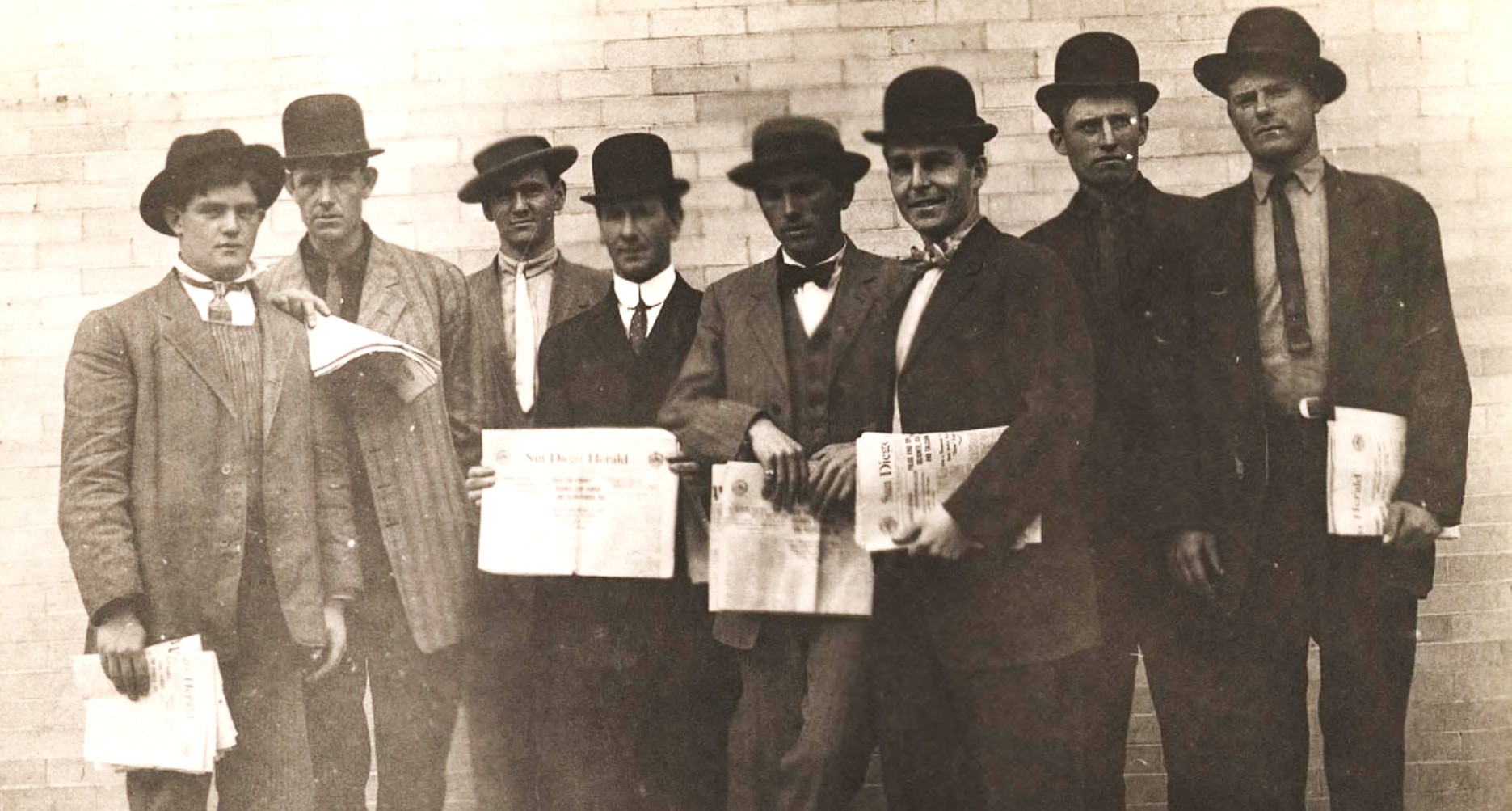
Heroic wobbly and Socialist free speech fighters return defiance as they are sentenced in San Diego for their roles in the long, brutal conflict which saw several deaths. Includes speeches from E.E. Kirk, Jack Whyte, Harry McKee, and Fred H. Moore.
‘Men Defy the Corrupt Court’ by Mortimer Downing from Industrial Worker. Vol. 4 No. 21. August 15, 1912.
What it costs to test the validity of the anti-free speech law in San Diego:
E.E. Kirk, Lawyer, Socialist, 6 months in jail, $300 fine.
Harry McKee, Lawyer, Socialist, 3 months in jail, $300 fine.
Jack Whyte, workingman, I.W.W., 6 months in jail.
Wood Hubbard and Robert Gosden, workingmen, I.W.W., sentences under advisement.
E.E. Kisor, workingman, I.W.W., one year’s probation–must report to the probation officer once a month.
San Diego, August 6. Proud and vital history in the class struggle was made when Judge Sloan sentenced the free speech fighters to imprisonment and fines because they had the audacity to attempt to make a legal test of the free speech ordinance in the capitalist courts. This was the first case, the feature trial, the legal measure of strength of the Free Speech and Anti-Free Speech forces. Class consciousness, solid, vigorous, defiant, placed the prisoners at the bar in triumphant attitude toward the court and the world and turned the magistrate on his bench into an apologist for the law.
Six months after a body of citizens attempted to test their supposed right to free speech, during which most of the defendants were in jail, these men received their penalties. The sentences came at the end of a two weeks’ trial for conspiracy to break the law.
When the prisoners were brought to the bar there was no cringing, no whimpering, no plea for mercy. E.E. Kirk, who with Fred H. Moore had conducted the defense, was the first of the accused men to make his statement to the court, when asked what he had to say why sentence should not be pronounced. During a vigorous protest against the whole course of the trial he stated to the court:

“Myself and these men before you had never the intention to violate the conspiracy law. I, acting individually and they, each for himself, on February 8 last, determined to test the reasonableness and the validity of the anti-free speech ordinance of this city passed January 8. I and they were willing to take the consequences of the act we committed, namely, breaking that ordinance for the purpose of bringing it before your honor, having a test of it here and perhaps appealing it to a higher court for proper adjudication. We deny and still deny the constitutionality of that ordinance. There was no conspiracy on our part.
“Your honor has learned and does know of a conspiracy, but it was the conspiracy of the police and John F. Sehon to make a simple misdemeanor or the breaking of a city ordinance the grave crime of defying a state law. Your honor should have judicial notice of that conspiracy. It is also within your knowledge that in connection with that police conspiracy police and vigilantes indulged and were indulged by the legal powers in a campaign of brutality which would have disgraced the darkest days of the Spanish Inquisition. I assert that your honor should have taken judicial notice of innocent blood and let the guilty go tree. For these reasons I make no appeal for mercy. I do not whimper, I will take what your honor will give of the penalties of the law for an act I did not commit, and I know these men with me are in the same mind.”
Jack Whyte put his protest on slightly different grounds. Replying to the court he said:
“I have no mercy to ask from the court. It has been put in evidence here that sometime I said, ‘To hell with the courts.’ If I did I have no apology. Why? Because the very Indictment upon which I am tried opens with a lie and repeats lies throughout its contents. This indictment opens in the name of ‘The people of the State of California.’ This would leave men to suppose that the people of California were behind this proposition. That is a lie. If the people were behind this prosecution they would also have been behind the vigilante outrages which your honor has made no attempt to punish as a judge or prevent as a man and a citizen.
“I have seen workingmen brought into your courts and railroaded to the penitentiary, have seen the rich go free. I am supposed to have a trial by a jury of my peers. Did I have it? You sir, know I did not. My jury began with a multi-millionaire and ran down to a few cockroaches. Are they my peers? Workingmen were kept off that jury. Your honor knows it. For that reason I ask no mercy. I am willing to take your sentence because I must, not because it was just. I have just ground to say, ‘To hell with your courts.’ I have better ground to express to you, sir, my unspeakable personal contempt.”
Harry McKee said:
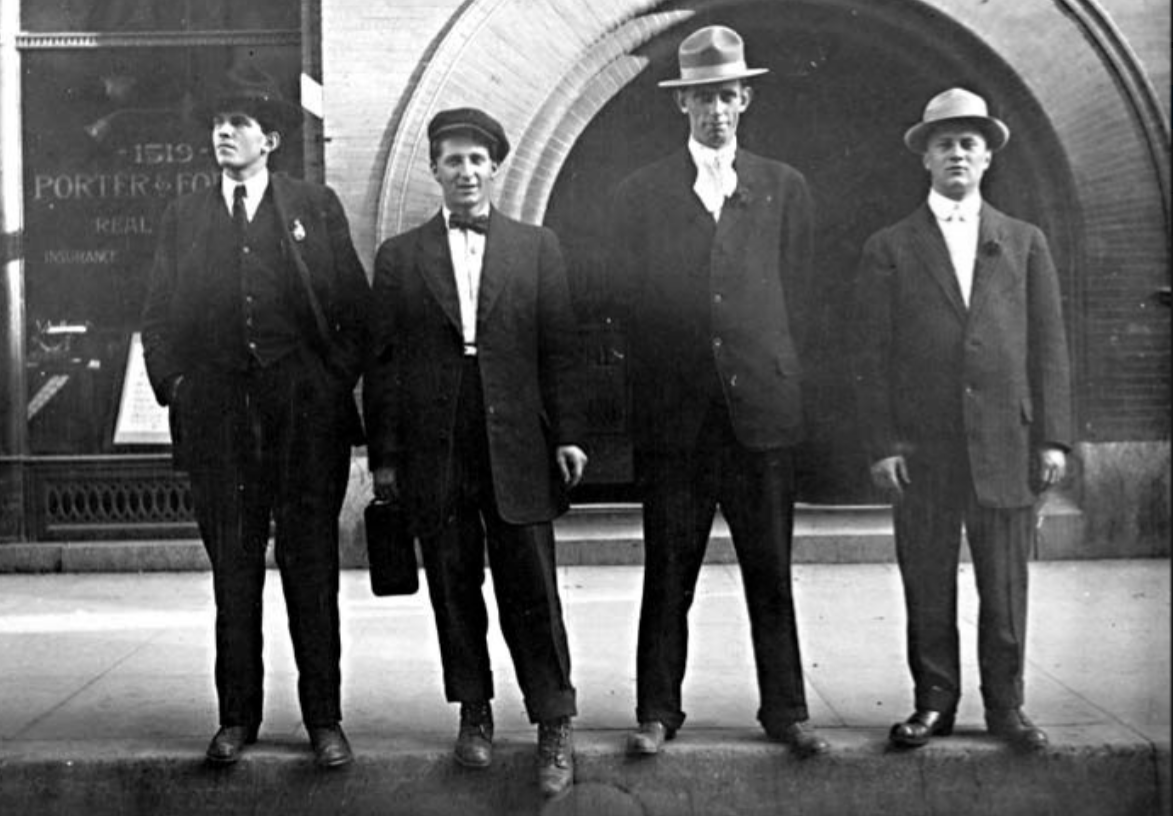
“I am here for sentence but I am guiltless of crime. Your honor knows that I am not a conspirator. You know that I have simply stood up for my rights and expressed my rightful indignation against the vigilante outrages. The district attorney chuckles and claims the verdict, but we who receive your sentence claim the victory. We are not defeated. The victory is with the people we have made our case before the world. We are triumphant no matter what sentence your honor may inflict.”
Proving that these men lost nothing by asserting their manhood is the fact that Judge Sloan in imposing sentence read from a writ ten paper prepared before he came into court. Had they sought mercy according to the recommendation of the jury in the case their sentences would have been the same, because as the court explained anything less than the full penalty would be mercy in these cases.
Fred H. Moore, principal attorney for the defendants in his final address to the court said:
“Your honor has heard what these defendants have to say why sentence should not be pronounced upon them. I have no apology to make for them. I have no apology to make for Jack Whyte. Your honor must know that Jack Whyte merely voices the belief of thousands of men and women throughout this country. There are more Jack Whytes in San Diego. There are more of him in San Francisco, New York, Chicago, St. Louis, Chicago, everywhere throughout this nation. They exist because of a condition in social life which is nowhere better illustrated than in the political party to which your honor belongs. Your honor knows that the reason why the progressive republicans have come into existence is because a former president of the United States accuses the incumbent president of grave injustices and that his opponent retorts with equally grave accusations against him. Your honor knows that there is a condition of public unrest which calls for immediate remedy. These conditions will not be cured by sentencing the defendants to imprisonment or fines. The crime of which these men are accused are purely psychological. It is a result of social conditions. Your honor should have taken judicial notice of this fact during the trial. Your honor in imposing sentences on these men should now take judicial notice of the conditions and the fact that a series of unparalleled outrages have been allowed to go unpunished in this community while these men for merely attempting to test a police regulation are brought before you on the grave charge of conspiracy and the petty misdemeanor which is the base of this trial has been exalted into an offense against the state laws.
“Your honor in imposing sentence should also take notice of the fact that behind these men are three of the great factors in shaping the destiny of the nation, the American Federation of Labor with 2,500,000 members, the Socialist party with 650,000 recorded votes at the last election and the Industrial Workers of the World. Your honor, if just, must consider that these men represent a class too numerous to be neglected and too powerful to be ignored. In attempting to test the anti-free speech ordinance of this city the defendants merely voiced the will and desire of these three great organizations and in the case before the court had no other purpose than to test thoroughly the validity of a law that invaded a sacred and constitutional right of each and every one of the people of the United States.”
Judge Sloan in imposing sentence stated that he was not responsible for social conditions and had only to execute the laws as they appeared on the statute books. He went on to state that he was ready at any time to try any of the so-called vigilante cases and to give any proven offenders the limit of the law. He then asserted that the defense had never sought any process before him either as magistrate or a judge against the vigilantes.
Judge Sloan was here interrupted by Attorney Kirk with a recital of numerous instances in which process was sought against the vigilantes in the superior courts of San Diego and were all denied. Attorney Moore also called attention to applications made directly to Judge Sloan in which the latter had stated as a reason for refusing relief that illegal conditions had been met by other lawlessness.
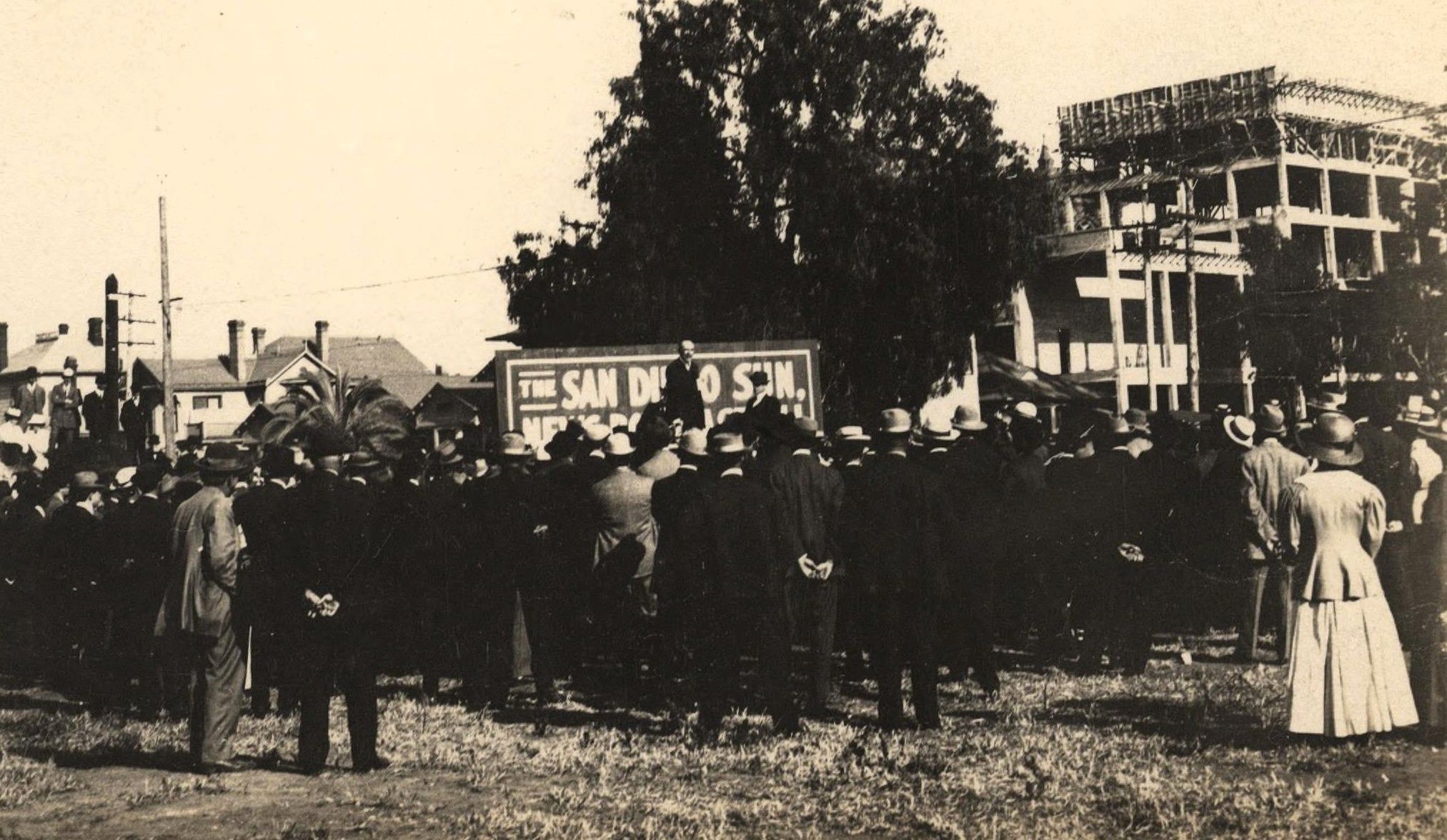
Judge Sloan expressed his great pain because he was called upon to inflict a sentence upon some of the defendants because he had known them for years and had learned to respect them as men and citizens. In the case of Harry McKee, especially, he said he felt sorrow, because he knew McKee as a friend and knew him to be sincere and a good citizen, but that he was compelled to do his duty as he saw it and therefore the sentence must be passed.
After the trial was closed, Fred H. Moore stated in an interview:
“This is the first time in my bar experience that I have known defendants to stand up before the court and triumphantly reassert the causes for which they were to suffer. I believe the incident of these defendants reasserting their rights before the sentencing judge is without parallel in the history of the San Diego bar. It marks a new era in the struggle to better social conditions and the actions and attitude of these men will have a wider influence upon public affairs than any other one feature of the fight for free speech which has been waged in San Diego.”
E.E. Kirk and Harry McKee took appeals to the higher courts and were held on $1,00 bail each.
MORTIMER DOWNING.
The Industrial Union Bulletin, and the Industrial Worker were newspapers published by the Industrial Workers of the World (IWW) from 1907 until 1913. First printed in Joliet, Illinois, IUB incorporated The Voice of Labor, the newspaper of the American Labor Union which had joined the IWW, and another IWW affiliate, International Metal Worker.The Trautmann-DeLeon faction issued its weekly from March 1907. Soon after, De Leon would be expelled and Trautmann would continue IUB until March 1909. It was edited by A. S. Edwards. 1909, production moved to Spokane, Washington and became The Industrial Worker, “the voice of revolutionary industrial unionism.”
PDF of full issue: https://www.marxists.org/history/usa/pubs/industrialworker/iw/v4n21-w177-aug-15-1912-IW.pdf
 Revolution's Newsstand