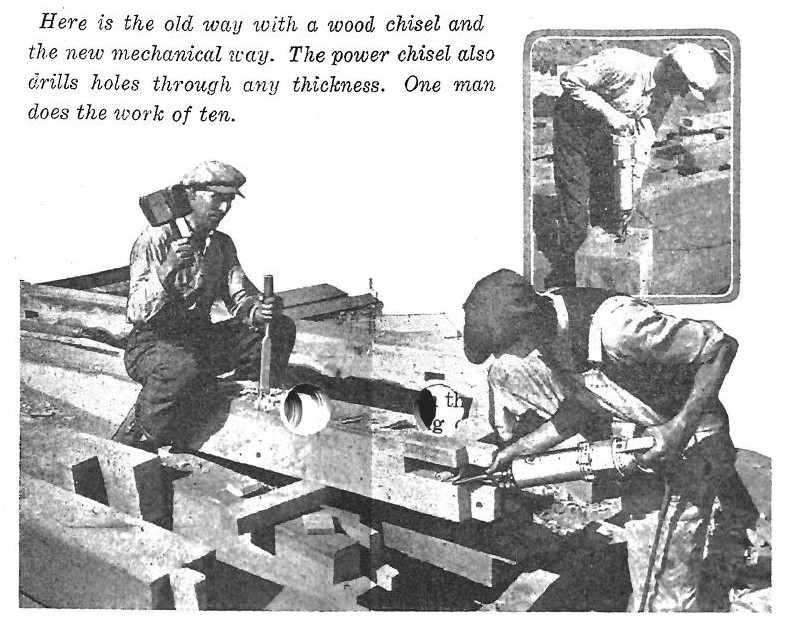
Many of the same issues face construction workers today. Veteran labor activist Jack Johnstone, T.U.E.L.’s National Organizer, on the transformation wrought by technological changes on building workers and their unions; the role of the leadership of those unions in conspiring with the bosses to become an employers’ hiring hall, organizing the workforce for them; and the need for amalgamation of all the trade’s unions into a industrial unions.
‘Organization and New Technique in the Build Trades’ by Jack Johnstone from Labor Unity. Vol. 2 No. 4. May, 1928.
WHILE the building industry has been revolutionizing for the past 40 years, it is only since the end of the world war that rapid strides in that direction have been made. This important development has been almost completely overlooked by the building trade unions, but is being taken full advantage of by the employers.
Today the building trade workers are mere cogs in an industrial wheel. The craftsman of 30 years ago has disappeared and in his place has come a host of specialized semi-skilled and unskilled workers, who produce huge skyscrapers the main parts of which have been built in a factory, numbered, brought to the building site and assembled. Of course it would be wrong to say that skill has been eliminated. What has happened is that skill has been diluted and the number of skilled men, especially the building pioneers (carpenters, masons and bricklayers), needed on a building has been reduced and their relationship to the building so changed that they are no longer the dominant factor that they were 25 or 30 years ago, and common labor plays an ever more important part.
Age of Steel Begins
The erection of the Waldorf Astoria Hotel in New York in 1897 marked a definite change in building construction. While steel had been used before, (the Tower Building, New York, 1889; the Masonic Temple, Chicago, 1890, etc.) the building of this first sky scraper in the world with steel frame and elevator marked a new epoch in building. The introduction of the steel skeleton as the sole support for a building, replacing masonry, lumber and brick as the basic material, had a far-reaching effect, not only in building construction but upon the workers in the industry. In building construction it meant the elimination of the heavy wall base, the elimination of supporting walls, a reduction in building costs, the raising of the sky line to a limit which has not yet been reached. In other words, the introduction of steel as a basic material in building construction was the foundation upon which has been built in a very few years the highly centralized mechanized industry. Without the steel skeleton, and later reinforced concrete, without the pneumatic caisson process for the sinking of piers to great depths, the modern skyscrapers would be impossible.
Building by Machinery
With the establishment of the steel building frame began a rapid development of machine power, the introduction of new materials and substitute materials, causing specialization not only of workers but also of building employers, creating a host of contractors and sub-contractors, until building construction seemed to be hopelessly decentralized. However, this was just the first phase of the revolution that was taking place as machine power increased, and the mechanized process in building operations developed. The building industry developed rapidly from a localized character into an immense national industry that created huge companies requiring the investment of large capital, dominating local builder gave way to national trade contractors, national general contractors, forcing eventually, in 1922, the amalgamation of these national employers’ associations into one national industrial employers’ organization, the American Construction Council.

With this process completed, the stabilization of building construction became assured. Since 1922 rapid progress has been made in this direction. Far and large, the building industry today is controlled by finance and industrial capital with the bankers playing an important, and in times of labor troubles, a dominant role.
The introduction of new basic materials and the development of further substitutes for wood, brick and stone, coupled with the rapid introduction of power machinery, changed, multiplied and mechanized building operations, obscured heretofore rigid craft boundary lines causing struggles against the introduction of machinery, and created new organizations of workers, throwing all of the building trades unions into ruinous jurisdictional wars. The basic causes of these wars are neither discussed in, nor understood by the unions. If they were, jurisdictional disputes would not occur and a process of amalgamating the workers’ forces to conform to the new industrialization in building construction would have followed.
United Bosses, Divide Workers
Here are just a few of the new and substitute materials that have made the skyscraper possible, the introduction of which have caused devastating jurisdictional war steel and reinforced concrete replacing wood and masonry as basic materials, concrete and cork floor in place of wood, artificial stone in place of dressed stone, granolithic stone and steel stair cases instead of wood, plaster board and metal ceilings in place of lath and plaster, metal window frames, doors, casings, base, shelvings, medicine cabinets, etc., in place of wood, metal concrete forms instead of wood, enamel and patented preparations instead of paint, etc.
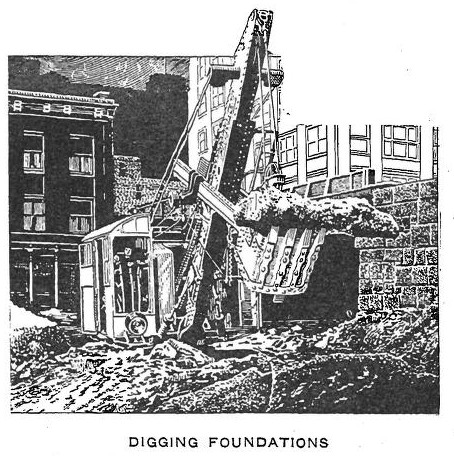
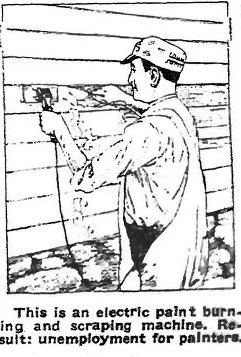
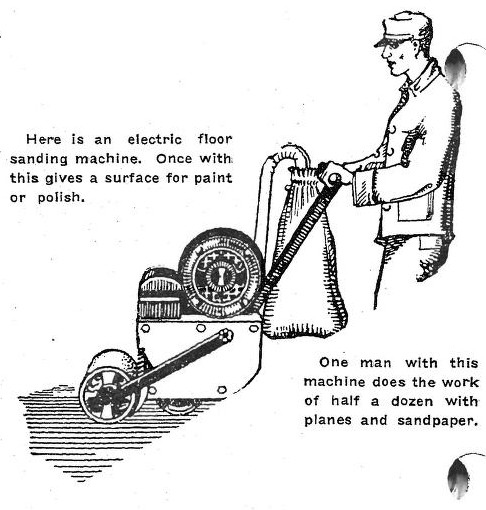
Equally important in the development of modern building construction is the introduction of new machinery and the development of power operations, among which are : the pneumatic rivetter which does the work formerly done by eight men and now a new process of electric welded joints, being developed to take the place of the rivet; other pneumatic tools, such as for chipping stone, etc.; steam, electric and gasoline shovels, hydraulic and elevator dredges, the perfected hoisting engine with its increased power, improved brake and mechanical control, etc.; the power-driven pick, grab-lines and other excavating machinery, the portable belt conveyor, the power concrete mixer, the gravity distributing concrete tower, the stone and granite cutting machine, the cement gun, the paint spray, the joiner, the floor scrapper, the nailing machine. These few examples show to what extent the building industry has been mechanized. Scores of building operations are performed by power machines, most of which have been developed within the past 15 years. In the process of mechanization of building operations, skill has given way to speed and so-called efficiency. Today it is quantity they want, with quality becoming the product of factory-made material, or regulated by the machine process rather than by the mechanic. The building must move upwards so many more floors a week or a month. So many bricks must be laid per day, so many doors are hung, so many feet of floor are laid, so many bathrooms etc. are enameled, so many yards of plaster. Up-to-date machinery has taken the place of good mechanics and good laborers. The carpenter, hod-carrier and building laborer of 25 years ago is not the carpenter, hod-carrier and building laborer of today. Here is a new industry, and a new type of worker, with new problems, that require new methods.

Intelligent workers no longer fight against the introduction of machinery unless it is of the character of the paint spraying machine, which is injurious to health. The struggle of the workers must be to control the new machinery, so that it will serve and not enslave them.
The only response that the trade unions have made to the great change in building construction has been: (1) To increase the number of unions. (2) Ruinous jurisdictional quarrels. (3) Federation of craft unions. (4) To help form a national employers’ industrial organization. (5) To fight the left wing, which advocates amalgamation and a progressive program for the trade unions.
The formation of local building trade Councils and the Building Trades Department of the American Federation of Labor indicated a single craft union could no longer cope with the situation and fight the employers successfully alone. However, with this craft union change, trade union development stopped. The weakness of the craft form of organization was recognized as early as 1913 when a resolution was adopted by the Seattle convention of the Building Trades Department held that year, endorsing the amalgamation of the building trade unions into five departments, viz: Mason Group, Iron Group, Pipefitting and Power Group, Building Finishing Group and Wood Working Group.
This proposition, however, was allowed to die with the adjournment of the convention. To emphasize the weakness of the craft unions, it might be well to devote a little space to what has taken place among the employers.
Period of Confusion
To some extent, the revolution in building construction prior to the world war had the same effects upon the employers as it did upon the workers. As the change in building construction was being made, it first created confusion, new interests came into the field, old firms with old methods had either to change their ways or make way for the new firms with the new methods. This was not accomplished very easily or peacefully. However, employers have a class virtue that has been lacking among the workers. Generally, no matter how bitterly they may quarrel among themselves, their forces can be quickly knitted together in a common struggle against the workers. This was seen in the struggles of 1900 when the Chicago employers, organized into the “Contractors Council” locked out and completely defeated the Chicago building trades workers. This was followed by similar action of newly organized “Building Trades Employers Association” of New York City in 1903, when the building trades workers were defeated after a five months bitter strike. These successes served as an incentive to employers in other cities and similar local organizations were formed.
Employers Organize
Some early attempts were made to organize the employers upon a national and industrial scale, such as the formation in 1887 of the “National Association of Builders” and later in 1912 the “National Association of Builder’s Exchanges”, but it was not until 1917-18 that the movement took root. The National Association of Builders Exchanges played a powerful pioneer part in the work of organizing the employers industrially. However, it had all the weakness of a loose federation, the boundary lines of its members were vague, its jurisdictional quarrels were as bitter as the jurisdictional quarrels in the unions. It sponsored the formation of the “National Board of Jurisdictional Awards” to settle disputes with the unions, and set up a Commercial Arbitration Court to settle similar disputes within its own ranks, the latter achieving as little success as the former.
In 1918 the American Institute of Architects issued a call for a convention of employers’ organizations for the purpose of forming a national industrial employers’ union. While nothing of a lasting nature came of this meeting, the machinery had been set in motion. The employers were flooded with campaign literature. The trade union officials headed by Donlin, President of the Building Trades Department of the A.F. of L., became boosters, if not actually organizers, for the formation of an employers’ industrial union. So anxious was Donlin that the employers should have a real fighting organization, that he gave out the following gem in 1920:
“The trouble with the construction industry is that we are not organized. We are suffering from too many things which a strong organization could remedy…If labor should then be held responsible for stopping production, the unions could then be called in by the Congress (controlled by the employers!) to explain…What we need is a Congress with teeth in it.”
General R.C. Marshall, who was also interested in seeing that his co-employers formed the proper kind of organization in reply to Brother Donlin said:
“Unless organized labor will maintain a reasonable attitude toward the other elements of construction which have a common interest with it, these other elements will go to the other extreme. Insistence upon a labor monopoly or upon an employer monopoly of the conditions of labor under the non-union shop. The closed shop, or any other plan is bound to bring reaction after reaction according as circumstances give power to one of the other. In the Building trades, labor is largely organized and should be willing to deal with employers. By many it is considered that their right to do so is fundamental. Also, the right of the employer to contract with whom he pleases is equally fundamental. It is necessary that these forces work together for the good of the industry. If the trade unions in the building industry perform the services for their members and the corresponding trades which they are in a position to perform, I believe that they need not fear to recognize the right of freedom of contract for the individual, and if they will recognize that right of the construction employers of the country will, I believe, not only recognize that right but come to adopt collective bargaining through the unions as a more satisfactory means of handling labor questions because of the very nature of the industry and because the unions are organized.”
General Marshall was one of the organizers of the “Associated General Contractors” which was formed during this general campaign in Chicago in 1918. This association went on record for the open shop in 1920, and supported by the so-called Citizens Committee and the banking interests, led the struggle against the Chicago building trade workers in 1920-22.
During 1921-22 a number of national employers’ conferences were held, culminating in the organizing of the American Construction Council in Cleveland, June, 1922. This organization is an amalgamation of the various national employers’ trade associations into a departmentalized employers’ national industrial organization, each department with equal voting power, and its decisions are final. It is sponsored and fully supported by the financial interests, and peculiar as it may seem, by the upper strata of Labor’s officialdom. In 1923 it appropriated $25,000 for organizing work, for the building of powerful local builders’ congresses. Since its formation it has made rapid progress. It is a mighty organization and is ready to whip any wavering contractor into line with its program, by the use of the financial and industrial boycott. This is the organized force that the building trade unions will have to deal with in future struggles; it is a vastly more centralized and powerful organization than anything organized labor has achieved in this industry. Brother Donlin has had his wish fulfilled. The American Construction Council has teeth in it.
The building trade workers are the next target for a general attack. This is obvious. With the valuable assistance of the building boom they were able to stop the open shop drive of 1920-22, and since that time increase the numerical strength of the unions and while the working conditions are bad and the speed-up system allowed to develop unchallenged, the unions were able to retain their standard of living by increasing hourly wages to meet the rising living costs.
On the other hand, the rest of the labor movement has been on the retreat. Proof of this is abundant. The majority of basic industries are working open shop. The powerful Railroad Shopmen’s Federation has been demolished. The once powerful United Mine Workers of America is fighting a lockout and has been hacked to pieces, by the coal operators and by John L. Lewis, its international president, until today 70% of the bituminous coal is being mined in non-union territory. So serious is the situation generally that President Green, of the A.F. of L. has to admit publicly that the very life of the labor movement is in danger.
The whole base of the labor movement has been narrowed down to a point which endangers its very existence. The cause of this is the corruption of the ideology of the movement by so-called leaders. The very vitals of the movement are being eaten away by the anti-working class policies of the Greens, Wolls, Hutchesons, Donlins, et al. Green says that the life of the labor movement is in danger. Yes, it is, but it has been brought to that pass by such schemes as the B.&O. plan, the Landis Award, “Worker-Employer Co-Operation,” “Labor Life Insurance,” and other pet schemes of class collaboration which Matthew Woll and others parade under the high sounding title: “Higher Strategy of Labor.” A little more of this higher strategy of labor and the labor movement won’t be worth a damn.
It is not a mere idle thought to say that upon the shoulders of the building trade workers rest the task of stopping the retreat of the workers. With the building boom at an end, unemployment on the increase, with an industry that has been flooded with new workers during the boom and the speed-up in full swing, a well-organized employer class is only waiting until conditions ripen in order to launch an attack. On the other hand, there are nearly a million organized workers who have been fairly steadily earning wages for the past five years, a good morale, a rank and file that is willing to put up a militant struggle, not merely a defensive one against wage cut, but offensively for the 5 day, 40 hour week, for better working conditions, against the speed-up and for real union job control. The organized building trades workers at this moment are in a most favorable position for a struggle that will not only advance their interest but advance the interests of the entire labor movement.
The obstacles that stand in the way are the leaders, because they refuse to lead. The fact is, they are incapable of leading. With five years of favorable conditions, the shorter work week is not even a general talking point, the speed up system was allowed to develop without challenge, and working conditions were allowed to go to the dogs. Even in wage increases the rank and file had sometimes to step over the heads of their leaders. The rank and file must take a further hand in the game.
It can be safely said that craft ideology and the craft form of organization can no longer advance the interest of the building trades workers. To follow this old method of struggle in the present stage of development means defeat. Amalgamation is the next step that must be taken by the building trade unions. Away with the so-called higher strategy of labor! Just plain ordinary united struggle against a common enemy–the employers. What is needed is a UNION with teeth in it, fighting against wage cuts, for the 40 hour week, against speed-up, for job control and a uniform agreement for all trades to expire at the same time.
In 1924 Labor Herald was folded into Workers Monthly, an explicitly Party organ and in 1927 ‘Labor Unity’ became the organ of a now CP dominated TUEL. In 1929 and the turn towards Red Unions in the Third Period, TUEL was wound up and replaced by the Trade Union Unity League, a section of the Red International of Labor Unions (Profitern) and continued to publish Labor Unity until 1935. Labor Herald remains an important labor-orientated journal by revolutionaries in US left history and would be referenced by activists, along with TUEL, along after its heyday.
Link to a PDF: https://www.marxists.org/history/usa/pubs/labor-unity/v2n04-w23-may-1928-TUUL-labor-unity.pdf
 Revolution's Newsstand