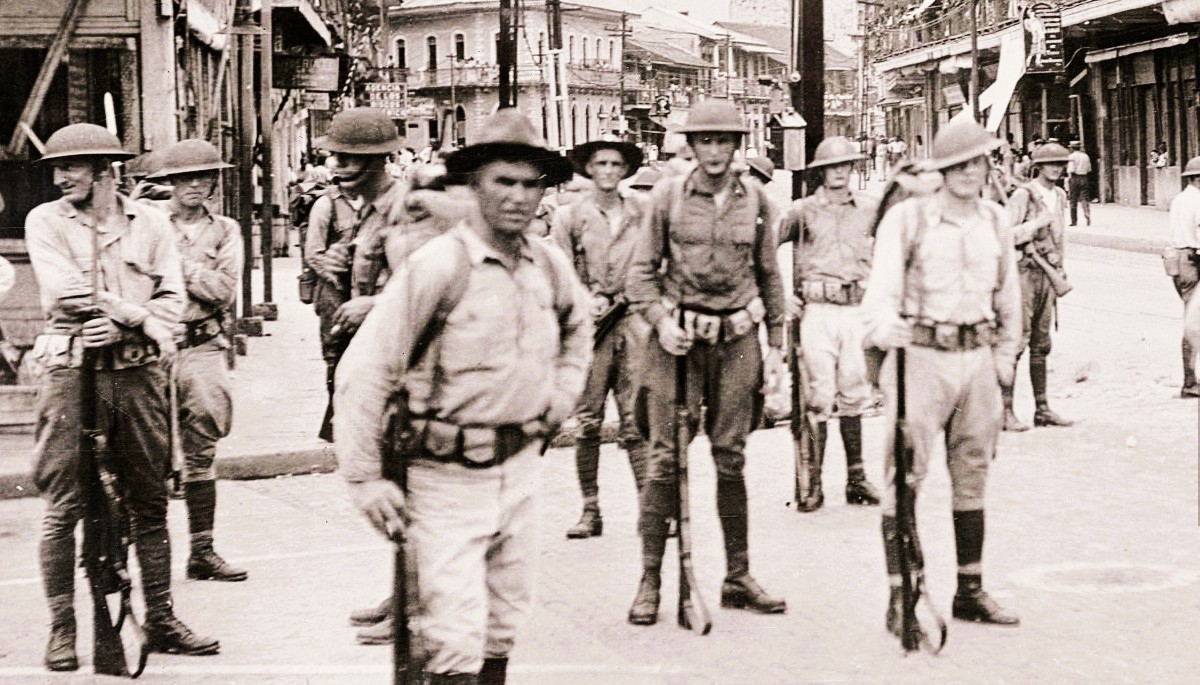
In an article that could be written today, the supplicant Panamanian government was forced by mass outcry in 1927 to bring popular rejection of a proposed treaty with the U.S. to the League of Nations. Charging violations of its sovereignty by stipulations that Panama immediately join in any war the U.S. engage in, the League’s Assembly ruled, with caveats, in Panama’s favor. In response the U.S. Congress and Secretary of State Frank Kellogg dismissed the body and threateningly asserted that the United States would never abide by any international decision that challenged its control over the Canal.
‘American Imperialism Decrees Perpetual Slavery for Panama’ by H.M. Wicks from The Daily Worker. Vol. 4 No. 209. September 15, 1927.
COMMENTING upon the report that Dr. Eusebio Morales, former foreign minister of Panama, suggested at Geneva that the league of nations intervene in the dispute between that nation and the United States over the question of sovereignty of the Canal Zone, Secretary of State Kellogg declared emphatically that “the league of nations has nothing whatever to do with American control over the Panama Canal zone, now or in the future.”
This a mere repetition of the attitude of American imperialism since the infamous Roosevelt steal of 1903-4, when the United States launched the canal project. From that day to this the Canal Zone has been under the blight of American despotism. The government of Panama has become the creature of Wall Street and the political minions at Washington have ruthlessly used the armed forces of this country to hold in subjection the inhabitants of the zone. The state department, replying to the alleged statement of Morales, condemns to perpetual slavery those unfortunate enough to exist within the Canal Zone. This sentiment is also affirmed by Senator Claude A. Swanson, ranking democratic member of the foreign relations committee, whose political career cannot be distinguished from the Coolidge gang and who introduced the world court resolution in the senate. That resolution and the bitter struggle that ensued upon the floor of the senate exposed in dramatic relief the common political line followed by the majority supporters of both the two old parties in behalf of their masters, the Wall Street bankers. Swanson went even further than the state department and revealed the strategic position of the Canal for military purposes:
“One reason why the United States must have a navy on a parity with Great Britain is so that the United States can discharge its international obligations in connection with the use and neutrality of the Canal. The United States does not feel that, in consideration of this international obligation, it should have a navy inferior to Great Britain, which would practically put control of the canal under the British navy. The United States will not tolerate any interference in this matter of the Panama Canal from any source whatsoever.”
Swanson, one of the luminaries of the Wall Street republican-democrat coalition in the senate, avoids stating the real motive for demanding the maintenance of a big navy. Certainly it does not require a navy on a parity with England to guard the canal, for the simple reason that British would not dare concentrate her full naval power in a struggle for the control of this territory. Its navy is used to defend every outpost of its far-flung empire. The United State needs its navy for precisely the same reason that British imperialism needs its big navy–to inflict the blight of its predatory parasitic imperialism upon the colonial and semi-colonial countries. Swanson, by bringing up the question of naval parity with Britain, publicly announces that the dominant wing of the democrat party is in full and complete accord with the republican administration policy of the Coolidge-Mellon regime as exemplified by Hugh Gibson at the Geneva naval conference that revealed in dramatic form the antagonisms between the United States and England. The leaders of both the old parties perceive clearly that the conflicting interests between the two giant imperialist powers of the world can never be settled around conference tables. At the same time both Britain and the United States perceive that the greatest menace to imperialism in general is the Union of Socialist Soviet Republics and the Chinese revolution. In addition to defending their present imperialist conquests both of these powers, in varying degrees determined by their own special interests, strike to destroy the Russian and Chinese revolutions. This fact is ignored by such politicians as Swanson.
In this connection it is timely to recall the fact that American imperialist policy in China is the direct opposite of its attitude toward the Southern Republics. In the case of the Western Hemisphere the Monroe Doctrine is used to close the door to the aspirations of European imperialism. American imperialism demands undisputed domination of the two American continents. (Wall Street by its tremendous economic power is rapidly bringing the British dominion of Canada under its domination.) In the case of China the Wall Street gang demands the “open door” in order that it may strive to oust the other powers from that vastly rich territory and secure undisputed domination of it. When and if that goal is realized it will close the door against other powers as it does today in the Latin-American countries. The apparent contradiction between its policy in China and in Latin-America can be easily reconciled when it is understood that the aim of yankee imperialism is to dominate the whole world.
And in carrying out this aim the United States certainly is not going to permit, for a moment, any nation or group of nations to threaten its supremacy in countries under its domination.
The canal itself is of tremendous military importance inasmuch as it affords a means whereby the Atlantic and Pacific fleets may merge for any concerted action necessary to maintain and extend the rule of Wall Street over the republics to the south. In a world war it would also be invaluable as an aid in facilitating heavy concentration of forces either on the Atlantic or the Pacific.
Panama is but one of many nations sharing a common fate of victims of the most ruthless despotism extant. It has special significance inasmuch as its position on the canal makes it a very sensitive nerve center for American imperialism and any suggestion of challenge to yankee domination meets with determined resistance at Washington.
Certainly at a time when the ravaging of Nicaragua by American marines assumes particularly repulsive forms with the systematic murder of natives proceeding day after day in order to conquer more territory for a second canal the American banditti is not going to temporize with those who question its domination of its first canal.
IT is impossible at this moment to perceive, through the maze of intrigues and the cabals of the league the real motives behind the declaration of Morales. It is doubtful if it is a deliberate provocation on the part of Britain, but it is certain that Sir Austin Chamberlain and his associates will welcome the statement of the former foreign minister of Panama as an aid in combating the influence of the United States upon smaller nations that have raised embarrassing questions regarding the domination of the league by the big European powers.

There is also the possibility that Morales is playing the game of that section of the American imperialists who favor this country entering the league of nations in order to wrest domination from the big European nations and use it for its own international brigandage. The question might purposely have been brought up so that supporters of the league in America can have their political marionettes raise the question in congress, and at least, revise the world court resolution so that the United States can take it place in that body which furnishes the legal cloak for the international pillage that is carried out in the name of the league.
In this connection it is amusing to note the indignation of the so-called liberal senator, William E. Borah of Idaho, chairman of the senate foreign relations committee, who joins Kellogg and Swanson in declaring that the question of Panama is a question for the United States only. Borah, who shared with Jim Reed of Missouri the leadership of the anti-world court forces is not astute enough to perceive the deeper currents of international duplicity and, although his position as defender of the middle bourgeoisie impels him to fight against European entanglements in general he is frequently found in the camp of the most outspoken imperialists.
AGAIN, there is, of course, the possibility that Morales speaks for those small Panaman business interests who object to the establishment by the United States of commercial houses in the Canal Zone. It was this clause in the new treaty between the United States and Panama that aroused the greatest antagonism when it was before the Panama congress for ratification. While the majority of native capitalists of that nation are agents of yankee imperialism there are small petty bourgeois groups who seek an independent existence, which they are denied in case of monopoly of commercial business by the government of the United States. Even granting that Morales may speak for the small capitalists of Panama the fact remains that his action can be used by the powers for their own ends. Certainly the class prejudices of a spokesman for the Panama small business men could be utilized in the league by the Wall Street gang in order to reopen the question of the world court of the league of nations and insist that the defense of the “neutrality” of the canal necessitates this country having official representation on that tribunal. On the other hand British diplomacy may use such prejudices to endeavor to weaken the influence of American imperialism and for its own specific ends.
THAT there is no revolt on the part of the Panama government against Wall Street and that it is still subservient to Wall Street was evidenced by the comments of the officials of that government who declared they could not understand why Morales made such a plea to league members. The editor of the semi-official “Panama American” asserts that the question of United States sovereignty is “purely academic” and deals only with whether the “United States possesses rights of sovereignty over the canal zone or only such rights as it might exercise if it were really sovereign.” Such a stand is to be expected from a spokesman of a government that in the most venal and servile sense is the pliant tool of Wall Street despotism.
It is only a short time ago that the armed forces of the United States rescued the Panaman government from the fury of its own population and that government remains in power today only by virtue of Wall Street support.
Less than two years ago, in October, 1925, armed forces commanded by Brigadier General C.H. Martin, under direct orders of General Lassiter, in command of the zone, let loose upon the population of Panama City the most frightful terror in suppressing tenant demonstrations against high rents. Labor headquarters were sacked, workers were savagely butchered in the streets, the tenant leaders were jailed, the suppression even extended to the relatives of the victims who tried to attend their funerals. “Order” was restored by the gunmen of imperialism and the vassal government of Wall Street was secure. After two days of ruthlessness the only sound in the streets was the tramp of the iron heel and the muffled groans of the victims of the outrage.
In spite of the twaddle of Kellogg and Swanson about the civilizing role of the United States the record in Panama is that of ravager of small nations.
The way to fight American imperialism is not by futile appeals to the league of nations but by organization of the Latin American nations into a powerful anti-imperialist bloc as, an instrument for a direct fight against the marauders. This will not be done by the political tools of Wall Street but by the oppressed and bleeding masses of workers and peasants who must rise against the combined agencies of yankee tyranny.
The Daily Worker began in 1924 and was published in New York City by the Communist Party US and its predecessor organizations. Among the most long-lasting and important left publications in US history, it had a circulation of 35,000 at its peak. The Daily Worker came from The Ohio Socialist, published by the Left Wing-dominated Socialist Party of Ohio in Cleveland from 1917 to November 1919, when it became became The Toiler, paper of the Communist Labor Party. In December 1921 the above-ground Workers Party of America merged the Toiler with the paper Workers Council to found The Worker, which became The Daily Worker beginning January 13, 1924.
PDF of full issue: https://www.marxists.org/history/usa/pubs/dailyworker/1927/1927-ny/v04-n209-NY-sep-15-1927-DW-LOC.pdf
 Revolution's Newsstand