In the third addition to his serial on the German Revolution, Fraina looks at the impact of the Brest-Litovsk negotiations and surrounding Soviet propaganda offensive.
‘The Background of the German Revolution: III. Peace and Propaganda’ by Louis C. Fraina from Revolutionary Age. Vol. 1 No. 14. January 18, 1919.
A FUNDAMENTAL issue of the Russian Revolution had been the issue of peace. On this Issue class antagonisms developed implacably–the imperialistic bourgeoisie had to continue the imperialistic war, because its interests and its world-relations were bound up with it; the revolutionary proletariat and the impoverished peasantry had to struggle for the end of the war, as war was devouring the revolution and multiplying misery and oppression. The new proletarian Soviet Government, organized on November 7, issued an offer to all belligerents for an armistice on all fronts as a preliminary to concluding peace on the basis of no annexations and no indemnities. The Bolsheviki recognized that their program was not realizable through an appeal to the governments, but only through an appeal to the proletariat for pressure upon the governments and the revolutionary struggle against Capitalism and Imperialism–the revolutionary struggle against all Imperialism was the means of securing peace, immediate, real permanent.
The German Government accepted the armistice–for purposes of its own; the Allied Governments rejected the armistice–for purposes of their own. And on this issue of the armistice, as on the issues of the war, majority Socialism again divided on nationalistic lines–German majority Socialism favored the armistice, majority Socialism in France, Belgium and Great Britain repudiated the armistice. The governments had become the arbiters of “Socialist”‘ policy.
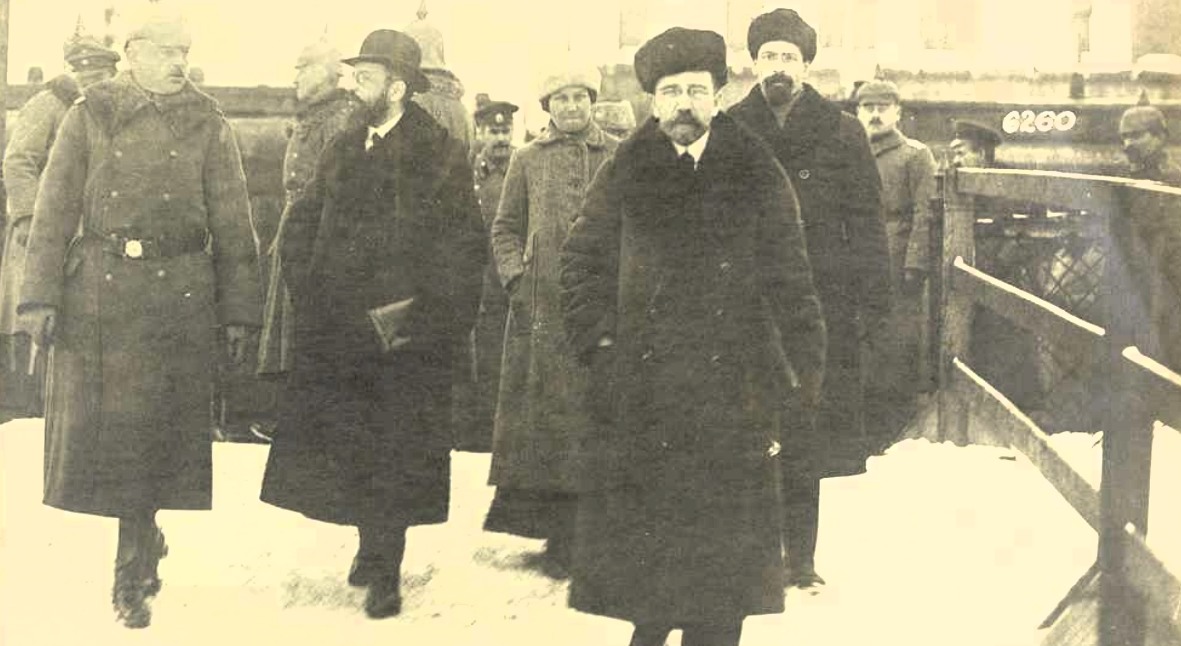
The Allies refused, equally, to enter into general peace negotiations; and imperialist Germany and Soviet Russia engaged in a peace conference at Brest-Litovsk in December, 1917. The Bolshevik delegates offered proposals for a general peace, all the while appealing to the Allied proletariat and Socialism to compel their governments to accept peace negotiations; but their appeal met no decisive response. The abstention of the Allies allowed Germany to force separate peace negotiations upon Russia. The Austro-German delegates accepted the formula of no annexations and no indemnities in words, but repudiated it in fact, insisting upon indemnities and the annexation of the Baltic Provinces in veiled form. Trotzky and the other Bolshevik delegates exposed the sinister imperialistic aims of the Austro-German delegation, but to no avail: German and Austrian Imperialism, with the tacit approval of majority Socialism, had determined to impose an imperialistic peace of violence upon the Soviet Republic.
The Bolshevik delegates used the forum of Brest-Litovsk to speak to the proletariat of Germany and Austria, and of the Allied nations. Their policy at Brest was supplemented by an intensive agitation among the Austrian and German Soldiers for revolutionary action against the war. This propaganda assumed gigantic proportions; and when the German delegation insisted that this propaganda should cease, Trotzky answered that the armistice terms did not forbid freedom of press and propaganda; and when the Bolshevik delegation officially crumpled, the propaganda went on.
This revolutionary propaganda among the Austro-German troops had been going on for months previously. When, due to counter-revolutionary treachery, Riga was captured in September, the Army Committee of the Twelfth Russian Army, upon evacuating the city, issued a proclamation to the German soldiers: “The Russian soldiers of the Twelfth Army draw your attention to the fact that you are carrying on a war for autocracy against Revolution, freedom and justice. The victory of Wilhelm will be death to democracy and freedom. We withdraw from Riga, but we know that the forces of the Revolution will ultimately prove more powerful than the force of cannons. We know in the long run that your conscience will overcome everything, and that the German soldiers, with the Russian Revolutionary Army, will march to victory and freedom.” In October, a formidable mutiny broke out in the German fleet at Kiel. and the sailors of the Russian Baltic fleet sent their greetings:
“The revolutionary sailors of the Baltic Fleet send their fraternal greetings to their heroic German comrades who have taken part in the insurrection at Kiel.
“The Russian sailors are in complete possession of their battleships. The Sailors’ Committees are the High Command. The yacht of the former Czar, ‘Polar Star,’ is now the headquarters of the Fleet Committee, which is composed of common sailors, one man from each ship.
“Since the Revolution, the Russian Fleet is as busy as formerly, but the Russian sailors will not use the fleet to fight their brothers, but everywhere to fight under the Red Flag of the International for the freedom of the proletariat throughout all the world.”
For months the soldiers had been fraternizing on the eastern front, the Russians spreading revolutionary ideas among the Germans and the Austrians,–a fraternization objected to by the imperialists on all sides, since it was a revolutionary threat to all. At the All-Russian Soviet Congress on November 8, a peace decree was adopted, proposing an armistice and appealing to the proletariat of Germany, France and Great Britain to “decisive and energetic action,” which “will help us bring to a successful conclusion the fight for peace, and at the same time the liberation of all the working classes from slavery and exploitation.” Simultaneously, a proclamation was issued to the German soldiers, announcing that Socialism and the proletariat in Russia had conquered all government power:
“Our program, to the execution of which the Government has immediately proceeded, consists in the proposal of an immediate democratic peace, which has already been communicated to the belligerent nations and their Governments, in the transfer without compensation of all the land to the peasants for their use, and in the realization of Workers’ Control of industry….
“Soldiers, Brothers! We ask you to stand by Socialism with all your might in the struggle for immediate peace, as that is the only means to secure a just and permanent peace for the working class of all countries, and to heal the wounds which the present most criminal or all wars has inflicted on humanity.”
A bureau of International Revolutionary Propaganda was established by the Soviet Government, and 10,000,000 rubles appropriated to assist in revolutionary Socialism in all belligerent nations. A series of daily papers for revolutionary propaganda, in German, Hungarian and other languages, which were circulated by the millions among the Austro-German soldiers while the delegates were discussing at the peace conference…One of the appeals to the German soldiers read as follows:
“Brothers, German soldiers! The great example of your comrade Karl Liebknecht, the most eminent leader of International Socialism, the persevering and long-continued struggle which you have conducted by publishing newspapers and pamphlets, by numerous demonstrations and strikes, the struggle for which your Government has thrown into prison hundreds and thousands of your comrades, and lastly, the heroic revolt of your sailors of the Fleet serve as a guarantee to us that the mass of the working class of your nation is ready to enter the decisive struggle for peace.
“Hasten our assistance! In the name of the Workers’ and Peasants’ Government we guarantee that our soldiers shall not move one step forward if you decide to take into your hands the flag of peace, and even if the struggle for peace inside your own country takes away part of your forces from the front….”
The proletarian revolution in Russia, in its struggle for peace and for its own complete success, had to struggle for the international revolution. It issued, accordingly, the clear call to class action, to the proletarian revolutionary struggle: by this sign alone could it conquer…
The Brest negotiations proceeded. The aims of Austro-German Imperialism were clearly revealed, and were in turn revealed to the Austro-German soldiers by means of revolutionary proclamations, pamphlets and rapers. The German revolt did not materialize; Austro-German Imperialism became even more brutal and insolent…The revolutionary Socialists in Germany, in spite of all disadvantages, supplemented the Bolshevik propaganda at the front by a revolutionary propaganda of their own. Many revolutionary appeals were issued, of which this is one issued by the Spartacus Group:
“The German Government has demonstrated by means of the negotiations at Brest-Litovsk, that it wishes to throw dust in the eyes of the masses and to aggravate the death struggle of the warring peoples. Its pretended love for peace is merely a mask. Its statement that a partial peace would bring us nearer to a general peace, is a lie and imposture.
“A separate peace with Russia would increase the fury of the war and, consequently, increase the slaughter. The sufferings of the German people would not be abated.
“It becomes the duty of the German working class to battle unceasingly for a general peace.
“There is only one means of putting an end to the present butchery and misery of the workers–the overthrow of the government and the bourgeois class, in the way that this was done in Russia. It is solely by mass effort, by the revolt of the masses, by a mass strike paralysing all economic activity and all car industries: it is solely by a revolution and the establishment of a people’s republic in Germany by and for the working class, that an end may be put to the slaughter of the toilers of all lands, that a general peace can be achieved.”
In January and February, 1918, all this agitation expressed itself in action. Great strikes and demonstrations against the war and for peace broke loose in Germany and Austria. This action verged on revolution. In Austria, in one district alone, 90,000 were on strike, and the total must have been over a million. It was the initial mass action of the proletariat, out of which might have emerged general revolutionary action against war, against Capitalism and Imperialism. The strikes and demonstrations in Austria broke loose against the orders of the union bureaucracy and the majority Socialism: when the news of these strikes reached Trotzky, he badgered the Austro-German diplomats into postponing the Conference for a week, hoping that the movement would broaden and deepen, but in Austria, majority Socialism, in spite of not having acted to produce the movement, placed itself at the head and betrayed it into “legal” action. The movement spread to Germany, where hundreds of thousands of workers were involved; but again the union bureaucracy and majority Socialism acted against the movement. Majority Socialism ordered the strikers back to work, preached incessantly against a revolution, betrayed the German proletariat and the Russian proletariat, the cause of Socialism and peace. The movement was not broken by the government, but by counter-revolutionary Socialism: that is the great fact.1
Isolated, abandoned equally by the proletariat and Socialism in all belligerent nations, the Bolsheviki at Brest-Litovsk were overwhelmed. But again Trotzky refused to accept the imperialistic treaty imposed by German Imperialism, and turned to the desperate expedient of a “declared peace”–that is, the Bolshevik delegation refused to sign the “robbers’ peace,” but declared the war at an end: a final appeal to the world, and particularly to German Socialism. But Austria and Germany insisted upon signing the peace, and sent their soldiers to invade helpless Russia. This was in February. Two currents developed in Russian Bolshevism–one favoring a revolutionary war, however desperate, the other insisting upon ratifying the peace, and waiting for the proletarian revolution in Germany. Lenin represented this latter attitude, and said:
“The Russian Revolution, reaching a culminating point in November, when the proletariat secured the reins of Government, was bound to pass through a period of civil war and internal disorder, because the propertied classes could not be expected to give up their privileges without a struggle.
“Therefore the war with reactionary organizations (the fight against the sabotage by which the intelligentsia tried to overthrow the Soviet Government by breaking the state machinery), must continue until the bourgeoisie sees the hopelessness of further resistance and surrenders unconditionally.
“This means the necessity for the Soviet Government to concentrate all its forces on the internal struggle.”
The policy of the Russian Revolution must be based on the general international situation–namely, the probability or improbability of the outbreak of Social Revolution in the rest of Europe; but the chances of this in the immediate future are slight. Therefore it is a mistake for the Russian Revolution to base its policy on uncertain eventualities:
“In Germany the reaction has temporarily triumphed, setting before the Russian Revolution the alternative of further war or an annexationist peace.
“To sign a peace with German Imperialism is not objectively speaking, treason to international Socialism.
“When workmen are beaten in a strike, and have to accept bad terms from employers, they do not betray their class because they cannot get all their demands at once. They only accept bad conditions in order better to prepare for another struggle later on.
“If the Russian Revolution continued the war in alliance with Anglo-French Imperialism against Austro-German Imperialism the basis of the old secret treaties recently published and not openly repudiated by the Allies, then it would be prostituting itself to foreign imperialists.
“As long as there no Social Revolution in England and Germany, the Russian Revolution must seek the most profitable conditions in existence, relying as little as possible on the English or German governments negotiating one against the other.
“It is not true that the Russian Revolution is deserting Socialist comrades in England and Germany by signing a separate peace. It takes them longer to do what Russia has done because their Imperial Governments are stronger than the old Russian Imperial Government. Nevertheless, the material weakness of Russia forces her to recuperate for internal reconstruction.”
It would be a rash adventure to enter upon a holy war against German Imperialism, even if Russia were able to do so, on the chance of revolution in Germany breaking out in the next few months, for meanwhile defeat would mean more onerous conditions for the future developments of the Russian Revolution:
“Russia, if she has peace, can become the envy of all lands, and the centre of gravity of the Socialist world. By concluding a separate peace Russia can utilize the fact that the Anglo-German imperialists are too much engaged in a bloody struggle to attend seriously to her. So can therefore concentrate on the internal development of the Revolution.
“If Russia, under present conditions, attempts both enterprises–internally to reap the full fruits of the Revolution, and externally to carry on the conflict against foreign Imperialism–she will lose both her objects; but if she concentrates on internal development now, she will secure her second victory later.
“The war will last long and Imperialism will finally be unmasked completely, on both sides. The example of the Russian Revolution will continue to inspire the peoples of the world, and its influence will be enormous. On the one side will be the bourgeois system and war for conquest waged by two imperialistic groups, on the other peace and the Socialist Republic.
“The reorganization of Russia, based on the dictatorship of the proletariat, the nationalization of banks and of big industry, the exchange of products of the cities with the co-operatives of small peasants, is economically quite feasible, provided we have a few months to devote to the job. Such an organization will make Socialism unconquerable in Russia, and will provide a permanent basis for the formation of a powerful red army of peasants and workers.”
The Lenin conception conquered; and the All-Russian Soviet Congress in March, 1918, ratified the Brest-Litovsk peace.
Brest-Litovsk marked the first break in the imperialistic war, and was a great contributing factor to the coming of peace. If Soviet Russia had continued the war it would have meant the triumph of the counter-revolution and Capitalism: and the German proletariat, surrounded on all sides by capitalist nations prepare to cut the throat of their revolution, would have hesitated. But, with a Socialist Russia prepared to assist, a tremendous ideologic impulse was given to the coming of the German revolution. Moreover, while the Bolsheviki ceased the military war against Germany, they continued the class war of revolutionary propaganda, smuggling agents and literature into Germany urging a proletarian revolution. The Bolshevik Ambassador to Berlin, Joffe, was the centre of the revolutionary propaganda, using his “diplomatic couriers” to bring into Germany money and literature for the use of the revolutionary Socialists. The class war was waged by Soviet Russia, in Germany and all Europe, the struggle for the international proletarian revolution.
NOTE
1. After the strike movement had been killed, Dr. Drews, Prussian Minister of the Interior, said the strikes had served Germany’s enemies, and accused the Social Democratic Party of encouraging the strikes. To this the Berlin Vorwaerts, organ of majority Socialism, answered by quoting Prime Minister von Dandle of Bavaria as having thanked the Social Democratic leaders in a speech in the Bavarian Chamber of Deputies for “ensuring control of the strike movement, as thereby the strike was forced into normal channels.” Could turpitude and treason to Socialism reach lower depths than this?
The Revolutionary Age (not to be confused with the 1930s Lovestone group paper of the same name) was a weekly first for the Socialist Party’s Boston Local begun in November, 1918. Under the editorship of early US Communist Louis C. Fraina, and writers like Scott Nearing and John Reed, the paper became the national organ of the SP’s Left Wing Section, embracing the Bolshevik Revolution and a new International. In June 1919, the paper moved to New York City and became the most important publication of the developing communist movement. In August, 1919, it changed its name to ‘The Communist’ (one of a dozen or more so-named papers at the time) as a paper of the newly formed Communist Party of America and ran until 1921.
PDF of full issue: https://www.marxists.org/history/usa/pubs/revolutionaryage/v1n14-jan-18-1919.pdf
 Revolution's Newsstand