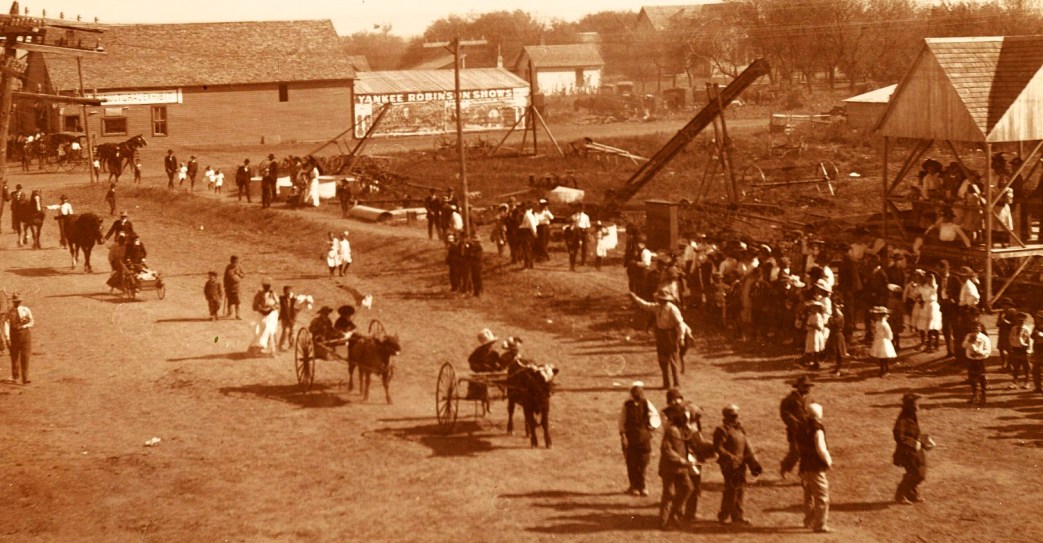
Circus workers learn that ‘between equal rights, force decides.’
‘Circus Gives Direct Action Lesson!’ by J.A. McDonald from Solidarity. Vol. 5 No. 252. November 7, 1914.
Kansas City, Mo., Oct. 28. One hundred and fifty men employed by the Yankee Robinson Show, learned last Saturday at the point of a gun, that direct action has its merits. They have also a higher respect for “lead” as a medium of exchange. This show paid off these 150 men with the aid of guns, tent poles and other circus paraphernalia. This type of “justice” so common in capitalist ethics, is well known in the circus fraternity as “red lightning,” and is at the end of the season a common manner of paying off the unorganized. The men were at 7:30 brought into the pay car, the second last car in the circus train going over the Missouri Pacific, and “paid.” The Robinson circus still has the money, but the stiffs have their money’s worth of experience.
The show promised to pay at Frankford, Kansas, the last show before going into winter quarters at Granger, Iowa, where the owner is one of the respected citizens. At Frankford the men gathered around the pay car. W. Larkin, the stable boss for the show, announced in a voice permeated with the essence of brotherly love and honest Christian principles, that the men would be paid at Centralia, Kansas. They were. At Centralia the show stopped and all men were ordered to the pay car. The men, some of whom had $70 due them as back pay on their summer’s work, gathered to receive the rewards of honesty and faithful service, till the car was full. The dramatic incident followed of starting the train and handing of two dollars to each man. They were then pushed out of the car by other circus employes and officials with guns and clubs of various natures with the train going a speed of over ten miles an hour.
Many of the men were injured while getting off the train. One of these, C.H. Morgan, who was cooking for the show and who with 55 others arrived in Kansas City last night, had his right leg so injured that he will, for the coming winter, be a subject for the hospital and charity.
After arriving at the I.W.W. hall the men, none of whom were “wobblies,” decided they would fix them with the law. They went to the State Commissioner of Labor. They have so far received nothing certain but sympathy. They do not find any of the Kansas City restaurants that will accept cheques drawn on the Bank of Sympathy and consequently many of these men are moneyless, homeless and foodless. Some of them are already scratching their heads and wondering is honesty the best policy and if it is why doesn’t the boss take a little of it for himself?
Some of the men think that perhaps direct action is after all better. Two weeks before, the Yankee Robinson show had in its employ six I.W.W. men. The management tried to put them off when they wanted their money and then to pay them with tent poles. They showed their cards and told the officials that they themselves could put a little of the show’s direct action into practice and, that their strong point was doing it first. They told them that if they were not paid and now, there would not be any Yankee Robinson show. Of course the management knew they were bluffing. But, whereas and because the I.W.W. is not respectable– certainly not–and have no respect for private robbery or public property, also because they did not wish the morals of THEIR men degraded, they decided–and rather suddenly–that they would pay them.
J. A. McDONALD.
The most widely read of I.W.W. newspapers, Solidarity was published by the Industrial Workers of the World from 1909 until 1917. First produced in New Castle, Pennsylvania, and born during the McKees Rocks strike, Solidarity later moved to Cleveland, Ohio until 1917 then spent its last months in Chicago. With a circulation of around 12,000 and a readership many times that, Solidarity was instrumental in defining the Wobbly world-view at the height of their influence in the working class. It was edited over its life by A.M. Stirton, H.A. Goff, Ben H. Williams, Ralph Chaplin who also provided much of the paper’s color, and others. Like nearly all the left press it fell victim to federal repression in 1917.
PDF of full issue: https://www.marxists.org/history/usa/pubs/solidarity-iww/1914/v05-w252-nov-07-1914-solidarity.pdf
 Revolution's Newsstand