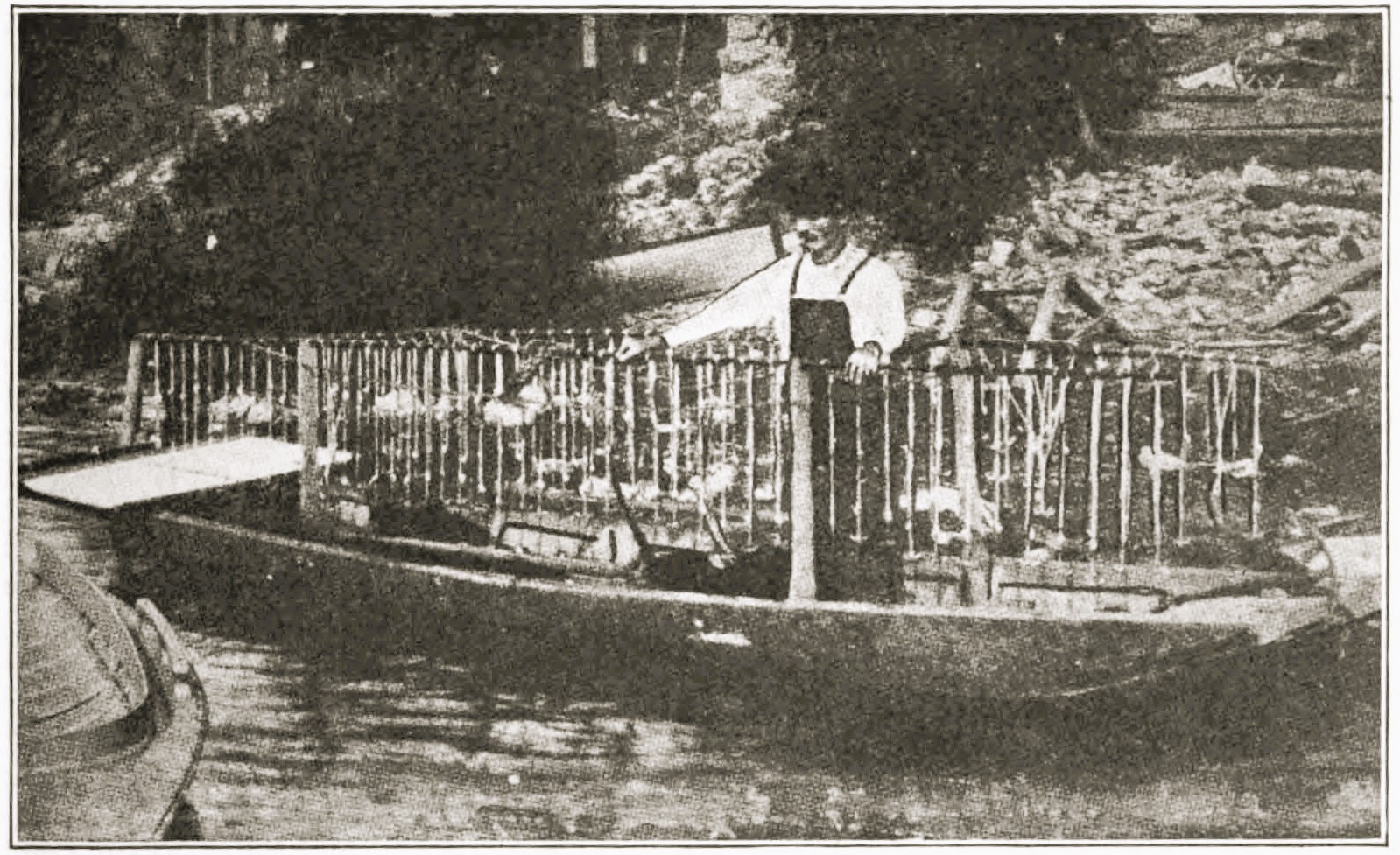
When Muscatine, Iowa was a seat of the class war. For decades, the city was the world’s largest maker of pearl buttons, stamped from clam shells harvested from the Mississippi River. Muscatine’s workers waged a hard, losing struggle for unionization lasting three years from this report. It would not be until 1933 that workers would win union recognition. However, the strike helped build the Socialist Party in the state, with Muscatine itself electing two Socialist aldermen during the conflict. Button making and its rebellious workers below.
‘Pearl Buttons’ by Lee W. Lang from International Socialist Review. Vol. 12 No. 6. December, 1911.
MUSCATINE, IOWA, is the center of the button industry of the world. J.F. Boepple, a native of Germany, over twenty years ago, started the first button shop in the Mississippi valley and made buttons from clam shells taken from the bed of the Mississippi river. When he first started a shop he used foot power to run the cutting machines and the process of centering, polishing and drilling holes in the buttons was done by hand. Of late years the business has evolved to a point where nearly all the process of making the buttons is done by machinery. To begin with the clam shells are taken from the river bed by means of a rake or a hook, they are cooked in order to get the clams out of the shells, and the shells are sold to the manufacturers.
While the clams are being taken out each one is searched thoroughly for pearls and quite often a clam digger makes a good find. After the shells reach the manufacturer buttons are cut out of them, of various sizes, by men who are paid by the gross. A gross is 144 buttons, but the men are made to cut 168 buttons for a gross, the manufacturer claiming that the two dozen extra buttons are to make up for the imperfect buttons. But this is not the truth, for the boss counts out all imperfect buttons, besides forcing the men to cut the extras.
The next processes that the buttons go through are grinding, centering, drilling holes in the buttons and also polishing the same, all of which is done by automatic machines. The operatives employed to do this work are women and girls. They must finish and even sort the imperfect buttons for which they receive no pay. The manufacturers sell all the buttons, as even the thinnest are marketable though not bringing quite as good a price as the perfect buttons. Still the bosses refuse to pay the workers anything for the thin buttons. After the buttons are finished and sorted they are sewed on cards. This is one of the most dastardly schemes that was ever worked onto any community. The bosses pay one and one-half cents per gross for sewing the buttons on cards and the people have to carry the buttons from and to the shops. In most cases the school children have to do this work. The children are forced to help their mothers to sew buttons. I have seen children sewing buttons before school, at noon hours, after school hours and in the evening. The mothers sew all day long. Some have to neglect their housework to make from $1.50 to $2.00 per week.
All of the church societies sew buttons for the benefit of the churches. One church society has sewed as high as. 66 gross in two hours’ time and the result, at one and one-half cents per gross, was 99 cents, and as there were eight women present it averaged 6 cents per hour. One woman has tested herself and on an average of a ten-hour day she cannot sew more than four gross per hour, making sixty cents a day. It must be remembered that a woman cannot keep this rate up, as the work is hard on the eyes, it affects the spine and produces nervous wrecks.
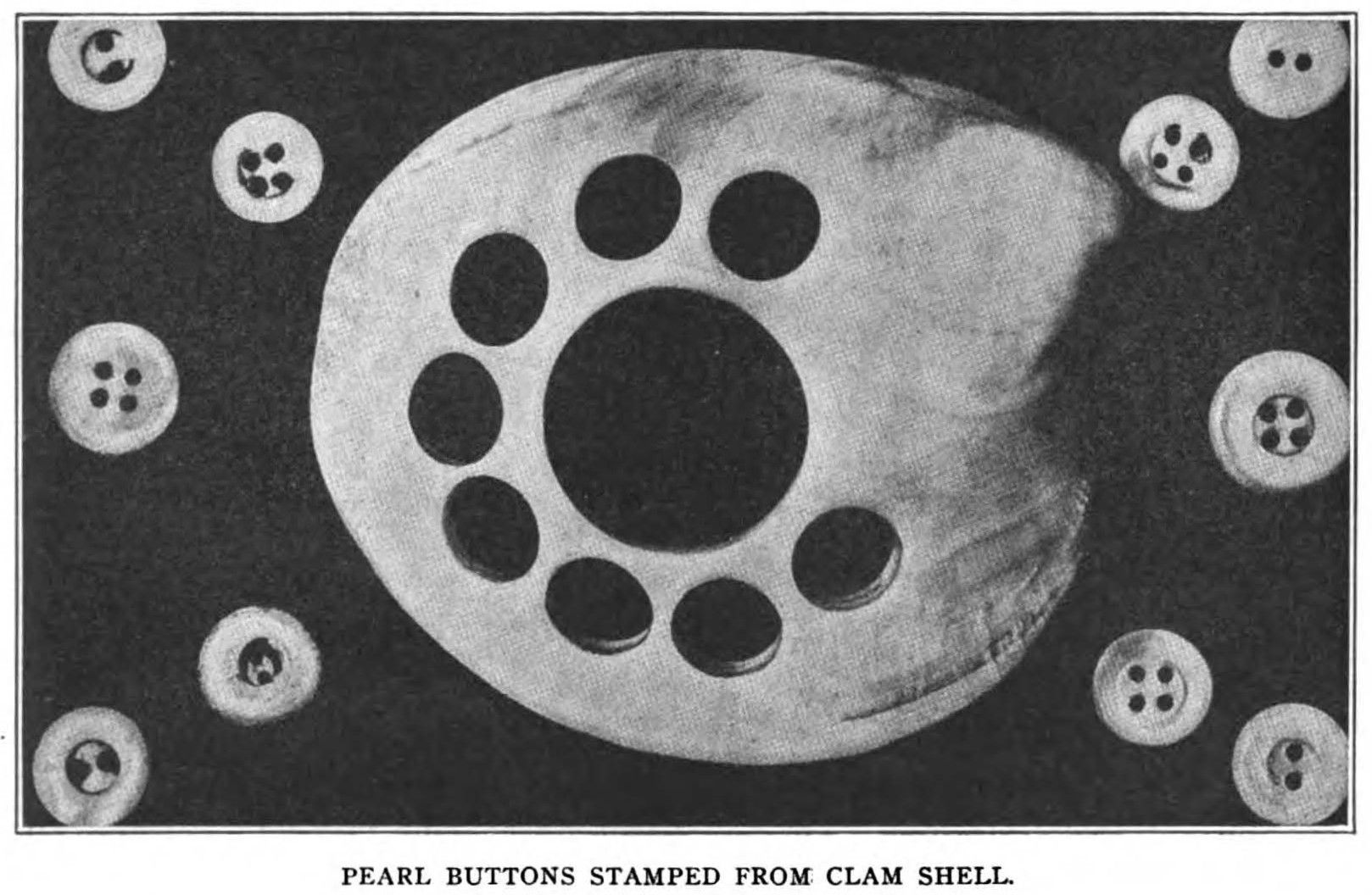
A prominent lawyer has figured out the labor cost of making buttons to be less than eight-tenths of one cent per dozen. The buttons are sold at retail from 10 cents to $1.50 per dozen. The business has increased to enormous proportions of late. When it was in its infancy the workers used to make pretty fair wages, but in the last few years, since the manufacturers have become larger and have organized, they have reduced the wages of the workers to a starvation point.
During the last ten years various attempts were made to organize the workers in the button industry, but it was a hopeless task until the fall of 1910, when the manufacturers reduced wages to such a point that it became unbearable and the workers organized. O.C. Wilson, Socialist city alderman, was the principal figure in organizing them and at the present time he is the business agent of the union and is giving the manufacturers a run for their money. After the workers nearly all joined the union, the manufacturers took fright and on February 25th, 1911, locked out the workers for nine weeks and the workers refused to go back to work without their union cards. After the manufacturers used all the means at their command, even going so far as to have the militia here, and not being able to induce the workers to go back they had Governor Carroll arrange for a settlement and the button workers agreed to it. But to the sorrow of the workers, the manufacturers discharged many of the best union workers and a halt had to be called.
On October 2nd the button workers of Muscatine went out on strike for the closed shop and all the men in the different shops as well as the girls went out with the exception of a few who worked through the lockout last spring. Over 2,000 people are affected by the strike and the bosses are feeling the result. Emmett T. Flood, of Chicago, organizer for the A.F. of L., is in charge of the strike and is doing well in keeping the workers together. As soon as the workers went out, they established a restaurant and a commissary and with aid from the different unions throughout the country they are keeping their members supplied with the necessities of life. They are buying coal, potatoes and flour in carload lots and giving it to the strikers.
The Commercial Club recently held a joint meting with the manufacturers and business men of the city and adopted resolutions, pledging their support to the bosses and standing for “law and order,” such as has been doled out to the workers. About 300 business men aligned themselves with the bosses, signed the resolutions for “law and order,” and business has been pretty dull with them ever since. The real object of the manufacturers was to induce the business men to help intimidate the workers and they are trying the same by refusing the workers credit and urging them to go back to work. The business men were used as stool pigeons and are now sorry for what, they have done. The manufacturers have imported thugs from Chicago and they are causing all kinds of arrests and throwing all kinds of people in jail on no charge at all. The marshal, who is a Democrat, a young but ignorant brute, said he would go the limit to protect the scabs.
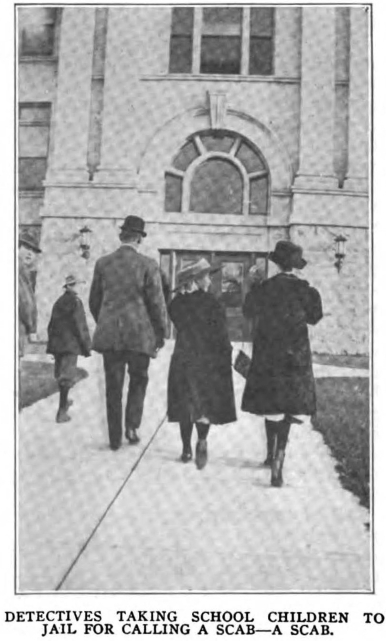
Miss Finnegan, of Chicago, was arrested and held in jail for six hours, having to give $300.00 cash bond, and after four days’ waiting, the officers said they had no charge against her. L.W. Lang, a Socialist school director, was also arrested, jailed, not allowed to see his friends or telephone to them, given no breakfast, not allowed to give bonds until he had lain in the ratty bummery for twelve hours. Then he was only let out on cash bond of $300.00. He was given a trial in police court, refused a trial by jury, and found guilty of using profane and indecent language, according to the testimony of a Chicago slugger. The case has been appealed to the district court. This was simply a trumped-up charge because he was a Socialist official and they are trying to discredit the Socialists. Four children, ranging from 12 to 14 years of age, were arrested and taken to the county jail and placed inside, which is strictly forbidden by the statute of the state of Iowa. They were kept there for four hours and dismissed.
The mayor has refused to allow any public parades. The unions asked for an injunction against his orders, but the judge upheld the mayor. On account of not being able to parade and counteract the business men’s meeting, held a few evenings before, the unions of the city, under the auspices of the Muscatine Trades Assembly, held a great mass meeting at the Opera house, at which time Miss Finnegan, Emmett T. Flood, A. S. Langille, Mrs. Raymond Robins and other local speakers spoke. The opera house was filled with people who wanted to hear the message for the workers. Overflow meetings were held in the Trades Assembly hall, speakers going from one hall to another to satisfy the crowds. Resolutions were adopted protesting against the way the police officers were making illegal arrests and pledges were made to aid the button workers.
Most of the button manufacturers started with very little capital and today they are nearly all worth hundreds of thousands of dollars. The manufacturers are going to any lengths to accomplish their aim of breaking up the union. The Socialists are carrying on a campaign with literature, educating the workers and showing them how they must have the law-making and law-interpreting power in their hands. Next spring will see a general cleaning up of the old parties and then the workers will for the first time enjoy some of the rights which their forefathers fought for. Discontent is the order of the day the world over and it is the promise of a better day for the workers.
The International Socialist Review (ISR) was published monthly in Chicago from 1900 until 1918 by Charles H. Kerr and critically loyal to the Socialist Party of America. It is one of the essential publications in U.S. left history. During the editorship of A.M. Simons it was largely theoretical and moderate. In 1908, Charles H. Kerr took over as editor with strong influence from Mary E Marcy. The magazine became the foremost proponent of the SP’s left wing growing to tens of thousands of subscribers. It remained revolutionary in outlook and anti-militarist during World War One. It liberally used photographs and images, with news, theory, arts and organizing in its pages. It articles, reports and essays are an invaluable record of the U.S. class struggle and the development of Marxism in the decades before the Soviet experience. It was closed down in government repression in 1918.
PDF of full issue: https://www.marxists.org/history/usa/pubs/isr/v12n06-dec-1911-ISR-gog-Corn.pdf
 Revolution's Newsstand