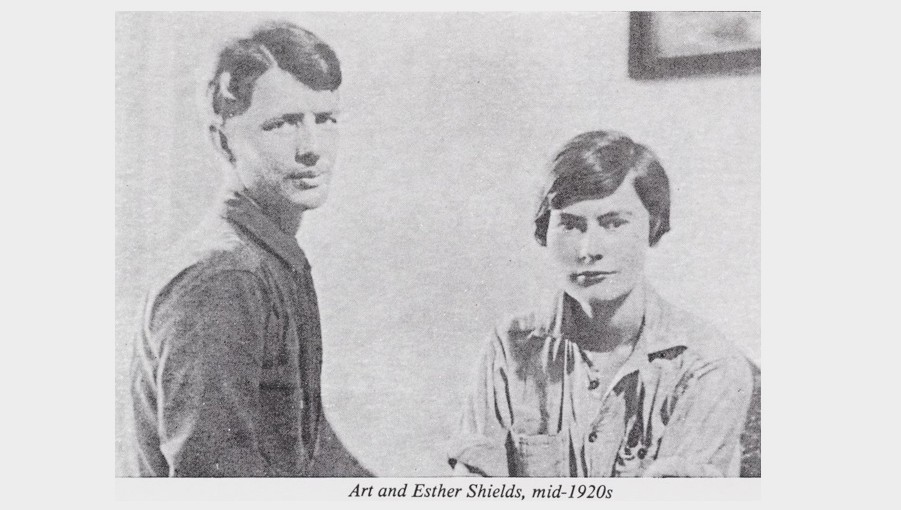
Esther Lowell was a traitor to her class, born into the blueblood Lowell’s of Massachusetts, she would graduate from UC Berkeley in 1922 and begin a long career as a labor journalist and researcher, joining the Communist Party in the mid-20s. The partner (they did not believe in the bourgeois institution of marriage) of fellow reporter Art Shields for over 60 years, Lowell and Shields worked for labor’s Federated Press, she would become a central figure in the Labor Research Association, sponsored by the Party. In this valuable article, Lowell promotes research as an essential part of labor’s struggle, giving us a history of various projects, their functions and their limitations.
‘Research–For What? Technicians’ Aid to Labor’ by Esther Lowell from Labor Age. Vol. 17 No. 3. March, 1928.
WHAT is organized labor doing to adjust itself to the technological revolution which is sweeping through industry today? Are trade unionists studying the problem of their displacement by more and more automatic processes? Whole groups of skilled workers, on whose craft control the American Federation of Labor was based, are now being wiped out. Industry is spending millions to hasten the change. What must intelligent workers do?
Today 67 workers do the work 100 did just 25 years ago. This is a general average found by the National Industrial Conference Board, a research agency maintained by the biggest corporations of the United States.
More specific facts are found in Power magazine for August 9, 1927. Figures gathered by Arthur Huntington for Iowa State Board of Education contrast the daily output per worker in 1890 with that of 1927 in various industries:
Cigarettes—Now and Then
Anyone in New York City can easily see the change for himself in one industry—cigarette making. Down in the East Side on Avenue B near Tompkins Square there is a tiny dark shop where a worker labors frantically fast poking bits of tobacco into little paper tubes. Slowly the pile of finished smokes accumulates.
Up on the Great White Way of Broadway in the Forties is a Lucky Strike demonstration shop. Shiny machines grind away during the hours the theatrical crowds are thickest. At one end is the hopper of shredded tobacco which drops the material down on rollers. At the other end comes out the finished package of cigarettes ready—to be gathered in dozen lots for further packing. The machine rolls the cigarette, seals it, drops the right number into the tinfoil and label cover it has folded together, seals the package with a revenue stamp, puts waxed paper around it, and there you are! Now quickly the packages accumulate and are taken away by one of the workers. Of course the number kept at the demonstration is larger than the number of workers handling the machines in the real factories, but even then the difference between the Lucky Strike production and the Avenue B shop is startling.
Goodbye Glass Blowers
Another industry where technology is eliminating most of the workers is sheet glass. By the Coburn process the liquid-glass is forced out in a long ribbon, smooth and shining and ready to be cut, packed and shipped. The old glass blower who used to blow the hot liquid into long cylinders which had to be laid out and cut, flattened again and polished, is gone forever from a modern glass plant. Henry Ford is making plate glass for his new Model A cars by a somewhat similar process, pushing the glass out of the furnace in sheets ready for cutting and polishing.
Technologists tell us that they could get rid of practically all the hard dirty work of the world and give us all more hours of leisure than of labor. But to do this under our present business management of industry is impossible. It would be utterly unprofitable to those who collect the big dividends now. Too many vested interests would be hit.
Industrial research, paid for by big business, is naturally not concerned directly with improving the world for the most of us. Improvement in our living conditions comes more or less incidentally. Industrial research today is trying mainly to find new ways of making money grow money—to find new kinds of products to sell. Not to find better products to sell—shoes that would fit better, be waterproof and last longer as well as look handsome. But to find products that will wear out reasonably fast so that frequently they will have to. be replaced. Sales are expected to make profits; more sales, more profits.
Big Wastes Go On
That’s what some of this elimination of waste means. Finding new sale products in present wasted materials. But the big social waste of making flimsy shoes goes on, despite industrial research, because it is profitable. The researchers may attack, sometimes with labor cooperation, the little wastes of motion, power and materials or time in the individual plant or department. The big waste of producing shoddy products for quick sale goes unchecked.
Look at the coal industry. In both anthracite and bituminous efficiency campaigns are on. Little wastes of production in the individual mine are attacked. Machine loaders or mechanical cutters are put in or an attempt is made to make miners do double work. The big waste of burning raw coal and wasting by-products goes on profitably for the operators. Socially the loss is incalculable. Coal is valuable for power primarily, heat and by-products secondarily. But power can be produced from coal far more efficiently than by shipping the raw fuel to distant factories or homes, burning it as is and letting by-products go up in smoke which darkens our—cities and makes their air a burden to our lungs.
“About $200,000,000 annually is being spent in the United States for industrial research by industrial corporations and by the federal government,” says the National Industrial Conference Board. Undoubtedly besides researching to boost sales, some of this industrial research is misnamed for investigations into new speedup schemes, more anti-labor devices like the company union, yellow dog contract and injunction. The Conference Board includes some of these in its researches. This is the “industrial research” which builds “scientific management” under “efficiency engineers.” Its material is personnel—labor in relation to the individual machine or part of production—rather than the industrial process which is the flow of raw resources (coal, iron, etc.) through their conversion into end products (power, heat. steel rails, etc.).
Where Is Labor’s Research?
Organized labor in the United States has no official research body. Some of the international unions have research departments—electrical workers, pressmen, hosiery workers, etc. These are small and specialized and to some extent a duplication of effort which a national labor research body could eliminate.
The American Federationist, organ of the American Federation of Labor, in the December 1927 issue, called attention to the new “index of labor’s share” which it has run for several months. This is a statistical indication of how much of the value of manufactured articles is paid labor in wages. It gives also the fluctuation in purchasing power of wages as related to retail prices of articles. ‘This index and the A.F. of L. pamphlets are the result of research work of a kind. Besides the A.F. of L. sets up a special committee of international union officers to make special studies, as for instance when the Union Labor Life Insurance Co. was projected.
Definite recommendation that the A.F. of L. establish a research bureau was made by Morris L. Cooke, consulting engineer and president of the Taylor Society, in the August 1927 Federationist. Cooke suggested a 2c yearly per capita tax to endow a national labor research agency and information clearing house.
Cooke proposed joint research committees established by unions in agreements with employers, to work on problems of piece-rate pay systems, relief from monotony and drudgery of work, 5-day week, protection against accident, sickness, unemployment and old age, etc. The A.F. of L. research bureau would cooperate with these–committees, said Cooke. Organized labor would thus participate in efficiency, or management engineering.
It would not be the primary function of such research bodies to study the changing technology of industry but rather the existing processes toward simplification and standardization of motions, development of relief periods, and possibly even to work for private industrial insurance instead of state social insurance against the hazards of workers’ lives.
Local labor research work is undertaken by several Labor Colleges. Philadelphia Labor College, under E.J. Lever and now under Israel Mufson, developed research work of value to unions participating. Seattle Labor College, under William Kennedy, is doing the same and would undertake broader studies of the basic industries of lumber and shipping if funds were forthcoming.
Research and Research
Brookwood Labor College has a labor research endowment fund which enables some of its faculty to prepare valuable studies. Arthur Calhoun’s A Worker Looks At Government and David Saposs’ Readings in American Trade Unionism are products of this fund. Saposs sees little hope for more fundamental labor research backed by trade unions until there is a militant labor movement demanding and supporting it.
For six and a half years the Labor Bureau, Inc., has operated on a business basis as a research agency for labor. Many A.F. of L. unions (locals of typographical, textile, pressmen, railway shop crafts, machinists, miners, etc., and several central bodies) have utilized the research services of this Bureau, as have several independent organizations—Amalgamated Clothing Workers, Brotherhood of Sleeping Car Porters, and Shoe Workers Protective unions. While it is not designed as a profit-making institution, it maintains its services at a professional rate for research work. This means often a cost to labor that is “high in proportion to the union’s ability to pay,” as Alfred Bernheim of the Bureau phrased it.
“If we had three times as much work from unions, we could cut costs to them perhaps in half,” Bernheim estimated roughly. The Labor Bureau helps maintain its staff, in addition to research jobs, by auditing union books. Its members also do special writing, editing and other supplementary work. Bernheim, Evans Clark, David Saposs, and George Soule started the Bureau. Stuart Chase and Otto Beyer Jr., promoter of the B.&O. union-management cooperation plan, joined later. Two formerly affiliated Bureaus, Middle West Labor Bureau in Chicago and Pacific Coast Labor Bureau in San Francisco, still operate in cooperation with the original organization.
Garland Fund Helps
Some duplication of function exists between the Labor Bureau and Rand School Research Department, now under Solon De Leon. Before the Labor Bureau existed, in 1915, the Rand School Department (then under Alexander Trachtenberg) did research studies on the cost of living for Big 6, New York’s typographical union, and for the International Ladies’ Garment Workers’ Union. Lately it has done an interpretation of the agreement between the International Pocketbook Makers’ Union and the employing group and compared the adjustment of various unions to the introduction of new machinery. Its charges for such studies are usually not so high as the Labor Bureau’s but it has done fewer of them.
The Rand School Research Department is a ready reference bureau for unions or workers’ fraternal and political organizations. It answers hundreds of inquiries, usually without charge or with only a suggestion to contribute payment. It puts out an annual labor year book, maintains a research library for unionists and labor students, and occasionally prepares special studies. For the past year it has issued a valuable Index to Labor Periodicals and Publications, most of which are not classified in other published indices. Its research staff consists of Solon De Leon, Nathan Fine and Anna Rochester. Its main financial backing has come from the American Fund for Public Service but it hopes to become self-supporting.
Single labor research projects have received aid from the American (Garland) Fund, e.g., the Workers’ Health Bureau study of dye workers’ hazards in Paterson, N.J. Some research studies published by Vanguard Press (itself set up by the American Fund) have been made possible by the Fund—Charles Wesley’s Negro Labor in the United States; the series on Soviet Russia; and Robert Dunn’s excellent study of Company Unions, which LABOR AGE backed in distribution. Leland Olds’ widely read economic research for Federated Press likewise has been facilitated by the Fund.
Labor Age Research
Labor Age Service Bureau aims to be a research agency for trade unions. Editor Louis Budenz’s work for the American Federation of Full Fashioned Hosiery Workers indicates part of what he wants this group to do. Budenz organized the campaign to unionize Real Silk Hosiery Co. of Indianapolis. He not only directed publicity, dug for useful facts about the opponent, and served as general adviser to the union on tactics, but actually went into the field to direct operations, make his own contacts and develop his own organizing technique. He is doing a similar job now for the union in Kenosha, Wis.
Research work of the League for Industrial Democracy, whose membership is of college students or graduates, is often useful to unionists. The study three Yale Liberal Club members made of the New Haven neckwear makers’ situation, published by the L.I.D., is distinctly valuable to the unions involved.
Technical Alliance
Fundamentally different from any research body now existing and of value to labor was the Technical Alliance.
It was an organization of technical men of the highest standing in various fields of engineering—chemical, mechanical, electrical; etc. Howard Scott, chief technologist of the U.S. government’s Air Nitrates Corp., Plant No. 2, at Muscle Shoals (and later consulting engineer for the state of New York), was the far-seeing mind promoting the Alliance. Charles P. Steinmetz and Bassett Jones, consulting engineer, both then employed by General Electric, were members. Dr. Richard Tolman, professor of physics at California Institute of Technology, and technicians from the federal bureau of standards, department of agriculture, and other divisions, belonged. Thorstein Veblen was one of the few economists with them and Stuart Chase, now of the Labor Bureau, Inc., worked with the Alliance.
Organized labor’s aid was sought by the Technical Alliance in collecting industrial information. Service to labor was offered, when sufficient information could be collected, in pointing out the strategic position in industry of any union, and the technical trend of the union’s—part of industry in the whole. Because of the short life of the Technical Alliance (winter 1920-21), few unions ‘profited by its work. It was interested in having workers organized industrially along the lines of their function—each worker to represent his specific function in the union and be responsible for information about his section.
Preparing a “design of coordinated industry” was the idea of the Technical Alliance. This would be the production of all we need and supplying of essential services with the least expenditure of energy possible in the long run—operation of industry on a balanced load. It would be real elimination of waste. Autos and shoes that wear out too soon would no longer be made but products that would serve us with the maximum of scientific efficiency.
Design a scientific social order, proposed the Technical Alliance. Goodbye all this crazy competition, overproduction and underconsumption, advertising, duplication of effort on all sides, and efficiency schemes that mean speeding up the worker. “Any merely repetitive motion in industry can be done better by the machine than by the worker,” Scott said.
Scientific Social Order?
Human activities in the United States were sifted down io 90 socially necessary functions by the Technical Alliance. Each function was given a department of design, of construction, of operation and of maintenance.
“It was a whale of an exciting adventure for awhile,” says Stuart Chase. But it was “a long ways ahead of its time,” he thinks. Such an ambitious program as the Technical Alliance had could be carried out only with the support of a great endowment (like Russell Sage or Rockefeller Foundations), says Chase, or of a militant labor movement.
Scott, however, asserted that it is necessary to design a unified, scientific social order for survival. The business order cannot be scientifically designed because it is based on the production of goods for sale not for use. The business order is cutting our natural resources, said Scott, to a point beyond which it cannot operate. The design of. a scientific order to take its place is necessary, or even what resources are left will not supply many of us the necessities of life. The Technical Alliance would have enlisted labor’s cooperation now toward designing the future, aiding unions in making readjustments to changing processes, and would give labor the idea of what a rich life with a minimum of toil the technologists could produce for us if given the chance.
Labor is becoming more interested in research. Whether it will follow the lead of a Cooke into the mazes of efficiency engineering or whether it will seek the assistance of technologists such as those the Technical Alliance drew is a problem for unionists to consider. For what sort of way out.is labor looking?
Labor Age was a left-labor monthly magazine with origins in Socialist Review, journal of the Intercollegiate Socialist Society. Published by the Labor Publication Society from 1921-1933 aligned with the League for Industrial Democracy of left-wing trade unionists across industries. During 1929-33 the magazine was affiliated with the Conference for Progressive Labor Action (CPLA) led by A. J. Muste. James Maurer, Harry W. Laidler, and Louis Budenz were also writers. The orientation of the magazine was industrial unionism, planning, nationalization, and was illustrated with photos and cartoons. With its stress on worker education, social unionism and rank and file activism, it is one of the essential journals of the radical US labor socialist movement of its time.
PDF of full issue: https://www.marxists.org/history/usa/pubs/laborage/v17n03-mar-1928-LA.pdf
 Revolution's Newsstand