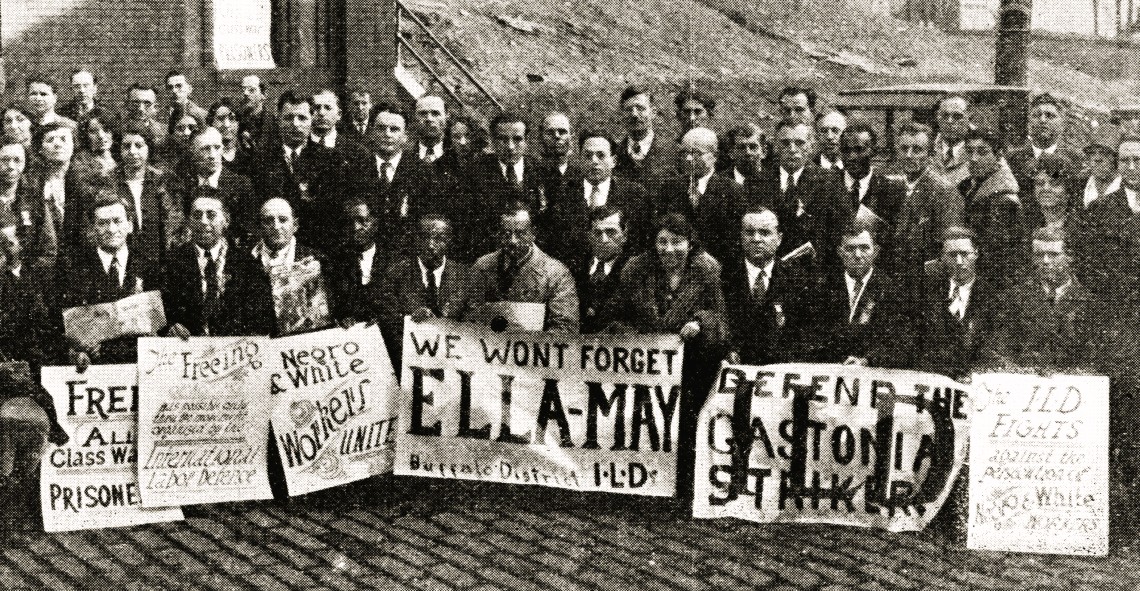
Far more than just collecting money for prisoners, the International Labor Defense was a genuine mass organization with tens of thousands of members and a range of activities. Then National Secretary explains the work of an I.L.D. branch.
‘Defense Branch at Work’ by A. Jakira from Labor Defender. 4 No. 11. November, 1929.
THE functions of the branches of the International Labor Defense are very important and manifold. It is impossible to lay down iron bound rules for the conduct of branch meetings or for the carrying on of defense work. The branches are continually being supplied with instructions and directions from the National and District Offices. These instructions should be followed by all branches as effectively as possible under the local conditions. The branch it-elf, however, should develop initiative and work out plans on how to meet the local problems. The suggestions given here may be of help to the branches, and should be used as guide.
1. The secretary opens the meeting and calls for the nomination and election of a chairman. He submits a proposed order of business prepared previously either by himself or by the branch executive committee. The members of the branch, of course, have a right to change or amend this proposed order of business if the majority so desires.
2. After the election of the chairman and the adoption of the order of business the secretary reads the communications or the most important parts of these. All points requiring action should be taken up immediately after the communication is read or should be added to the order of business to be taken up at a later hour.
3. A few minutes should be spent on a roll call, paying of dues and the acceptance of new members. Special attention should be paid to those members who are inactive and fail to at- tend branch meetings. These members should be visited or written to and urged to take active part in the branch activities. The branch should discuss this question from time to time and decide upon the methods to be used.
4. The question of the Labor Defender should be taken up and ways and means found for increasing its circulation.
5. Each branch should pay close attention to the local cases, local strike situations and be ready to give any assistance that may be necessary. A list of sympathizers and friends who would be ready to put up bail when necessary should be compiled. Where City Central Committees exist this should be centralized on a citywide scale.
6. The branch should give serious consideration to all campaigns and demonstrations carried on by the district or national organization and should help make them a success.
7. On many occasions it is necessary and advisable to form united fronts with other workers’ organizations for joint action. Such was the case, for instance, in the Sacco-Vanzetti campaign, such is the case at present in the Gastonia Defense campaign. Such united fronts, in order to be effective, should, as a rule, be formed not with the leaders, but with the large masses of workers of the various organizations or of the shops, factories, mines and mills. The branches (or the City Central Committees, where such exist) should work out their own plans. These plans should always be in line with the general policies and instructions of the National or District Offices.
8. The I.L.D. branch must always find ways and means to reach the broad masses of workers with its propaganda. The branch should compile a list of organizations and have members visit them in order to enlist their support for defense work. The question of carrying on campaigns in the shops, factories, mines, mills or lumber camps must be given special consideration by the branch–thru factory gate meetings, thru distribution of literature, thru indoor mass meetings in sections where the factories are located, etc.
9. From time to time the International Labor Defense arranges tag days, or house-to-house canvassing. The branch should in all such instances discuss the matter thoroughly and work out plans to make the tag days or house-to-house collections a success.
These house-to-house canvassing and tag days must not be limited to collection of funds only, but always be accompanied by the proper agitation, propaganda and organization work. The members participating in such tag days or house-to-house collections must be supplied with the necessary leaflets or literature, with application blanks, Labor Defenders, etc.
10. From time-to-time special affairs are arranged for defense-dances, showing of films, picnics, banquets, tea parties, bazaars etc. Such affairs should be thoroughly discussed and properly organized.
11. The question of recruiting new members must always be given consideration–how to get new members, how to get organizations to affiliate as a body, how to form new branches in places or shops where no I.L.D. branch exists.
12. Educational work is another question of importance. Each branch must carry on some educational work. Much time could be spared for this work at the regular branch meeting if the routine work is attended to by the branch executive committee. Special educational meetings should also be held, to which friends and sympathizers should be invited. Speakers or lecturers should be secured from the city or district office. If this is impossible one of the members of the branch should be assigned to lead the discussion on a certain question.
There are plenty of questions to be discussed. For example take the Gastonia trial a discussion should be carried on about the real issues involved, why the textile workers strike, the role of the capitalist government in the strike, how the workers can best protect themselves against capitalist justice, the fascist methods used by the bosses. The construction and aims of the International Labor Defense should be discussed, so that every member will realize why he or she should take active part in defense work. The question of the white terror in other countries should be discussed and compared with the white terror in the United States, the need for solidarity of the workers internationally.
13. Each branch should make an effort to undertake the responsibility of raising five dollars per month towards the Prisoners Pledge Fund to be sent to the National Office. Out of this fund the National Office sends five dollars to each political prisoner and twenty dollars per month to their dependents.
From the above it is clear that the I.L.D. activities are numerous, and that the I.L.D. is not merely a “collection agency,” but a real fighting organization, an important weapon and shield of the workers.
Labor Defender was published monthly from 1926 until 1937 by the International Labor Defense (ILD), a Workers Party of America, and later Communist Party-led, non-partisan defense organization founded by James Cannon and William Haywood while in Moscow, 1925 to support prisoners of the class war, victims of racism and imperialism, and the struggle against fascism. It included, poetry, letters from prisoners, and was heavily illustrated with photos, images, and cartoons. Labor Defender was the central organ of the Scottsboro and Sacco and Vanzetti defense campaigns. Editors included T. J. O’ Flaherty, Max Shactman, Karl Reeve, J. Louis Engdahl, William L. Patterson, Sasha Small, and Sender Garlin.
PDF of issue: https://www.marxists.org/history/usa/pubs/labordefender/1929/v04n11-nov-1929-LD.pdf
 Revolution's Newsstand