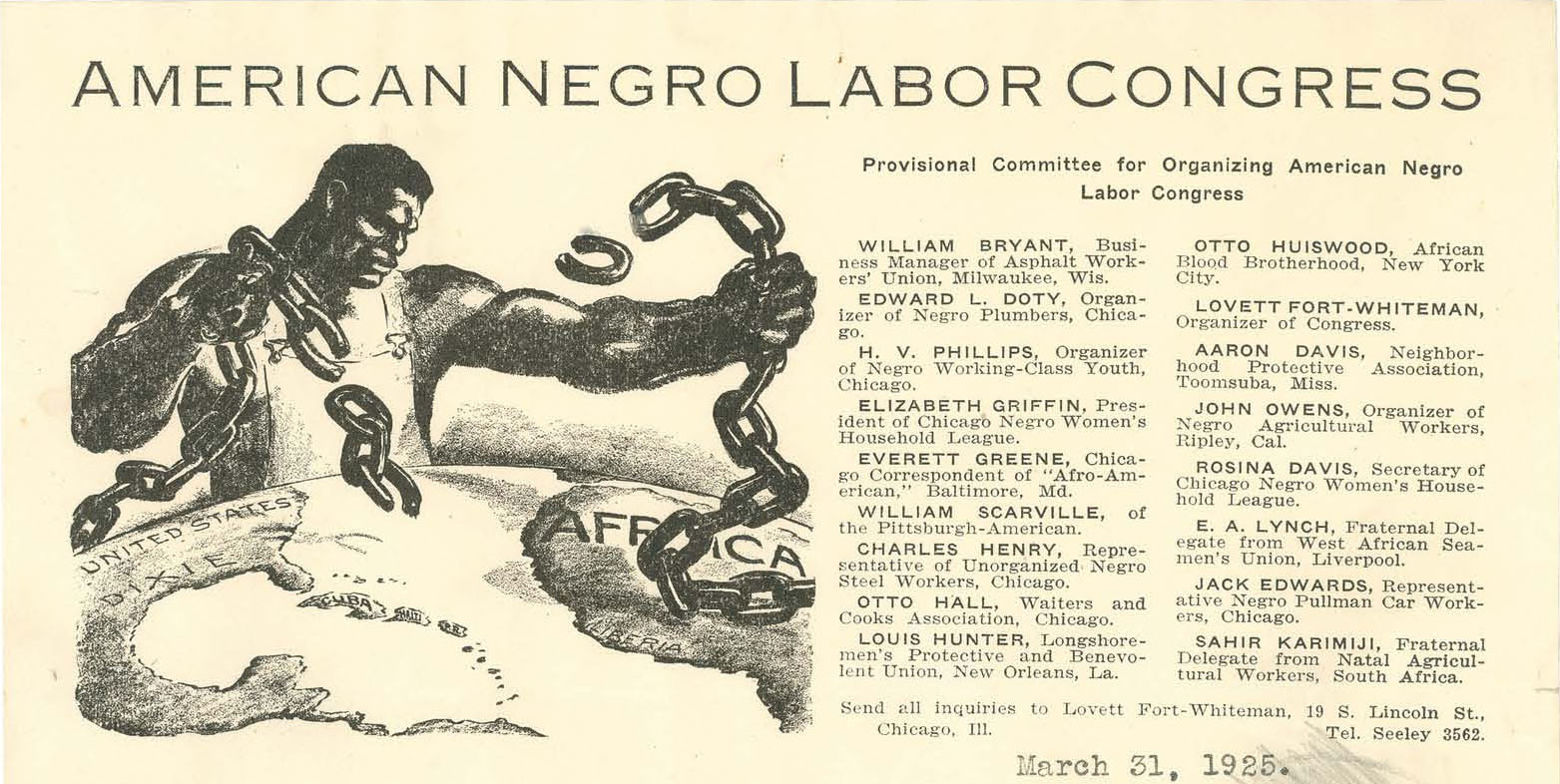
Full reports on the final day of Chicago’s historic national founding meeting of the A.N.L.C. as the conference lays the basis for future work with resolutions on Carrying Out of Tasks; International Solidarity; Company Unions; Militarism and Young Negroes; The Fight Against the Ku Klux Klan; Negro Children and Child Labor; Negro Housing; Against Imperialist Domination; and Marcus Garvey. Finally full a perspectives and tasks on The Unions, Negro Labor, and the A.F. of L.
‘Day Six of the American Negro Labor Congress Lays Basis for Future Work Negro Labor’ from The Daily Worker. Vol. 2 No. 249. November 1, 1925.
AMERICAN NEGRO LABOR CONGRESS OUT TO ORGANIZE
A.N.L.C. Lays Basis for Future Work Negro Labor
The first American Congress has closed its sessions with the adoption of a permanent plan of organization, which is to carry out the plans for work laid down by the delegates during the past week.
In spite of the attacks of William Green, head of the American Federation of Labor, and other reactionary labor heads, in spite of the slander of the whole capitalist press, in spite of the conspiracy of silence on the part of most of the Negro papers, this congress has attracted the attention of colored workers and farmers all over the United States.
It has passed resolutions analyzing the relations of the colored workers with the white workers, the relations of the colored races with one another, the influence of imperialist policies on the Negroes in various parts of the world.
It has pointed out the path that must be followed if the Negro is to gain admission to the trade unions, and, finally, it has shown that it is the present system, with its policy of dividing the workers among themselves on the lines of racial and religious differences, that is the real cause of the virtual enslavement of the darker races.
To Carry Out Plans.
But the American Negro Labor Congress has now laid down a plan for future work, so that the organization may become more and more influential among the Negro masses, and so that the it may take steps to carry out plans which it has discussed.
The constitution adopted at this first national convention of the American Negro Labor Congress declares that “the purpose of this organization shall be: To unify and strengthen the efforts of all organizations of Negro workers and farmers, as well as organizations composed of both Negro and white workers and farmers, and sympathetic organizations, and also individuals, for the protection from discrimination, persecution and exploitation, of the Negro race and the working people generally. And, with this aim, it is especially our purpose. to bring the Negro working people into the trade unions and the general labor movement with the white workers, and to remove all bars and discriminations against Negroes and other races in the trade unions so that all races may have complete equality in the labor movement. And further it shall be our purpose to aid the general liberation of the darker races and the working people thruout all countries.”
International Solidarity.
That the congress is looking forward to work of a worldwide scope is shown in a passage in the constitution which gives the executive council (the “majority of whom must be composed of working people”) the power “to call or to join with any other appropriate organization in issuing a joint call for world congresses of such a kind as would in its opinion serve the interests of the Negro masses. It shall have authority to negotiate and to make friendly arrangements for co-operation with other Negro organizations of economic or political character, but not with any organization or persons antagonistic to the Negro race or to the working people as a whole, nor shall any negotiation or arrangement or co-operation be made with any political organization of any person for political purposes, except with a political organization of the working class or farming class.”
In another passage, the congress expresses its attitude of friendliness towards other organizations working in good faith for the interests of the Negro race: “The American Negro Labor Congress is not a rival organization as against any other existing organization wishing to serve the Negro people, nor a rival to any labor organization. On the contrary, the congress wishes to give co-operation and brotherly help to all bona fide organizations having the interest of our people at heart. The congress invites the affiliation of all such organizations. Especially the American Negro Labor Congress will not be a rival to any trade union or labor union, but will do all in its power to build up and strengthen all bona fide organizations of the working people.
“Our attitude toward any bona fide labor union is–we want our people to join it; we want our people to strength it; if any labor union excludes persons of our color we demand that it shall let them in for the mutual benefit; if it will not let our people in, we will encourage the formation of unions of our people, not as rival unions, but as unions demanding to be joined together with the former union in a single organization for all races without discrimination. We favor that all labor unions shall affiliate with the American Federation of Labor wherever this is reasonably practicable and create a larger unity of labor. Otherwise that is, where the general labor organization in a given field is not affiliated to the American Federation of Labor–such independent union will receive our support, although influence will be used in general to bring all labor organizations into the American Federation of Labor.”
Attitude on Company Unions.
The attitude of the congress is stated as follows: “In all cases where the word ‘union’ is used, it is understood and specified that the many existing so-called company unions (organized or controlled by employers), are not considered as unions. However, any minority within such a ‘company union’ may, upon organizing as a minority and declaring its purpose to attain the quality of a real labor union, be entitled to representation in the local council and also to the national congresses.”
The congress has provided for a number of local bodies, to be composed of Negro labor unions, mixed labor unions not having any rules or customs discriminating against Negroes, groups of Negro industrial workers organized for the purpose of obtaining admission into existing unions, organizations of Negro agricultural workers, delegates elected by groups of three or more Negro workers (or mixed Negro and white workers) who work together in a workshop, factory or farm.
For Inter-Racial Committee. Plans for the formation of inter-racial committees to unify the workers of all races and show the similarity of interest between them are laid down in the constitution. The congress charges the local councils with the duty of negotiating with trade unions and race organizations, “in the endeavor to establish in each locality an inter-racial labor committee to be formed of delegates from Negro workers’ organizations and white workers’ Organizations. These inter-racial labor committees are to have the purpose of organized co-operation of the working people of both races to establish between them harmony, understanding, and good will; to bring all Negro workers into the trade unions on equal footing, with equal conditions, equal pay, equal rights to all kinds of employment, so that there will be no more conflicts between the working people of the two races, but that all can strive together to improve their condition.”
The character of the national committee elected to direct the work of the congress during the coming year is in keeping with the working class character of the organization. The small committee of nine includes Roy Mahoney and William Scarville, both workers in steel mills; C.W. Fulp, a miner and head of a miners’ union; Edward L. Doty, a plumber; Douglas, a street sweeper and C. Bills, a member of the Longshoremen’s Union. The other members are Bertha Lomax, the head of the students’ organization of Howard University, H.V. Phillips and Lovett Fort-Whiteman.
The following excerpts are from a resolution presented by the Young Workers League delegate, Corienne Robinson, to the congress as the demands of the young Negro workers in America:
Militarism and Young Negroes.
“The militarists of the country, at the same time that they discriminate against the Negroes in the army, bend all efforts towards using the masses of young Negroes as a reserve for their struggle against the labor movement of the country. Special colored units of the national guards are built and sometimes only colored troops are used by the government for strikebreaking purposes. Experiences in France during the war, when Negro troops were used as cannon fodder in the most dangerous situations and treatment received by Negro troops on returning to the United States, as in the Houston riots, have helped to convince many young Negroes that they have no place to serve in any of the militaristic adventures of the white bosses.
“Especially, today when American militarism is being developed for the purpose of maintaining the American empire, young Negroes have no place participating in such an organization which will be used to keep their colored brothers in the colonies in oppression.
“The firm stand taken against compulsory training in the schools by the students at Howard University is a fine example of the position that our race should take towards militarism, which is the armed force of the U.S. imperialists by which they maintain their rule over the colonies and which is used to keep down the workers at home.
The Ku Klux Klan.
“…thru the state legislature and the schools, the ku klux klan carries on a campaign to control the educational policies of the public schools and to force a certain kind of compulsory religious education upon all students. Thru this control of the educational apparatus, the klan hopes to instill its religious and racial prejudices into the minds of the youngest children.”
Negro Children and Child Labor
The resolution made the following demands:
“Equal pay for equal work for young Negro workers and other workers.
“A minimum wage.
“Complete abolition of child labor.
“A six-hour day and a five-day week for workers under 18.
“No discrimination against young Negroes in the schools. No segregation. Equal educational opportunities for Negro and white children.
“Against the use of Negro troops in strikes or imperialist expeditions. Against segregation in the army.
“Abolition of corporal punishment of young Negro workers on the farms, plantations, and in the mills.
“For admission of young Negroes into unions at lower initiation fees. “A week-end rest of 44 hours for all young workers.”
Negro Housing.
In a resolution from which the following excerpts are taken, adopted by the American Negro Labor Congress, the congress declares itself opposed to all forms of race segregation and calls upon all Negro workers to fight all attempts made to segregate the Negro:
“The American Negro Labor Congress declares, itself unalterably opposed to the segregation of our people in separate residence districts. We declare the discrimination against Negroes in regard to which part of the city they may live in and which part they may not live in, is a political question and must be dealt with just as we deal with discrimination in voting. The time has come when the living accommodations of the public cannot be left to the private control of a few wealthy parasites who decide where the colored man live and where he may not live, or whether he can have a house to live in at all.”
The following resolution was adopted encouraging the struggle of the Haitians in their fight against imperialist invasions:
Against Imperialist Domination.
“The peoples of Haiti, San Domingo the Virgin Islands, Hawaiian Islands Porto Rico and the Philippines, are now by violence and oppression being denied their right of self-determination by the United States government; therefore
“Be It Resolved, That the American Negro Labor Congress sends its fraternal greetings and encouragement to the peoples of the insular possessions of the United States who are struggling for their independence; and that we endorse their brave fight and promise them all possible aid; and
“Be It Further Resolved, That any permanent directing body that may be chosen by this congress stands instructed to enter into communications and to establish relations with all representatives of those struggling peoples so as to make our help to them a vital reality, and to invite them all to send their delegates to our next congress.”
The Friday evening mass meeting which wound up the series of mass meetings the American Negro Labor Congress has been holding, sent the following cablegram to Abd-el-Krim, congratulating him in his fight against French imperialism and calling upon Krim to attend the world race congress to be held in the near future:
“American Negroes greet you as hero commending your gallant struggle. Invite you to attend world Negro congress next year–American Negro Labor Congress.”
In another telegram the congress called upon the Senegalese troops, now fighting on the side of French imperialism to join the Riffians to achieve their independence. The cablegram appears in full:
“To the Senegalese Negro Troops in the French Army in Africa:
“American Negroes appeal to all our brothers in Africa to refuse to fight against the heroic people of the Riff, but to join with Abd-el-Krim to free African soil from imperialist invaders.”
The congress also sends the following cablegram to the Chinese strikers in Shanghai:
“We greet you as brothers fighting for a common cause and urge you to drive imperialists from your soil.”
The congress is also sending a protest to President Coolidge in behalf of the members of the 24th Infantry who are at present in Leavenworth prison for their participation in the Houston race riots, when Negro soldiers showed their resentment to the criminal assault of a white policeman on a Negro woman. In the following protest the congress demands that the president of the United States immediately release these imprisoned Negroes as honorable and heroic men.
“President Calvin Coolidge,
“Washington, D.C.
“Delegates assembled in first annual convention of the American Negro Labor Congress voted today unanimously to protest against continued imprisonment of former members of the 24th Infantry now confined in Leavenworth penitentiary. The imprisonment and summary and unfair hanging of members of the 24th Infantry represent a shameful stain upon the history of this country. The trouble arose out of effort to protect a woman of our race from cruel assault by a white policeman and these Negro soldiers should have been honored for, their motive and courage. The colored soldiers were absolutely blameless for bloodshed which resulted from attack by white mob. All thinking Negroes demand that the remaining prisoners be immediately released as honorable and heroic men and not merely pardoned as criminals receiving leniency.”
The congress also sent the imprisoned soldiers the following telegram telling of the action taken by the congress in protesting to President Coolidge against their imprisonment:
“American Negro Labor Congress in session here by unanimous vote protests against your imprisonment. We have sent a telegram to President Coolidge to this effect. The imprisonment of members of your regiment and the summary and unfair and brutal execution of others represents a shameful stain upon the history of this country. The trouble arose out of your effort to protect a woman of our race from cruel assault by a white policeman and we honor you for your motives and your courage. We hold you absolutely blameless for the blood that was spilled as a result of the actions of the mob which attacked you. Therefore you are entitled not to leniency as pardoned criminals, but to immediate honorable release as heroic and innocent men.”
The gathering also sent a telegram to Marcus Garvey, imprisoned leader of the Universal Negro Improvement Association:
“American Negro Labor Congress opening here today sends its deepest sympathy for your, sufferings in prison. Your imprisonment is an act of persecution and an attack against all of our people. We demand your unconditional and immediate release and urge you fight against deportation from this country only by a united action of all organizations of Negro people and farmers can such persecution be brought to an end.”
LABOR CONGRESS URGES NEGROES TO JOIN UNION
Denounce Use of Race as Strikebreakers
The American Negro Labor Congress which closed Its sessions Saturday, Oct. 31, at the Metropolitan Community Center, 3118 Giles Ave., in one of its last sessions passed a resolution urging the American Negro workers to join the American Federation of Labor wherever possible. Where the unions maintain color bars that bar the Negro worker from the union, the Negro is urged to form unions of Negro workers and then attempt to join the American Federation of Labor.
In the following resolution adapted by the congress, the use of the Negro as a scab is condemned and the congress promises to fight any attempt to use the Negro as a strikebreaker to break the strikes of other workers:
The Negro and Organized Labor
“The Negro workers, who constitute one-seventh of the workers of America, are today an important factor which must be incorporated within the organized labor movement if a genuine and successful effort is to be made to maintain and improve the standards of the worker, black and white. The world war, the migration of the people from the farms to the cities, the industrialization of the South, and the stoppage of European immigration, have established the Negro workers as an indispensable and powerful labor force.
“In order to improve the conditions of the Negro workers and to insure the standards of the white workers also, it is absolutely necessary that the workers of both races be organized in the trade union movement.
Trade unions are the organizations which are created by the workers to prosecute their fight against the employers for higher wages, better conditions and a proper standard of living.
“Only by the effective organization of the Negro and white workers in the unions is it possible to avoid union competition and remitting between these workers which will result In their common degradation. This was clearly demonstrated by the great steel strike of 1919 which was defeated because the steel barons could draw upon the vast army of unorganized Negro workers pitting them against the whites to the great injury of both.
“This perilous situation demands that white and black workers must be united solidly in the union and demonstrates that trade unions which fail to effect the unity of all workers, regardless of race, sex, nationality, religion of color on the sole basis of their common interests as workers, fail in the most necessary task for the protection and advancement of the workers.
“The unions, therefore, should neither exclude Negroes or wait until they are out on the picket line to start the necessary work of uniting them but should begin at once to conduct a thorogoing, efficient nationwide drive to organize the colored workers. They must forever break with the vicious and suicidal policy followed by many white unions In the past and still persisted in by some of the most highly skilled labor aristocrats who bar the Negro workers either by open clauses in their constitutions or by secret understandings and must throw the doors of the union wide open to the Negro workers welcoming them upon a basis of full equality.
Remove All Bars.
“The American Negro Labor Congress calls for the immediate removal of all bars and discrimination within the unions and demands equality of treatment in wages, opportunity for employment and representation in union administration and instructs its members to fight energetically to effect this in all unions.
“This congress condemns all scabs, Negroes who improperly recruit strikebreakers, and whites who disment [sic]. It resents the branding of Negroes as strikebreakers and points to the fact that where Negroes have been fairly treated they have made as loyal and aggressive union men as any other group of workers.
“This congress further condemns all efforts from whatever source to segregate the Negro workers in separate unions and demands that all such discrimination be abolished immediately.
“Any divisions in the trade unions and all dual or secession movements will be firmly opposed by this congress, but It declares that the Negro workers must organise their own unions to protect themselves and to fight their way into the unions as equals.
“The American Negro Labor Congress hereby instructs its officers and members to unite with all progressive bodies in the American Federation of Labor to eradicate the various evils of race discrimination in the unions and to achieve that unity of black and white workers which alone can insure their elevation and emancipation is absolutely necessary.”
The Daily Worker began in 1924 and was published in New York City by the Communist Party US and its predecessor organizations. Among the most long-lasting and important left publications in US history, it had a circulation of 35,000 at its peak. The Daily Worker came from The Ohio Socialist, published by the Left Wing-dominated Socialist Party of Ohio in Cleveland from 1917 to November 1919, when it became became The Toiler, paper of the Communist Labor Party. In December 1921 the above-ground Workers Party of America merged the Toiler with the paper Workers Council to found The Worker, which became The Daily Worker beginning January 13, 1924.
PDF of full issue: https://www.marxists.org/history/usa/pubs/dailyworker/1925/1925-ny/v02b-n250-NYE-nov-01-1925-DW-LOC.pdf
 Revolution's Newsstand