‘The Democratic Front Moves Forward in New York’ by I. Amter from The Communist. Vol. 17 No. 10. October, 1938.
An Editorial Introduction:
When did much of the U.S. left, including Communists, begin to tie their fate ideologically and organizationally to Liberalism and its parties? Among the detriments of those long ties are that workers now overwhelmingly identify the ‘left’ with liberalism, with the present crisis in consciousness and organization a clear manifestation.
For Marxists, liberalism, back to 1848 and before, has always been an enemy ideology; a capitalist world-view, one lying entirely outside of, and opposed to, the interests of workers and to the Socialist program.
Even in the Great Betrayal of First World War, where Socialist Parties voted for war and made common cause with their imperialist bourgeoisie, they never made programmatic alliances with them, or folded their parties into bourgeois ones, but rather continued to claim themselves independent parties of the working class, for better and for worse.
Twenty years later, after the failure of the German workers movement to prevent the Nazis, the European Popular Fronts formed as part of the Soviets diplomatic campaign to ally with the ‘Democracies’ to stem the fascist tide of the mid-thirties. As part of that effort Communist Parties–formed in opposition to the 1914 Betrayals–created those very alliances that the Socialists had even in 1914 refused. France and Spain being the most important. Both ended in fascism.
In the U.S., having no mass parties of labor or the left, a true 1930s ‘Popular Front’ was never a real possibility. Communist attempts at creating a Farmer-Labor Party (note, not a Workers Party or even a Labor-Farmer Party) were a series of failures, and in response to Roosevelt’s landslide election in 1936, the Communist Party determined there was little room outside the Democratic Party for ‘progressive action.’
What now was required was a ‘Democratic Front’ which would include the ‘certain liberal sections of bourgeoisie’, part of building an international alliance with the ‘Democracies’ as the only possibility ‘bulwark against rising fascism’ and subsequent vital defense of the U.S.S.R.
The Popular and Democratic Fronts coincided with the Moscow Trials, and saw both ‘Right’ and ‘Left’ Communist oppositions, including many in the leftward moving Socialist Party, denounce it as a new betrayal on par with that of 1914; complete with executions of its revolutionary opponents and another world-cataclysmic war as a result.
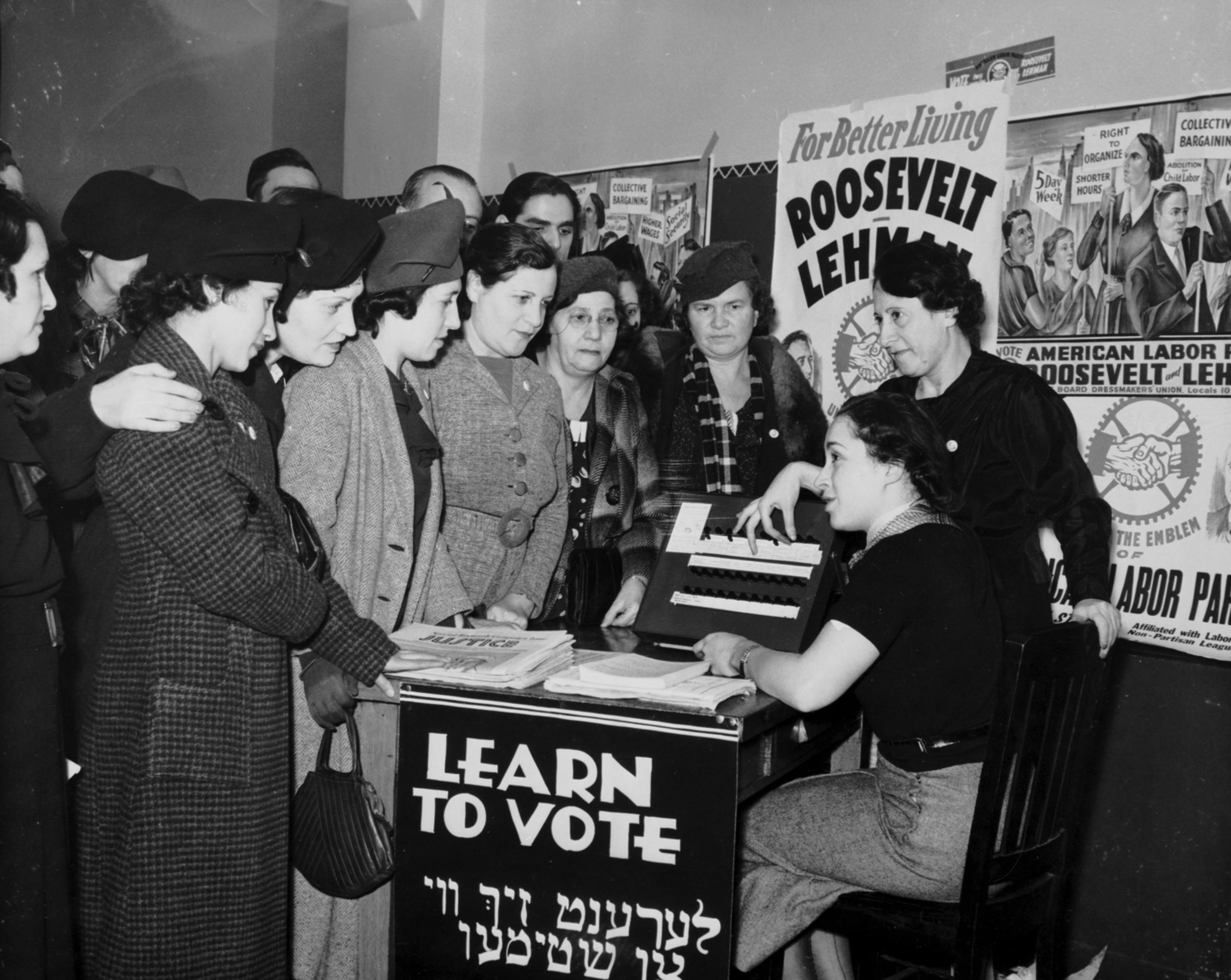
In New York City, the C.P. would soon unite with the right-wing Old Guard Socialists who recently split with the S.P. (who also were highly critical from the left of the A.L.P.), and many of the city’s A.F.L. unions, (again, not yet even the C.I.O.) to create the ‘American Labor Party’ largely centered in New York City. Playing a role similar to that state’s Working Families Party today, by placing Democratic candidates on A.L.P. ballot lines it acted as an adjunct to the New York Democratic Party.
The A.L.P were key supporters for New York mayor Fiorello La Guardia’s (a ‘Social-Fascist’ just a few years before) 1937 re-election, and Democrats in 1938s Congressional elections. An example of the theoretical retreat accompanied by the Democratic Front–from June, 1936, until the German-Soviet Pact in August, 1939, the word ‘Imperialism’ did not feature in a single title from any article in the Communist Party’s theoretical magazine. Previously, the world was ubiquitous.
In August, 1939 the the Democratic Front hit a snag with German-Soviet Pact. The C.P. rechristened Roosevelt a reactionary imperialist, joining the Henry Ford sin a ‘Keep the U.S. of of War’ campaign. All changed utterly the 1941 Nazi invasion of Russia when the C.P. gave full, uncritical support to the U.S. war effort in the Second World War as part of the vital effort to defend to Soviet Union from the fascist onslaught.
Never abandoning a strategic orientation to the Democrats since the failure of Wallace’s 1948 campaign, the official C.P. has remained firmly whetted to the liberal alliance to this day, in a vulgarized Popular Front where it even supported Hillary Clinton over Bernie Sander in that party’s primaries. Of course, this is hardly the only reason for much of the ‘Left’s’ self-identification with liberalism, and certainly not for its popular identification. However, it played a profound role in historically shaping the dynamic, particularly within the left.
Here, New York C.P. District Organizer gives a succinct reasoning behind the American Labor Party project, denounces its detractors, and gives many valuable details on how it organized and operated.
RN
‘The Democratic Front Moves Forward in New York’ by I. Amter from The Communist. Vol. 17 No. 10. October, 1938.
THE building of the democratic front in the state of New York for the 1938 elections shows a sharp realignment of forces. Following the elections of 1936 and the launching of the American Labor Party as an independent force, and the development of the election struggle in 1937, the building of the democratic front of all progressive forces against the reactionaries has moved ahead very rapidly.
As Comrade Browder declared in his report at the Tenth National Convention of the Communist Party:
“Of central importance is the deepening struggle of progressives against reactionaries within the Democratic Party…Nor is the Republican Party one reactionary mass, as might be concluded if one judged only by its representation in Congress…An outstanding example of this is New York City, where a section of the Republicans and the Communists were united with the American Labor Party behind the reelection of LaGuardia.” (Earl Browder, The Democratic Front. Workers Library Publishers, New York.)
Tammany Hall received a smashing defeat in the municipal elections of 1937. Yet Tammany Hall was not destroyed, since it retained an army of nearly goo,o00 voters behind the reactionary candidate of the Democratic Party, Mahoney. But several things have happened since 1937—not only the defeat of the Tammany machine and the election of a progressive municipal government headed by Mayor LaGuardia, but the continual exposures of Tammany graft and corruption, now culminating in the trial of James J. Hines, Tammany chief, and involving former District Attorney Wm. C. Dodge, Magistrates Hulon Capshaw, Francis J. Erwin and others.
REALIGNMENTS ACCELERATED
Within the Democratic Party realignments are taking place in New York, just as they are throughout the country. The clear call of President Roosevelt for rallying the progressive forces within the Democratic as well as the Republican Party for the support of a liberal policy has had its effect in New York. The aim, therefore, of all progressives in the coming Congressional elections is to remove from public office reactionaries both in the Democratic and Republican Parties.
New York City is a stronghold of the Democrats. In upstate New York, that is outside of the five boroughs, the Republicans hold sway, except in certain localities. Thus, in the Albany capital district the reactionary O’Connell Democratic machine has even tighter control than, and is just as corrupt and vicious as the Tammany machine in New York. The aim of the progressives is to remove from public office such reactionaries as the Democratic Congressman, John J. O’Connor, Chairman of the House Rules Committee; and Hamilton Fish, James W. Wadsworth, Robert L. Bacon, John Taber, Republican Congressmen from New York. Within the state, the vicious Red-baiter, State Senator John J. McNaboe, faces the opposition of all progressives, and the most serious efforts are being made to defeat him.
On the other hand, the election of an outstanding progressive, Vito Marcantonio to the U.S. Congress, is accepted as the task of all progressives in the Congressional District. Returning Marcantonio to the U.S. Congress will be a clear confirmation of. the democratic front line involving all political groups and nationalities within a Congressional district. Within the same district, the progressives, with the American Labor Party as the center, are uniting for the reelection of Oscar Garcia Rivera, Puerto Rican Assemblyman from Lower Harlem. The unity of the progressive forces around these two outstanding figures in a hotly contested campaign represents the broadest democratic front line yet attained in our state for the defeat of the reactionaries.
ECONOMIC DIFFICULTIES INCREASING
The election campaign takes place at a time of serious difficulties within the economic crisis. The State Unemployment Insurance Department reported a short time ago that 1,699,000 persons had applied for unemployment insurance. Considering that domestic and agricultural workers do not come within the scope of unemployment insurance, the number of unemployed must be estimated as far higher. During the month of July there was a general increase of 1 per cent in employment throughout the state and 2 per cent in the payroll. However, in New York City there was a 2 per cent drop in employment and only .01 per cent increase in wages, whereas in the highly industrialized Schenectady-Troy-Albany district there was a 6.6 per cent drop in employment and an 8.5 per cent reduction in payroll. These two adverse situations no doubt were somewhat counteracted by the harvesting season. In general it can be stated that employment in the state in the month of July was, according to official reports, 72.2 per cent, as compared to 1925-27, and payroll figures only 64.9 per cent.
REACTIONARIES UNITING
Who will be the state candidates of the Democratic, the Republican, and the American Labor Parties? At this stage we can only conjecture; but upon the appearance of this article the primaries will have taken place (September 20) and the conventions of the three parties will have ended. Thomas E. Dewey, District Attorney, who prosecuted James J. Hines, is the prospective Republican candidate for Governor, whose forensic abilities and link-up with the progressive LaGuardia administration are being utilized by the Republican Party to cover up its reactionary policy, program and leadership.
The unity of reactionary forces is to be noted in the proposal of Hamilton Fish that Al Smith be nominated by the Republican Party for U.S. Senator to replace the deceased Senator Copeland. Fish has further proposed that the Republicans run no candidate against the reactionary Tammanyite O’Connor. It is now proposed by the reactionary Republicans that Lehman be endorsed for short term U.S. Senatorship. In addition, the Republican Party, which has aspirations io capture the Presidency in 1940, not only looks upon the possibility of Dewey’s being elected as Governor of the state, but 2lso proposes the fascist minded Congressman Bruce Barton for the US. Senate, as another potential presidential candidate.
The very fact that the reactionary forces within the Republican Party feel a close kinship to the reactionary Democrats and are rapidly moving along the open path of uniting forces against the progressives confirms the above-cited statements of Comrade Browder. The call of President Roosevelt for the realignment of all liberal forces against the reactionary camp, cutting across parties, is a further confirmation.
It must not be assumed that the reactionary Republicans Democrats will campaign on an open reactionary platform. They are too clever for that. They realize that this would mean sure defeat. The reactionaries will stand on a demagogically “liberal” program, hoping in this way to mislead the voters and get their support.
The Democratic Party, on the other hand, faces this dilemma. Wishing to meet the desire of President Roosevelt that Senator Wagner be returned 19 the U.S. Senate as an outstanding liberal and progressive, it has at present only two other candidates who are often mentioned for governorship, namely, Governor Lehman, who has several times refused to stand for a third term, and Congressman Mead of Buffalo, who has an excellent progressive record. Although other names are being mentioned within the Democratic ranks, these are the outstanding possibilities.
It is clear that the American Labor Party, lining up generally with the New Deal, will follow the practical line of supporting New Deal candidates but will not support another Democrat unworthy of the name, namely Attorney-General Bennett, who is a reactionary. The American Labor Party has also made it clear that it will demand of the New Deal forces that among the five state candidates there shall be a representative of the A.L.P. At this time of writing the situation remains unclear. The forces, however, are moving definitely into two camps—all progressives on the one hand, and all reactionaries on the other.
THE STRUGGLES DEEPENING IN OLD PARTIES
This situation has developed not without serious deep-going struggles in both the Democratic and Republican Parties. The Republican Party has its George U. Harvey, Borough President of Queens, but at the same time it has its County Chairmen Simpson and Crews, who, in the main, are moving in the direction of a coalition of all progressive forces. The result has been a very serious struggle within the Republican Party with regard to the coalition policy agreed upon with the A.L.P. for candidates for the State Assembly and State Senate. In the Democratic Party there are reactionary elements fighting for control of the party. The Hines issue may be the breaking point for Tammany and the whole Democratic Party in the city and state of New York.
AMERICAN LABOR PARTY INDEPENDENT LINE CARRIES OUT
The A.L.P. has carried out a skillful tactical line. In the campaign of 1937 it united with progressives of all shadeswho were willing to fight against Tammany reaction. This successful coalition brought together people of all political affiliations determined to defeat the reactionaries. However, in preparation for the 1938 elections, the A.L.P. faced a difficult situation. Those in control of the Democratic Party refused to make any concessions to the A.L.P., despite the fact that on a statewide scale, the A.L.P. had polled about 500,000 votes in 1937. The Democratic leaders seemed to be of the opinion that it had the A.L.P. vote in their pocket.
Thereupon the leaders of the A.L.P. announced an independent slate. This acted as a thunderbolt both within the Republican and the Democratic ranks. The slate did not include the name of Governor Lehman for U.S. Senator. The A.L.P. correctly declared that Lehman was mainly responsible for the defeat of Roosevelt’s Judiciary Reform measure by making a public statement against it on the eve of the vote in the Senate. Governor Lehman also gave the tactical line to the reactionaries in the State Legislature by declaring in his message to the 1938 session of the Legislature that all the social needs of the state had been realized in the Legislature of 1937. The reactionaries.
The result of this declaration was that very few progressive measures were passed, such as the ratification of the Child Labor Amendment, and that the reactionary, Red-baiting McNaboe Committee was set up.
This position of the A.L.P. leaders created a struggle inside that party’s ranks. The A.L.P. nominated Sidney Hillman, president of the Amalgamated Clothing Workers Union, for U.S. Senator in place of Lehman. David Dubinsky, president of the International Ladies Garment Workers Union, issued a statement declaring his support of Lehman and pronouncing him a friend of labor. Abe Cahan, rabid, Red-baiting editor of the Jewish Daily Forward, attacked the leaders of the A.L.P., accusing Hillman of fraternizing with the Communists. Cahan was repudiated by the Board of Directors of the Jewish Daily Forward as a result of resolutions adopted by the Joint Executive Board of the Amalgamated Clothing Workers Union.
A.L.P. LEADERS SHOW REAL GENERALSHIP
The A.L.P. then entered into negotiations with the Republican Party in New York City for a coalition in support of A.L.P. and Republican candidates in various assembly and state Senatorial districts. This created consternation in the ranks of the Democratic Party. But it also indicated the independent line and role of the A.L.P. in building a broad coalition of all progressive forces, but dependent upon no other organization. This forced the Democratic leaders clearly to understand that the A.L.P. is a force that has to be dealt with and cannot be considered as an appendage to the Democratic Party.
While supporting Republicans for the lower offices, the leaders of the A.L.P. made it clear that their general line for candidates for the U. S. House and Senate and for the gubernatorial slate would be that of the New Deal Democrats. The A.L.P. proceeded to endorse such New Deal Democratic incumbents as Congressmen Sirovich, Cullen, Dickstein, Celler, all of New York City; Kelly of Rochester, and Beiter and Mead of Buffalo. Who the gubernatorial candidates of the A.L.P. will be, it is not possible at this writing to state. Nevertheless, it can and must be stated that the A.L.P. faces excellent prospects in the coming election and has established itself as a force to be reckoned with not only in New York City, but throughout the state.
SOCIALISTS, LOVESTONEITES AND TROTSKYITES ATTACK DEMOCRATIC FRONT LINE
The leaders of the A.L.P. have been accused by the Socialists (Old Guard and Thomas), Lovestoneites and Trotskyites of selling out the workers and the A.L.P. These people accuse the A.L.P. of creating merely another third party. They are opposed to the democratic front and both inside and frequently outside the A.L.P. carry on an open struggle against the correct democratic front line of the leaders of the A.L.P. However, Alex Rose, Executive Secretary of the A.L.P., recently issued figures indicating that the A.L.P. has nominated 16 A.L.P. candidates for Congress, 15 for the State Senate, 34 for the State Assembly. Of these candidates, one for Congress, four for the State Senate, and 12 for the State Assembly have been endorsed by the Republican Party. The A.L.P. on the other hand, has endorsed one Republican for Congress, three for the State Senate, and 13 for the State Assembly. The A.L.P. has also endorsed six Democrats for Congress, one for the State Senate, and three for the State Assembly. This makes a total of 82 Labor Party candidates nominated by the A.L.P., and 10 Democrats and 17. Republicans endorsed by the A.L.P. This, out of a total of 109 candidates involved in the elections in New York City alone.
Therefore, the indignant howlers against the correct democratic line that the foremost leaders of the A.L.P. advocate and fight for, are misrepresenting the line of the A.L.P. and doing everything possible to weaken the growing prestige, influence and strength of the A.L.P. They do this inside and outside of the A.L.P., acting as agents of reaction within the ranks of the A.L.P. In short, it may be said that the A.L.P., which in the last State Assembly was the balance of power, will in all probability have increased strength in the State Assembly, and will elect some members to the State Senate and probably one or more U.S. Congressmen.
It was to be foreseen that Democrats and Republicans would contest the A.L.P. nominations by running in the primaries of the A.L.P. At the same time Old Guard Socialists, dissatisfied with the candidates designated by the State Executive Committee of the A.L.P., are also running in the primaries. The Communist Party has already called for united support by all enrolled voters of the A.L.P. for the official designees of the A.L.P. There must be unity in the ranks of the A.L.P. to withstand the efforts of the reactionary parties and of sectarian and factional elements inside the A.L.P., both of whom are doing everything in their power to disrupt the A.L.P.
MORE DEMOCRACY NEEDED IN THE A.L.P.
It is true there are weaknesses in the set-up and procedure of the A.L.P. There is not sufficient democracy in the assembly district clubs. This is due not only to the general method of work, but also to the narrow, sectarian, cliquish methods of the Old Guard Socialists and their allies in the A.L.P., who try to restrict the membership of the A.L.P., instead of broadening out. But even this wall of resistance is being broken down through a correct attitude on the part of the A.L.P. leadership and the work of the progressives within the assembly district clubs. The work of the A.L.P., to too great an extent, is still restricted to the Italian and Jewish masses. As yet the organization has not attracted large number of native-American, Irish-American, Polish, German and other nationalities within the state, particularly in New York City. The A.L.P. has made as yet insufficient inroad among the rank and file of the A. F. of L. The leaders of the A. F. of L. try to brand Labor’s Non-Partisan League nationally and the A.L.P. in New York State as C.1.0. organizations. This is totally untrue, since there are quite a considerable number of A. F. of L. unions affiliated to the A.L.P. Nevertheless, the composition of the leadership of the A.L.P. in the counties and assembly districts is in too many instances quite narrow. We trust that at the coming county and state conventions of the A.L.P., more leading A. F. of L. people—Irish, German, Polish, Negro, Spanish-speaking and other elements–will be brought to the front.
MORE ATTENTION TO NEGROES AND FARMERS
A continuing weakness of the A.L.P. is its lack of a fundamental program for the Negro question, and for farmers and people in rural communities generally. It will be remembered that in the municipal elections of 1937 there was not a single plank in the platform of the A.L.P. in behalf of the Negroes. This should hardly have been expected of a progressive organization in New York. But now, particularly when, as in South Carolina and other parts of the South, the question of “white supremacy” is being raised in the sharpest manner since the days of the Civil War, the imperative need exists for all progressive groups and organizations to take a stand for equal rights for the Negroes.
Similarly as regards the farmers. Although it could not have been expected of the A.L.P., which is only two years old, that it could have made close contact with the farmers, nevertheless there are farmers and farm organizations in New York State which, long unde> the influence of the Republican Party, are today politically in a state of flux and can be reached with a correct program adopted by the A.L.P. Such questions as milk, taxation, flood control, soil erosion, debts and mortgages, high prices for manufactured products, etc., must be deal with. The attempt of Frank Gannett and other people and organizations of farmers to pit the farmers against the workers is evident also in New York State and must be dealt with.
THE SOCIALIST PARTY DWINDLING
The Socialist Party, which will this year conduct an independent campaign of “pure” socialism as the only solution for immediate problems, is in a ridiculous position. Several months ago the Socialist Party negotiated with the A.L.P. with the aim of affiliating with it by giving up the Socialist Party and joining as an educational group. The Socialist Party proposed that it be allowed to support only working class candidates nominated by the A.L.P. This demagogic and narrow proposal was rejected by the A.L.P. Thereupon the Socialist Party accepted an invitation of the Social-Democratic Federation (Old Guard Socialists) with the aim of unity. This unity evidently has not been achieved. Therefore the Socialist Party enters the election campaign with the aim of splitting away at least some thousands of progressives from the support of the candidates of the A.L.P. and the democratic front. Thus, the Socialist Party acts as a tool of the reactionaries, misleading its own members and some workers who still do not understand its splitting role of helping reaction in its effort to defeat the progressives. The prestige and influence of the Socialist Party are very low and the nomination of Norman Thomas for governor will not help very much to revive the party in New York. The healthy elements in the Socialist Party have already left its ranks, and its present tactics will only serve to drive out the few remaining people who do not wish to see the party used by the reactionaries to stem progress.
UNITY OF THE A. F. OF L. AND C.I.O. ESSENTIAL
Following the line of William Green and the Executive Council of the A. F. of L., who have endorsed the reactionaries Fish and Barton, the State Federation of Labor has attacked the A.L.P. as a “stooge” of the C.LO., warning and coercing the A. F. of L. rank and file affiliated to the A.L.P. to withdraw from it. The State Federation has not been very successful. Nevertheless, following upon the convention of the Allied Printing Trades and the Building Trades Unions in New York, the recent convention of the State Federation of Labor passed a resolution condemning the A.L.P. and declaring that it would support the old Gompers motto of “Reward your friends and punish your enemies.” This will in many instances lead to parallel action on the part of the A. F. of L. Non-Partisan Committee and the A.L.P.
Therefore it becomes the task of progressive A. F. of L. unionists to become active in the local A. F. of L. Non-Partisan Committees and to work for the endorsement, support, and election of the progressive candidates nominated by the A.L.P. and the democratic front. There is no question whatever that within the ranks of the A. F. of L. there is a real orientation toward the A.L.P. The sharpened relations between the A. F. of L. Executive Council and the leadership of the C.I.O. are being used to cause a cleft between the A. F. of L. and C.I.O. rank and file in New York state. Struggle between the two trade union organizations, such as has taken place in other parts of the country, has not been manifest to any degree in the state of New York. By careful, well-planned work, both in the A.L.P. and in the A. F. of L. Non-Partisan Committee, unity of action in the election campaign can be brought about. This will not only preserve the relatively good relations between the two organizations but will help bring about organic unity between the A. F. of L. and C.I.O.
CONSTITUTIONAL CONVENTION— CAMPAIGN ISSUE
One of the outstanding issues in the election campaign will be the amended State Constitution, which comes up for referendum on Election Day. The reactionary Democrats in New York City, allied with the reactionary Republicans upstate, have given us a new Constitution, many planks of which will be condemned by all progressives. It is necessary at this time only to mention the prohibition of proportional representation which was carried in New York City by a vote of nearly two to one and which formed the base for the election campaign of 1937. The results of the election have encouraged municipalities upstate, such as Yonkers and Schenectady, where a referendum on proportional representation is to take place this year. Tammany and the reactionary Republicans realize that they will not be able to hold control except through the old method of voting, which excludes all progressive minorities. The immediate aim, of course, is to remove the A.L.P. from the City Council and to prevent proportional representation from becoming a statewide method of election.
Similarly, the reactionary Republicans, who numerically controlled the Constitutional Convention, put across a reapportionment plan, which would automatically give control to the Republicans, even though granting a few extra seats in the State Assembly and Senate to New York City. These two planks are merely examples of the horse-trading that took place. The refusal of the Constitution Convention to give control of water power, particularly of the Great Lakes, to the state shows the forces that were in operation at the Constitutional Convention, namely, the utility interests. On the other hand, this being election year, some progressive proposals were placed in the new Constitution, such as a Labor Bill of Rights, health insurance, and housing. The Constitutional Convention therefore will become an outstanding issue in the election campaign, and it is to be hoped that the progressive forces throughout the city and state will unite for the acceptance or rejection of the various proposals that emanated from the Convention.
STAY-AWAY CAN DETERMINE ELECTION RESULTS
One of the intangible forces, but a very powerful one—not only in New York State, but throughout the country—must be brought into play. In New York State there are 1,800,000 eligible voters who either do not register and therefore cannot vote, or register and do not vote. The number of such stay-aways in New York City alone is 900,000. This is the largest group in the state. However, it has been found that in those Assembly Districts where the A.L.P. had a candidate and carried on a campaign, the proportion of stay-aways was far lower. This proves that there is a mass of discontented voters, not yet prepared to vote for the Communists but dissatisfied with the Republican and Democratic Parties. When, however, they are given a chance to vote for a progressive party and platform and for progressive candidates, they will be eager to cast their vote. The Communist Party is calling the attention of all progressives to this serious factor, which unquestionably is to be met with in all parts of the country.
FOR A POWERFUL COMMUNIST CAMPAIGN
Our Party will conduct its independent campaign. We have already nominated a full slate of candidates and have declared openly that we will withdraw candidates in favor of the candidates of the A.L.P. However, in those districts where the A.L.P. has no candidates and only reactionaries will stand for election, our Party will run its own candidate. The State Committee has outlined a very broad campaign of radio broadcasts, meetings, leaflets, folders, and election platforms, also in the most important languages. At the same time, our comrades are everywhere active in the assembly districts, unions, neighborhoods, and mass organizations, helping to build and strengthen the A.L.P. and getting support for its candidates. Our Party has declared openly, through Comrade Browder and through the resolutions of our national and state conventions, that our immediate aim is the rallying of all progressive forces for the defeat of reaction. Our interests do not lie apart from those of the progressives. We shall do everything in the coming election campaign, even more energetically than any other group, to rally the forces of progress against the reactionaries.
PROMOTING THE GROWTH OF THE “DAILY WORKER” AND THE PARTY
Our campaign will be conducted on the National Congressional Platform of our Party for jobs, security, democracy, and peace, as well as the state planks that have been affixed thereto. We will use the election campaign, not only for stimulating the growth and support of the A.L.P., but for building the circulation of our Daily Worker and Sunday Worker, which are playing a big part in placing the issues of the A.L.P. and progressives before the wide masses and will be a very powerful instrument for all the progressive forces during the election campaign. It must be noted that, although New York has a supposedly liberal press, there is only one daily paper which consistently supports and defends the New Deal, and that is the Daily Worker.
We will use the election campaign also for the strengthening of our Party and the Y.C.L. Wherever Communists are active, there progressive organization is built up. Seeing our Party members in action, uniting the forces of progress, building the A.L.P., we shall unquestionably be able to strengthen our own ranks by several thousand members.
This election campaign will be very bitter. The economic situation is not improving. Many a community is bankrupt. The unemployed in the localities face a bitter struggle. Attempts against the rights of trade union organizations are being made on all sides. The reactionaries mouthing progressive slogans—statements of John D.H. Hamilton, Chairman of the Republican Party, and Alfred Landon to the effect that they are not opposed to the New Deal but only to the method of its application, etc.—do not conceal the reactionary forces that are operating in both major political parties. The election campaign is bringing these issues sharply to the fore, as they have already done in the primary fights in other states. The progressive forces, on the other hand, are rapidly coalescing, and the struggle will come to a new showdown in the election campaign of this year.
Our Party is keyed up to an understanding of this situation and promises on the basis of correct organization of our forces and application of our united energies to conduct the best campaign we have done thus far. The forces of reaction are uniting. The forces of progress are on the march. The democratic front moves ahead. There must and will be a new victory for the army of the democratic front in New York this year.
PDF of full issue: https://www.marxists.org/history/usa/pubs/communist/v17n10-oct-1938-The-Communist-OCR.pdf
 Revolution's Newsstand