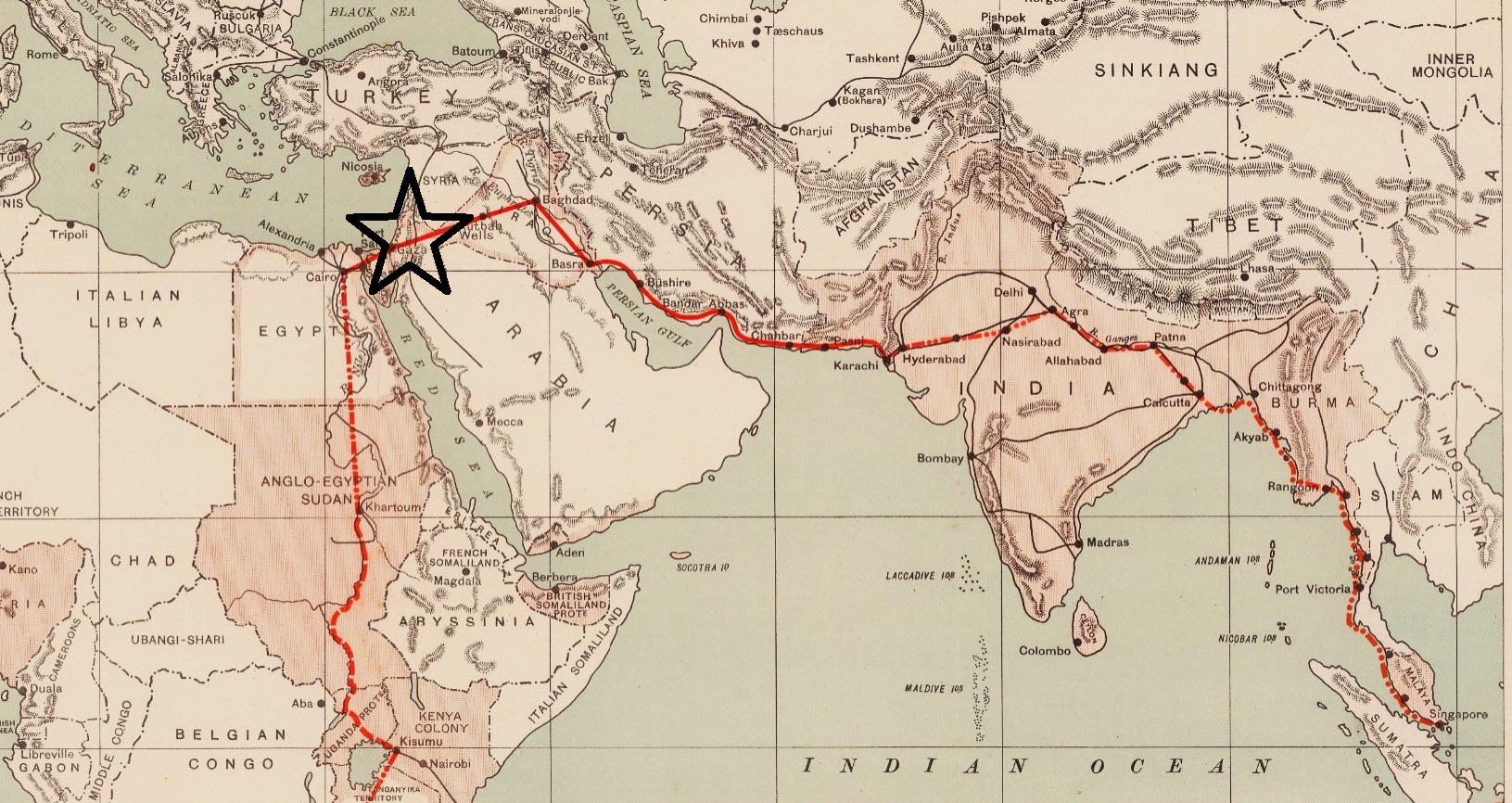
British imperialism’s foundational role in the 120-year-old crime in Palestine was comprehensive, conscious, and is ongoing. A Communist Party of Palestine comrade writing from Jerusalem gives an especially useful background, long- and short-term, to the social and political causes of 1929’s ‘Arab Revolt’. British imperialism’s sponsoring and protection of Zionist colonizing, and its intended dispossession of the inherently unreliable Arab Palestinian masses, sanctioned increasingly Zionist aggression in the mid-twenties. Leading, of course, to an Arab reaction, particularly among peasants and the urban poor. Britain’s ruling class and wretched nobility have not exactly been noted for their sympathy and protection of Jews over the centuries, including all the recent ones. Quite the contrary. Their ‘concern,’ aside from the messianic Bible-thumpers, has been based entirely on the strategic interest of the Empire. Not uncoincidentally, Palestine being a key to Britain’s control of the Eastern Mediterranean, the Suez and its trade, and Arabian Peninsula, staging ground for containing the Soviets, parcel of the long-term vision of an unbroken Empire stretching from Jaffa to Kuala Lumpur, all the while undermining their imperial rivals in the region. Any clues to the identity of ‘Alini’ would be much appreciated.
‘The Political Situation in Palestine’ by Alini from International Press Correspondence. Vol. 9 No. 50. September 13, 1929.
(Jerusalem). The policy of British imperialism in Palestine is determined by its policy in the Near East in general and by its policy in Arabia and Egypt in particular. It follows therefore that the national revolutionary movements of Palestine, Syria, Iraq, Transjordania, and also of Egypt are closely related. The political situation in Palestine is therefore under the direct influence the political factors and of the political situation of the countries mentioned.
The suppression of the Syrian insurrection in 1927, which coincided with the defeat of the Chinese revolution and with the defeat of the insurrectionary movement in Morocco, was the signal for an intensification of the aggressive policy of Anglo-French imperialism in the Near East and caused a reaction in the rational movements of Arabia and Egypt.
British imperialism, which fought against French influence in the Near East before and at the commencement of the Syrian insurrection, was frightened by the extent, the serious anti-imperialist character and the persistence of this insurrection most two years, and united temporarily with French imperialism and concluded a Treaty of Friendship with it. Anglo-French policy in the near East was coordinated upon the basis this agreement. A joint plan was worked out for the struggle against the national revolution and the communist movement.
Almost simultaneously (1928) the Parliaments in Egypt and Syria were dissolved by violence and British and French dictatorship respectively, were set up. British imperialism compelled the governments of Iraq and Transjordania to sign agreements which enslaved these countries and made King Feisal of Iraq and the Emir Abdullah of Transjordania with their Ministers marionettes to carry out the orders of their English “advisers” unreservedly. In order to subjugate the chief of the Wahabites Ibn Saud, British imperialism used intrigue and corruption in order to incite a number of Bedouin tribes to revolt against him. All this as well as intensified repression against the nationalists in general and against the communists in particular, were the characteristic phenomena of the co-ordinated Anglo-French aggressive activity in Egypt and Arabia.
After the defeat of the insurrection in Syria, the Arab national revolutionary movement capitulated. Only the chief of the Druses, Sultan Al Atrash refused to submit to the French and fled with the remnants of the insurgents into the desert. Even the Arabian Istahlal Party, which has supporters in all Arabian countries and which has a national revolutionary tradition, adopted a conciliatory attitude towards French imperialism. The capitulation affected also the Arabian national revolutionary movement in the other countries. The movement developed towards the Right and made its peace with the imperialists, that is to say, it became a national reformist movement. Only in Transjordania did the Arabian nationalists continue a desperate struggle (not with parliamentary methods) against the previously mentioned British agreement. The parliamentary elections were boycotted and street demonstrations against the British were carried out, etc.
The aggressive policy of British imperialism in Palestine following upon the suppression of the insurrection in Syria consisted in the promulgation of numerous laws and in the practical rule of British officials. In 1922 the British planned to hold parliamentary elections in Palestine within the frame-work of the British mandate. The Arabian nationalists, who were opposed to the British occupation of the country, boycotted unanimously the elections and thus spoiled the plans of the British. In 1928, following upon the 7th Arabian congress in Palestine, which openly confirmed the treachery of the rich landowners and the bourgeoisie towards the Arabian national revolutionary movement, the ruling classes, the same bourgeoisie, approached the British with the request that the latter should put their 1922 plan into action. This request was categorically rejected by the British authorities. Laws have been passed depriving the existing municipal administrations in the towns of their independence, robbing the toilers, and above all the ‘workers, of the franchise and giving unlimited powers to the British High Commissioner in Palestine and to the government. To-day the head of the town is no longer elected by the municipality, but appointed by the High Commissioner. The latter has also the right to deprive elected municipal councillors of their mandates. All the decisions of the municipal councils can be annulled by the High Commissioner or by the Governors. The budget is only valid after it has received the approval of the governors.
Only two months ago the governor of Haifa compelled the council there to recognise the British officials who had been rejected by the council. The protests of the council were ignored and it was compelled to submit. Despite unanimous resistance on the part of the population, the government of Palestine has concluded a customs agreement with Syria, which is calculated to prevent the development of the productive forces of the country. Laws have also been passed “settling” the agrarian question and introducing a register of assessment, which means, under the conditions obtaining in Palestine, the expropriation and the plundering of the Fellaheen (poor peasants). In the last year the repressive measures against the revolutionary workers in general and against the communists in particular, have taken on a mass character. More deportations took place than ever before. A barbarous regime has been introduced for the political prisoners, worse than ever before.
Apart from the general political causes which have led to the strengthening of the imperialist reaction, economic causes of a purely local character have had their effect in Palestine. Investigation into the possibility of an economic exploitation of the country were concluded at the end of 1927. The expansion of British colonial capital commenced in Palestine. Valuable minerals were discovered in the Dead Sea; the orange plantations proved profitable and a number of industrial undertakings existed (cement works, soap boiling works, power stations, etc.) to a limited degree. Through anonymous firms large-scale British capitalists under the leadership of Lord Melchett, Lord Reading, etc. bought up great areas of land suitable for orange plantations. At the same time they purchased the majority of the shares in a great cement works and in the soap boiling works in Haifa. They are also the chief shareholders in the society for the utilisation of the mineral resources of the Dead Sea and in the scheme for the electrification of Palestine, which runs officially under the name of an engineer named Ruthenberg. British colonial capital demands from the government of Palestine a policy of the strong hand in order that British capital may be able to occupy the dominating economic positions unhindered by the local population.
The means used by British imperialism in order to rule Palestine without any control on the part of the population. consisted not only of the incitement of national and religious passion and the incitement of the Arabs against the Jews, but also in the corruption of Arab notables in order to disrupt and demoralise the Arab national movement.
Even before the 7th Arabian Congress, the corrupt Arab notables like Issa al Issa (the editor of the newspaper “Falestine:), Nagiashibi (the mayor of Jerusalem) and others organized an opposition against the Arab Executive elected by the Arabian congress and demanded the abandonment of the anti-imperialist decisions, a reconciliation with the British authorities and a limitation to parliamentary means. Under the incitement of this opposition and under the impression of the defeat of the insurrection in Syria, the Arab landowners and the bourgeoisie betrayed the national-revolutionary movement.
The fact that the ruling classes succeeded so easy guiding the Arab national-revolutionary movement into a pro-imperialist policy, is to be explained by the lack of Arab mass organisations. There is no national-revolutionary political party in Palestine. The Arabian congress is elected by the landowners, the bourgeoisie, and in part by the intellectuals who have performed certain services. The weak national revolutionary wing, which is led by Hamdi al Hussein, who at present held in prison by the British, has only recently developed into a mass organisation of the youth and is now preparing the way for the formation of a left-wing national revolutionary political party.
The characteristic feature of the new national reformist policy of the Arabian Executive, is the abandonment of struggle against British imperialism. The Zionists, who were regarded by the Arabian nationalists before their 7th congress as an instrument of British imperialism and whom they fought against as such, are now regarded only as dangerous competitors standing in the way of a conciliatory policy toward British imperialism. The demands of the Arabian Executives are confined to the setting up of parliament and to the increase of the number of Arab officials, etc. Parallel with this policy, the Arabian Executive has intensified its struggle against national groups in general and against the Communist Party of Palestine in particular.
The national reformist change in the policy of the Arab movement was answered by the Zionists, who feared agreement between the Arabian Executive and the British, by a bitter struggle against the demand of the Arabs tor setting up of parliament and openly in favour of the maintenance of the present arbitrary regime of the British officials. Zionists succeeded in putting through a number of reforms in favour of Zionism: the exclusive right of unlimited immigration into Palestine for the Jews, the exclusive colonisation of the immigrants upon the State lands and the exempting of the immigrants from land taxes in the first years, national Jewish autonomy and democratic self-administration in the exclusively Jewish districts, increased admission of Jews into the police and gendarmerie, increase of the number of State officials of Jewish workers in the State undertakings, etc.
This policy of the Zionists was unreservedly supported by the reformist Zionist parties. The left-wing Poale Zion concealed its actual agreement with these Zionist demands by revolutionary phrases which cost nothing.
The political role of the reformists in Palestine is characterised by the following facts: In 1928, after the publication of the report of the British representative in the Mandate Commission of the League of Nations, which declared that were no insurrections in Palestine, the well-known reformist Beilinsohn wrote the following in the Palestine reformist newspaper “Davar”: “The British authorities must thank us Zionists and the reformists. A.) for peace in Palestine”.
Parallel with the intensifying reaction in Palestine, there a diametrically opposed process going on amongst the worst population. The growing exploitation of the workers an accompaniment of the capitalist development of the country, pauperisation of the peasants as the result of the expropriation of the land, and the capitalist development of agriculture (orange plantations), are the causes of the growing anger the workers and particularly of the peasants against the exploiters. Since the end of 1927, one agrarian conflict has followed the other. In this connection, the number of trials continually increased. We will limit ourselves to enumerating the most important conflicts: In Ain-Keven near Jerusalem in the villages of Arra and Karrara between the poor peas and the Arab rich peasants and rich landowners, in Wadi Havaras, between the Fellaheen and the Zionist organization, in Infiath between the Fellaheen and the rich Jewish colonists.
The number of strikes of the Arab workers is also growing. trike movement of the Arab workers is at present greater ever before. The most important strikes were: the strike e tobacco factory Mabruk in Haifa, the bakers, the building workers and the workers engaged in the building of the Rockefeller museum in Jerusalem, the strike in the quarries near Jerusalem, etc.
The agrarian conflicts, the growing strikes of the Arab workers and the commencing fraternisation of the Arab and Jewish workers (the frequently expressed wish of the Arab workers for a common organisation with their Jewish class comrades, the Jewish-Arab strikes and workers demonstrations of 1st August, prove the radicalisation of the working population in Palestine. The extent of this radicalisation must, however, not be overestimated. It shows the growth of the revolutionary movement, but has not yet reached the stage of a serious, class-conscious revolutionary offensive of the toilers Palestine against their enemies.
The Communist Party of Palestine is conducting a constant struggle against British imperialism and against its tools, the Zionist and Arab possessing classes. It rallies the Arab and Jewish workers and peasants under the slogans: the Evacuation of Palestine by the British troops, the independence Palestine and the other Arabian countries, a workers and Peasants government, the agrarian revolution, etc. The work of Communist Party is made extremely difficult by the illegality which it is compelled to work, and the persecutions on the of the British authorities and the Arab and Zionist reactionaries.
The British Labour Government is continuing the policy of its Conservative predecessors with a still greater imperialist consistency. During the whole time of its existence, it has brought about no political administrative and socio-economic changes in Palestine in order to mitigate the intolerable situation of the toilers. Under MacDonald’s Government the old barbaric regime has been maintained and the political persecutions have even been increased. Under MacDonald’s Government the exile and deportation of revolutionary workers and in particular of communists have taken on a still greater mass character than under the Conservative government (mass arrests and detentions in connection with the demonstrations on the 1st August). In conclusion, it must be said: The political situation Palestine before the insurrection was characterised by the aggressiveness of British imperialism, which supported itself upon Zionism and upon the reactionary attitude of the Arabian national reformist Executive, and by the radicalisation of the working masses of Palestine, and in particular of the Arab toilers, but this process had not advanced far enough to guarantee a victorious revolution in Palestine. This political situation explains the insurrection in Palestine and its character.
International Press Correspondence, widely known as”Inprecorr” was published by the Executive Committee of the Communist International (ECCI) regularly in German and English, occasionally in many other languages, beginning in 1921 and lasting in English until 1938. Inprecorr’s role was to supply translated articles to the English-speaking press of the International from the Comintern’s different sections, as well as news and statements from the ECCI. Many ‘Daily Worker’ and ‘Communist’ articles originated in Inprecorr, and it also published articles by American comrades for use in other countries. It was published at least weekly, and often thrice weekly. Inprecorr is an invaluable English-language source on the history of the Communist International and its sections.
PDF of issue: https://www.marxists.org/history/international/comintern/inprecor/1929/v09n50-sep-13-1929-inprecor.pdf
 Revolution's Newsstand