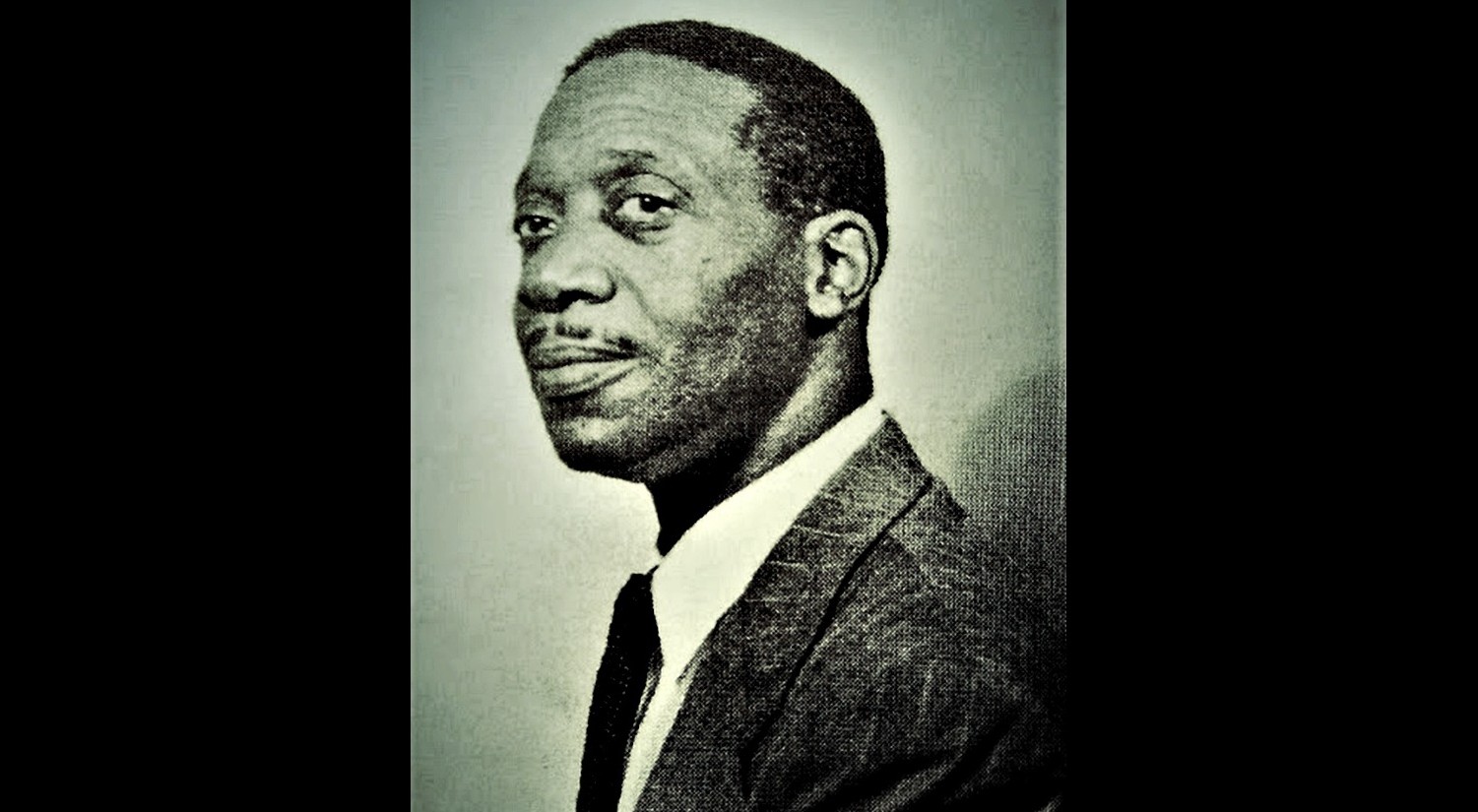
When Harry Haywood wrote this, he had recently returned to the United States from a five-year stay in the Soviet Union, studying at the Communist University of the Toilers of the East and the International Lenin School, as well as serving as a delegate to the Comintern’s Executive Committee. Rising to Politburo member of the C.P. when he came back and fully participating in the debates and struggles within it as a prominent ally of William Z. Foster. Haywood would become the General Secretary of the League of Struggle for Negro Rights and the leading Black intellectual of the Party in the 1930s.
‘The Crisis of the Jim-Crow Nationalism of the Negro Bourgeoisie’ by Harry Haywood from The Communist. Vol. 10 No. 4. April, 1931.
“Colored America needs nothing so much at this time as a Mahatma Gandhi. Gandhi argued that all the machinery of government in India is in the hands of the English and their native puppets. His people are neither in the possession of the implements of warfare nor are they trained in their use. They are without eco- nomic resource, illiterate and inexperienced. Therefore Gandhi argued that passive and non-violent resistance was the only effective weapon in India’s possession. He has won…. All India is following his lead, has eventually risen as one man and stopped cooperation, thus rendering impotent English government in India. The All Indian Congress has placed complete power in Gandhi to deal with England…Gandhi tells the story for colored America.”
Thus reads an editorial in the New York News and Harlem Home Journal, an influential Negro bourgeois paper.
It is not accidental that Negro reformism chooses as its ideal the arch betrayer of the Indian masses, Mahatma Gandhi. The reason for this monumental reverence of Gandhi is quite evident. The deepening crisis and rising temper of the Negro masses against the increasing yoke of oppression, make necessary greater demagogy on the part of the Negro bourgeoisie. Gandhi has developed to perfection this new type of demagogy. Gandhi has shown best how to fool the masses, how best to betray them under the condition of sharpening crisis and rising revolutionary movement.
This is why Gandhi, who has just sold out the Indian masses “for a mess of salt,” as has been aptly stated, has become the ideal of reformism in general, and of national reformism in particular. The strategy of the Indian bourgeoisie under the leadership of Gandhi, in betraying the revolutionary movement of the Indian masses, has become a pattern for study by all national reformists, especially at the present time when these latter, haunted by the spectre of revolutionary mass ferment, are deserting on all hands the national liberation movement for the camp of imperialism.
The same forces that compelled the Indian bourgeoisie under the leadership of Gandhi to embark upon the campaign of civil disobedience and salt tax boycott and which culminated in the dastardly desertion of the struggle of the Indian masses, are at work in the Negro liberation movement in the U.S. These forces are the gathering mass struggles of the Negro toilers against imperialism.
The crisis means a hundredfold intensification of the yoke of imperialist oppression upon the millions of Negro toilers in this country. It means a reducing of their already starvation level of existence to new low levels. In the South the masses of Negro tenant farmers, share croppers and farm laborers are being driven into further bondage and dependency by the slave driving landlords and usurers. Debt slavery and convict labor are increasing. Chain gangs lengthen. Disease and famine are rife. The Jim Crow districts in the cities, with their foul and pestilential housing conditions, inhuman congestion, exorbitant rents, are, under conditions of sharpening crisis, becoming virtual hell-holes of misery and poverty for the Negro toilers. The already poverty-stricken level of the Negro workers makes them the easiest victims of the vicious capitalist offensive of unemployment, wage cuts and speed-up.
A new and more cruel slavery is being prepared for the Negro masses. This is manifested in the fiendish terror of increased lynching orgies, increased Negro baiting activities of the KKK, the springing up of new terrorist organizations, with venomous Negro hating programs (Caucasion Crusaders, Black Shirts, etc.), the cold-blooded killings of Negro workers all over the country by uniformed police thugs, the driving out of entire Negro populations from towns.
The rapidly worsening conditions of the Negro masses, taking place under conditions of developing revolutionary labor movement, are rapidly creating the basis for a new rise in the Negro liberation movement. The harbingers of this development are already at hand, especially in the industrial centers, as witnessed in the growing militancy of the Negro workers, their active participation, with white workers, in strikes, street demonstrations, hunger marches, attacks upon storehouses and warehouses.
The first big movement of the Negro toilers took place during the period of post-war crisis, which resulted in ruinous consequences for the Negro masses—unemployment, riots and lynchings chiefly because of the immaturity of the Negro working class (large sections of which had recently migrated from the farms) and the weakness of the revolutionary labor movement. The leader- ship of this potential revolutionary movement was seized by the petty bourgeois intellectuals, who under the guidance of Marcus Garvey diverted the struggle into reactionary, utopian, back-to- Africa channels. But the present movement is developing under the sign of proletarian hegemony.

The further industrialization of the South, the migration of Negro peasants from the farms into the industrial centers of the North and South, has led to the strengthening of class differentiation among the Negro peoples.
The political awakening of the Negro workers is going on apace. The period since the post-war crisis has been marked by the emergence of a Negro proletariat upon the political arena as an independent class force. ‘The age-long isolation and particularism is being broken down in the crucible of sharpening class struggle. This development has been given added momentum by the present crisis and the growth of the revolutionary movement.
In this situation the Negro bourgeoisie finds that its leadership over the Negro masses is no longer undisputed. The growth and maturing of this “most important driving force” of the Negro liberation movement, the Negro working class, is a direct threat to the hegemony of the Negro bourgeoisie. It is clear that the latter cannot go on betraying the masses in the old way. It must find new methods, it must utilize more demagogy. In all the current writings and speeches of the foremost spokesmen of this group there is clearly evidenced a groping for these new methods. In the perusal of a number of articles written by such eminent Negro publicists as Du Bois and Kelly Miller, there is an open discussion of the “dilemma” or “crisis” and a seeking of a way out. The Negro bourgeoisie, as every other bourgeoisie, interprets its own class interests as the interests of the people as a whole. It is therefore quite clear that this “crisis of the Negro race” is in reality a crisis in Negro bourgeois nationalism which is being sorely tried by the growing militancy of the Negro masses.
The conditions of the Negro masses are worsening from day to day. They are clamoring for relief from their misery. They are demanding action on the question of their vital needs. This struggle of the Negro masses against starvation and against capitalist oppression, begins to break through the “pale” of enforced isolation and find its expression as part of the revolutionary labor movement. It is this that is the cause of the anxiety in the ranks of the Negro reformists. It is in this light that we must explain this new outburst of frenzied demagogy of the Negro bourgeoisie. The old methods of pacifying the masses are no longer effective in the present situation. New ways must be found to check the rising spirit of rebellion of the Negro masses against their deepening misery. New weapons of betrayal must be forged. Hence the adulation of the arch traitor, Gandhi. Hence the paeans of praise for this throttler of the revolutionary movement of the Indian masses, because it is Gandhi who is the embodiment of this new type. of demagogy.
The Negro bourgeoisie stands at the cross-roads. It must either place itself at the head of the growing movement of the Negro masses and carry out a semblance of struggle for the crying needs of these masses, or admit its complete bankruptcy. In other words it must master the teachings of the arch strategist of national reformism, Gandhi. It must “head in order to behead” that movement, in order to preserve the separation of the Negro masses under conditions of deepening crisis and developing revolutionary struggles. A glance at the present activities of the Negro bourgeoisie shows that their whole strategy is to narrow down the movement of the masses by placing before it limited objectives, to confine it to the Negro “ghettoes,” to prevent it from merging with the revolutionary labor movement.
Already at the beginning of the crisis, the Negro reformists began to intensify their demagogy among the Negro masses. Forced on by the growing militancy of the masses and the activities of revolutionary organization, the Negro bourgeoisie and their white “liberal” friends organized series of round table conferences to talk over the situation of how best to check the growing movement of the Negro toilers.
The main Negro reformist organizations on a national scale are the National Association for the Advancement of Colored People, and the National Urban League. The N.A.A.C.P. carries on activities on the political field, “fights” for reforms solely through legal channels. For example: It furnishes legal defense for outstanding cases of persecution of individual Negroes. In the case of lynchings its activities are almost solely confined to “investigations” and agitation for anti-lynch legislation.
The National Urban League, an organization noted for its strike- breaking activities, operates on the industrial field. Its program, according to the executive secretary, Eugene Kinckle Jones, is the “handling of the acute economic problems growing out of the presence of an increasing Negro population.”
The executive boards of both of these organizations include not only white liberals but also certain out and out imperialist elements. These organizations are financed by such representatives of American finance capital as John D. Rockefeller, Jr., and Julius Rosenwald. Also such imperialist agencies as the Stokeses and the Carnegie Foundation contribute to the support of these organizations.
The most acute question concerning the Negro workers at present is unemployment. The National Urban League has taken the leadership on this field with the support of all Negro reformist organizations, churches, Y.M.C.A.’s, fraternal organizations. Al- ready at the beginning of the crisis these organizations initiated so- called “emergency job finding campaigns.” Their program included (1) the organization of separate, Jim-Crow “relief” drives for the unemployed Negro workers; (2) the representation on all fake charity and relief committees, both on a local and national scale, as well as on so-called investigation and survey committees. For an example, the Wofter Committee appointed by the Rosenwald Fund (Chicago) upon agreement with President Hoover for an “economic” survey among Negroes. T. Arnold Hill, head of the Industrial Relations Department of the National Urban League, was recently appointed by Col. Woods, director of President Hoover’s “Employment” Committee as “liaison” officer between this committee and the Negro group. The program of the League also includes “making jobs” for unemployed intellectuals. In this connection it seeks to get prominent capitalists to invest capital in undertakings in the Negro districts and to have these enterprises staffed by Negroes. For example: the Dunbar Apartments and the Dunbar National Bank, John D. Rockefeller institutions in Harlem.
Hand in hand with these general activities an intensification of bourgeois separatist propaganda is being carried on. Everywhere the spokesmen of the Negro bourgeoisie are appealing for greater race loyalty, race cooperation, as the foreign born and the revolutionary labor movement is being intensified.
With the deepening of the crisis and the consequent increasing of the discontent of the masses, these activities are taking new forms. Within the last few months the Negro reformists have initiated boycott movements under the slogans of “Don’t trade where you cannot work,” “All jobs in the Negro districts for Negroes,” etc., etc. The agitation against the foreign-born and revolutionary labor movement which was already noted at the initial stages of the movement is now being put forward sharply. For in- stance, Oscar De Priest, millionaire congressman, is one of the staunchest supporters of the anti-foreign-born legislation proposed by the Fish Committee. In all mass meetings called by these fakers demagogic tirades are launched against the foreign-born and the revolutionary labor movement. The argument used is that the foreign-born workers are usurping the rightful places of the Negro workers in industry, and that the white revolutionary workers merely want the Negroes “to pull their chestnuts out of the fire.” The real reactionary essence under all of this demagogy and crass betrayal of the Negro masses is shown in the stand of De Priest on the United States Senate food “relief” bill. On this occasion De Priest rejected the bill, stating that “if we believe in states’ rights we should give the people of the states the right to take care of their own.”
The boycott movement was first started in Chicago a few months ago by the Negro reformists. It was supported in general by the white politicians who sought to utilize this movement for political capital. Agitation was particularly sharpened against the foreign- born; these pernicious activities finally resulted in a riot, in which Negro workers, egged on by the Negro reformists and their white capitalist friends, drove foreign-born workers from a construction job. This movement was temporarily stopped in Chicago chiefly due to the activities of the Communist Party. But recently it has again been revived, and this time threatens to assume national proportions.
In New York the movement is already on foot; for example, current issues of the Pittsburgh Courier, as well as local Negro bourgeois papers, carry lengthy articles calling for support of the “Don’t buy where you can’t work” movement. The movement in New York assumes broader aspects than previous movements in other cities. Here this movement is being inspired by such elements as Roscoe Conklin Bruce, Negro representative of John D. Rockefeller interests in Harlem, James Hubert of the National Urban League, James Stephens, Negro assemblyman in the New York legislature, and a number of white Tammany Hall politicians. These elements, through Stephens, have introduced a bill in the New York state legislature “against” discrimination against Negro workers by utility companies. The bill is proposed as an amendment to the civil rights law and will make it unlawful for utility companies to discriminate against Negroes on grounds of race or color. The bill, according to Stephens, “is an answer to the prayer of the Harlem Negroes to break into the employ of the New York Telephone Company, the New York Electric Light,” etc., etc.
However, even this fake gesture is negated by a stipulation that “under the provisions of the Stephens bill a Negro may seek employment of a public utility company, and may be turned down provided there is no work to be given.”
On this fake issue mass meetings are being called throughout the Negro districts; calls are being made for mass support of this bill. Hand in hand with this, at all meetings vicious attacks are being made against the foreign-born workers and the revolutionary labor movement.
The purpose of all of these pernicious activities of the Negro reformists and white capitalists is obviously to narrow down the developing mass movement of the Negro toilers against increased imperialist oppression, to isolate it from the general revolutionary movement, and to divert it into channels harmless for the imperialists.
In making “comparisons” between the Negro and Indian bourgeoisies it is necessary to keep in mind that the Negro bourgeoisie, unlike its Indian class brothers, has little or no connection with industry. Because of the terrific oppression of the Negro masses, the Negro bourgeoisie was late in forming. Even at the present time it consists in the main of a thin stratum of capitalist business people and intellectuals. The character of the oppression of Negroes in the Black Belt militated against the development of a Negro bourgeoisie in this district. Here the surplus labor of the Negro population was gobbled up by the white ruling classes. Therefore the only chance for the development was in the cities. Arriving on the scene only in the epoch of imperialism, at which time the chief means of production and transportation were already in the hands of imperialist monopolies, the Negro bourgeoisie could not get any foothold in industries. This explains its peculiar development as a class of insurance and real estate brokers, and bankers on a small scale, with their chief sphere of activities confined to the segregated districts of the cities.
Thus the October Resolution of the C. I. states that,
“Industrialization in the Black Belt is not, as is generally the case in colonies properly speaking, in contradiction with the ruling interests of the imperialist bourgeoisie, which has in its hand the monopoly of all the industry…”
Thus it is clear that the basic contradiction — the contradiction between the independent capitalist development of the country under the political domination of the national bourgeoisie and the monopolist colonial policy of imperialism—is lacking in the case of the Negro bourgeoisie. The market of the Negro business men and intellectuals is almost exclusively based upon the masses in the Jim Crow districts of the cities. ‘This almost complete dependence upon the Negro masses makes the Negro bourgeoisie interested in keeping these masses separated from the whites. It is interested in preserving the Black Belt in the cities. One of the prominent spokesmen of this group, writing in the St. Louis Argus (a Negro bourgeois paper) makes the following illuminating remarks in this connection.
“Such progress as Negro business has made has been due in a large measure to its segregated nature. Insurance is a case in point. Had there not been segregation in insurance, it is doubtful if Negro insurance could have survived. Behind almost all of the larger Negro fortunes is this same principle of segregation.”
Then under the sub-caption of “Thrive on Segregation,” the writer continues:
“The monumental fortune of the late Madam Walker and Mrs. Malone can be accounted for upon this principle of segregation. The wealth of our professionals comes under the same explanation. The Negro has achieved most wonderfully in those segregated fields in which he has a monopoly; he had a monopoly because of race prejudice…”
It is clear that this segregational interest of the Negro bourgeoisie coincides with the isolation policies of American imperialism, and lies at the basis of the collaboration activities of the Negro reformists with the latter.
These isolation tendencies of the Negro bourgeoisie are reflected in the Jim Crow nationalism of this group. Interpreting its own interests as the interests of the Negro people as a whole it attempts to rally the Negro masses in support of its class interests through slogans of “race loyalty,” “race solidarity,” etc., etc.
Thus the same writer quoted above says:
“Race loyalty offers the main source of hope. Those Negroes who hold that the Negro business man must measure up to the best white businessman before he need expect the Negroes’ patronage, are speaking beside the point; and what is more, they are asking the Negro to lift himself by his own boot straps…even our chain stores in a ‘cut-throat trade war’ would not survive unless Negroes supported them for racial reasons.”
On the other hand the Negro bourgeoisie is sensitive to national oppression of the Negroes which keeps the Negro masses at a poverty level and limits their buying power. This fact makes it interest- ed in raising the economic and cultural level of the Negro masses. Thus hand in hand with its slogans of “race loyalty,” etc., etc., it also puts forth the slogans of “social equality” (meaning by this equal opportunity), down with trade union bars, the purpose of which is to keep the Negroes in the lowest category of labor. In this interest, in raising the economic and cultural level of the masses, consists its link with the masses.
It seeks to reconcile the contradiction between its isolation interests and the interest of the masses by the following arguments: in order to secure equality, the Negroes must first gain the respect of the white people. This can only be done by the development of “race initiative.” The Negroes must become economically independent as a race. Hence they must support their own business and professional people.
The whole trend of this Jim Crow nationalism is towards building up a sort of segregated group economy among the Negro masses in the cities, with the Negro bourgeoisie as intermediaries between the Negro masses and the ruling imperialist bourgeoisie. It is clear that social equality in their sense means equal communities of Negro and white peoples living side by side in the cities, but separated. A sort of Jim Crow equality. The Negro bourgeoisie never questions the actual domination of the imperialist ruling class, but on the contrary servilely accepts the position of the latter as supreme exploiter. It has waived all rights to the Black Belt, it has become more or less reconciled to the limited atmosphere imposed on it by the imperialist bourgeoisie, and with the growth of the political consciousness of the Negro toilers, the segregational face of Negro bourgeois nationalism become more pronounced.
The two strategical lines in the liberation movement of the Negro masses are becoming more and more sharply defined with the development of that movement; the line of the Negro reformist which leads to betrayal of the revolutionary movement of the masses, and the line of revolutionary solution of the Negro question to be realized through a fighting alliance of the Negro masses and the revolutionary workers, Negro and white, under the leadership of the Communist Party.
The problem of petty bourgeois tendencies among Negroes will be further considered in some future issue.

There were a number of journals with this name in the history of the movement. This ‘The Communist’ was the main theoretical journal of the Communist Party from 1927 until 1944. Its origins lie with the folding of The Liberator, Soviet Russia Pictorial, and Labor Herald together into Workers Monthly as the new unified Communist Party’s official cultural and discussion magazine in November, 1924. Workers Monthly became The Communist in March ,1927 and was also published monthly. The Communist contains the most thorough archive of the Communist Party’s positions and thinking during its run. The New Masses became the main cultural vehicle for the CP and the Communist, though it began with with more vibrancy and discussion, became increasingly an organ of Comintern and CP program. Over its run the tagline went from “A Theoretical Magazine for the Discussion of Revolutionary Problems” to “A Magazine of the Theory and Practice of Marxism-Leninism” to “A Marxist Magazine Devoted to Advancement of Democratic Thought and Action.” The aesthetic of the journal also changed dramatically over its years. Editors included Earl Browder, Alex Bittelman, Max Bedacht, and Bertram D. Wolfe.
PDF of full issue: https://www.marxists.org/history/usa/pubs/communist/v10n04-apr-1931-communist.pdf
 Revolution's Newsstand