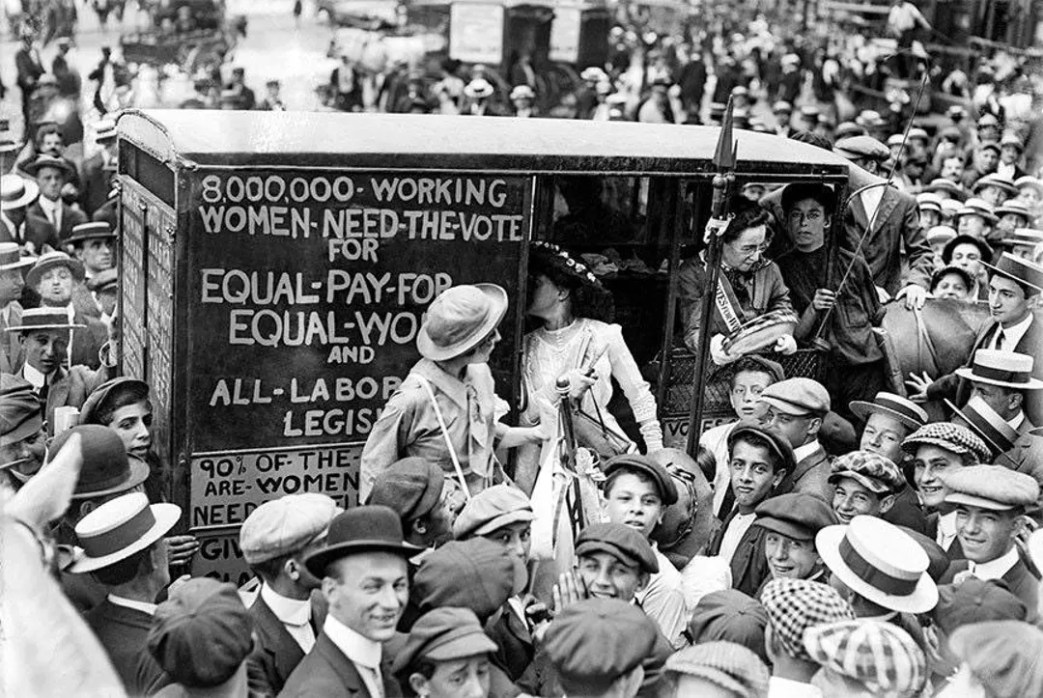
A working paper from the R.I.L.U.’s First International Women Workers Trade Union Conference on gender disparities in pay among workers. In 1930, women workers in the U.S. on aver made around 53 cents to the man’s dollar. A century later, the average is 85 cents.
‘Equal Pay for Women Workers’ from The Daily Worker. Vol. 7 Nos. 162 & 163. July 7 & 8, 1930.
The First International Women Workers’ Trade Union Conference brings together women worker delegates to the Fifth Congress of the Red International of Labor Unions for a struggle against capitalist: rationalization and betrayal by social fascists.
A LEADING task before the Red International of Labor Unions today is the mobilization of the broad masses of women workers in the front of the class struggle. The women workers, the most exploited and least organized section of the proletariat, are today playing an ever more important, and in some cases even predominant, role in industry in rapidly increasing numbers to replace more highly skilled and better paid men workers, and makes them the victims of a new and more intensive exploitation than ever before. Women workers and industries in which large numbers of women are employed are today the object of a rationalization drive of the capitalists.
Continuous wage-cuts, lengthening of hours and overtime, speeding up of machinery and heaping on of enormous additional tasks, the increase of machines to tend, the doubling and tripling of looms and spindles in the textile industry, the setting of ever higher standards of production, the speed-up of the traveling belt to a killing pace, these are the new devices of rationalization which are being introduced universally in all capitalist countries, especially in the period since the Fourth Congress of the R.I.L.U. and which fall with special severity upon the masses of women workers.
The world capitalist crisis and the growing mass unemployment is affecting women workers equally with men workers. Millions of women workers are unemployed in the capitalist countries and millions more are on short time, especially in the textile industry. The rapid intensification of capitalist rationalization and the growth of the capitalist crisis gives the struggles and demands of women workers a greater significance and importance than ever before in the general program of the labor moment.
The mobilization of the women workers in the common font of the class struggle for resistance to wage cuts and the speed-up, for the fight for better living and working conditions, the seven hour day and equal pay for equal work, for resistance to the reduction of social insurance, unemployment relief, maternity benefit and factory legislation, the drawing of women workers into the class front of international working class solidarity around the Soviet Union and against capitalist imperialism and colonial exploitation, these are the immediate tasks in the field of work among women which are being taken up by the Fifth Congress of the RILU, and especially by the First International Women Workers’ Trade Union Conference which will convene in connection with the Fifth Congress.
The Three-Fold Enemy.
The struggles of the women workers are directed against the three-fold enemy, capitalist imperialism and its allies, the social democracy and the trade union bureaucracy. The social fascists aid the employers and the capitalist state in every way in fastening the yoke upon the women workers and in the attempt to defeat their struggles.
At every point it is necessary to expose before the women workers the traitorous tactics of the trade union bureaucrats and the social democrats in parliament, to unmask the hypocritical, cowardly and demagogic tactics by which the social fascisti hope to delude the women masses and conceal their treason from them, and to organize the women workers for the most bitter struggle against them.
The record of the A.F. of L. and the Amsterdam International with regard to women workers is a black one–a long history of neglect and betrayal, which has culminated in the years since the world war in an open offensive against the women workers, which began with the demobilization after the world war and has reached its climax today in the fascist tactics in the factories and unions, the sabotage and obstruction of the struggle of women workers against capitalist rationalization, and the openly union-smashing activities of the social fascisti in present mass struggle in most of which great numbers of women are involved and are showing the greatest spirit and militancy.
The trade union bureaucrats use all possible methods in this work. Shop strikes against wage-cuts and speed-up are outlawed, which is easier because of the large number of unorganized among women workers. Mass strike movements in industries are obstructed and sabotaged and every effort made to defeat the workers through arbitration or compromise agreements, or to smash their resistance and break the strike with the aid of the army, police and fascisti of the employers and the capitalist-socialist coalition governments.
The bureaucrats invariably sell out the interests of the women workers, conclude most unfavorable agreements for them and try to drive them back to work with the aid of the police and gangsters. In the collective agreements, employers and union bureaucracy combine to give all women workers a position and wages below the least skilled men workers. This is done by including them as a separate category in the agreements as “women workers” or by making separate agreements for them, or simply by leaving them unorganized and entirely outside the collective agreements.
No attempt is made to organize the great unorganized masses of women workers, to set up special programs of demands for them or to lead and support their struggles. On the contrary all methods are used to defeat their struggles and break strikes in which they take part, by sabotage and obstruction of relief actions, by trying to break the solidarity of the workers, by playing off one section of workers against the other, skilled against unskilled, men against women.
Where women workers show militancy in of the group on a consistently class basis. Less landscapes and skyscrapers and more bread lines, strikes, etc…
The workers’ film movement in America must begin to outgrow the discussion stage. Enough has been said and written on this question. Its importance has long ago been formally recognized. The organization of an independent workers’ film movement in America is the next step. In this work the co-operation of every class-conscious worker is imperative the union activity or in strikes, the bureaucracy launches a campaign of persecution and expulsion which often results in driving them in masses out of the reformist unions, particularly where, as is the case to an ever increasing degree, the women workers show a particular inclination to follow the leadership and fighting slogans of the revolutionary opposition.
Women workers as the most unorganized section of the working class, entering struggles outside the control or against the fiat of the trade union bureaucracy, naturally find their leader in the revolutionary opposition and in the new revolutionary unions and come into direct conflict with the union bureaucracy as well as the employers and the capitalist state.
The union-smashing and strike-breaking activity of the trade union bureaucrats stands out especially in struggles and movements where larger masses of women workers are involved and where their interests are especially at stake.
The conflict of the women workers with the Triple Alliance of employers, capitalist-social-democratic governments and union bureaucracy appears in all the industrial struggles, large and small, of the recent period in the Passaic, New Bedford and Gastonia strikes and in the dressmakers’ and needle trades workers’ struggles in America, in the North Bohemian textile workers’ strike, the great Lodz strike in Poland, the strikes in Rouen, Darnetal, etc., in France, the Silesian textile workers’ struggle in Germany, the Rego Clothing Workers’ Strike in London, and in numerous smaller strikes and shop strikes against wage-cuts and rationalization in various industries, and at the present moment in the great woolen workers’ strike in England.
The social-fascists of the English unions and the Labor Government who succeeded with the employers in putting over a six and one half per cent wage-cut last year on a half million workers in the cotton industry, most, of them women, are being checked and defeated at the present moment in a similar attempt in the woolen industry. The Labor Government’s arbitration (MacMillan) award of a 10 per cent wage cut to the employed, and the union officials’ compromise of 5.8 per cent wage cut, have been met by the woolen workers, the majority of them women, with the most bitter resistance.
For the first time since the General Strike the British workers are putting up a magnificent fight against the combined efforts of the employers, union officials and Labor Government to drive them back to work with a wage cut. The traitorous role of the bureaucrats and the Labor Government is clear to the workers as never before; with open offers of compromise settlements by the union officials, with the arrests and police brutality, and the application of ancient union-smashing laws against picketing, the sabotage of relief by the union officials.
The preparations for the final sell-out are rapidly maturing, but the workers are standing solid in resistance, more than a hundred thousand strong, for a fight to the finish. In this great struggle women workers are playing a most important part both in the ranks of the strikers and in the leadership, and are fighting under the direction of the Minority Movement and the RILU against the traitors of Amsterdam and the Second International.
It is at the present period of capitalist crisis and rationalization that the betrayal of the women workers by the social-fascist trade union leaders appears in its most extreme and glaring form.
At a moment when the rapidly increasing participation of women workers in production and the class struggle, and their extreme exploitation as the special victims of capitalist rationalization calls for the most energetic and militant struggle against rationalization and its consequences for the women workers and for the organization of the broad unorganized working women masses, the A.F. of L. and the Amsterdam leadership is not only completely inactive in this field, but is working out a program, not of struggle, but of defeat and capitulation for the women workers. In cooperation with the socialist and “labor” coalition governments, trade union bureaucrats are aiding the capitalists in laying the chief burden of rationalization on the backs of the women workers and at the same time weakening their organization and undermining the small protection and security they receive under the social insurance and labor legislation of the capitalist states.
The union leaders, social-democrats and cabinets in all countries are busily engaged devising ways and means of reducing social insurance, health benefits, maternity benefits and unemployed relief, particularly in the case of the women workers, who, as the least ‘organized section of the workers, are the easiest object of attack in the capitalist-social-fascist campaign. And this at a moment when sickness and unemployment are increasing far faster among the women workers than among the men as a consequence of rationalization.
“Socialists” Aid Bosses.
It is in the field of unemployment insurance that the social-fascist bureaucrats are endeavoring to secure the greatest savings for the capitalists at the expense of the workers, and particularly the working women. In all capitalist countries a systematic raid is being conducted by the social-fascists upon the unemployment benefits of women workers. All sorts of disqualifications and discriminations are being introduced by legal decree or administrative process to deprive them of benefit, drive them off the registers of the labor exchanges and prevent them from getting further work.
At the same time to complete this drive against the women workers an energetic campaign is being conducted by the Amsterdam bureaucrats to place women’s work altogether in jeopardy, to question the right to work of women and especially of married women, to drive them out of the factories, and to make them the special victims of the mass discharges of the present period of capitalist crisis.
This attack upon the right to work of women workers has the further effect of weakening their hold on the job, and their status in the factory and the union, and consequently of crippling the women, workers in their efforts to organize and struggle against capitalist rationalization and the bosses’ offensive.
For the general lowering of the wage standard through the substitution of low paid women workers for higher paid men workers in the rationalized industries, the union bureaucrats seek to turn the responsibility not upon the capitalists for paying starvation wages to women workers.
They do not try to organize a struggle of men and women workers together for higher wages for both and equal pay for equal work, but rather they seek to throw the responsibility for the unemployment of the men workers upon the women workers, encourage a split in the ranks of the workers between the men and women, and try to turn the resentment of the men workers against the women workers instead of the capitalists.
The result of this policy is of course not to restore either work or higher wages to the men workers but to aid the employers in still further driving down the conditions of the women workers, who are thus not only left without organization but are deprived of union protection and support, and this undermines also the wages and conditions of the men workers.
This treasonable policy of protecting and aiding the employers and dividing and defeating the workers is the basis of the present drive of the Amsterdam leaders.
The social-fascist bureaucracy of the Amsterdam International will continue to do lip service to the slogan “equal pay for equal work” but in practice they have long deserted it, indeed never supported it, and never less than at the present time when the practice is everywhere and at all times “unequal pay for equal work.”
The gap between men’s and women’s wages is retained in all collective agreements negotiated by the bureaucracy. No demands are made for special raises for women workers to level up their wage standard to that of the men. On the contrary, wage demands, whether per cent increase or flat raise, result in maintaining the gap, and usually in increasing it, for smaller increases are usually demanded for women workers.
Equal Pay for Equal Work.
A general view of the wage standards provided in the collective agreements worked out by the union bureaucrats in Germany and England shows a wide and growing disparity between men’s and women’s wages. This policy is carried through by incorporating special clauses in the agreements unfavorable to the women workers or by concluding separate agreements without the support of the men workers. Or else, as is most often the case, the women workers are not organized at all or included in any agreement.
The responsibility for the great and growing disparity between men’s and women’s wages and for the terribly low and declining level of women’s wages rests squarely upon the social-fascists, social-democrats and trade union bureaucrats. Their tactics against the women workers in all fields are connected, and one aids in carrying through the others; sabotage and defeat of the organization and struggles of women workers, challenge of the right to work and unemployed relief, discrimination in social insurance, reduction of the wage level and co-operation with the wage cuts of the employers, and establishment of the principle of “unequal pay for unequal work.”
In fact the slogan of “Equal pay for equal work” seems to be applied by the bureaucrats rather in the negative sense to justify every inequality and discrimination in the wages of women workers on the basis that her productiveness or work is not equal to that of man’s. “Equal pay for equal work” and the “married women out of the factories!”, the slogan of the Belgian union bureaucrats, is typical of the attitude of the Amsterdam International.
Red Trade Unions Are Different.
The defense of the wages of women workers, of their right to work, the organization of their struggles against capitalist rationalization becomes thus the exclusive task of the red trade unions and the revolutionary oppositions. The Amsterdam International ever more cynically and openly deserts the women workers and at the moment of greatest need, of great and growing mass unemployment, wage-cuts and unheard-of exploitation leaves them at the disposal of the employers and tries to isolate them in the ranks of the working class by raising false issues between men and women workers, by neglecting the organization of women workers and leaving them altogether outside of the ranks of organized labor.
The Red International of Labor Unions, at this moment of crisis raises the banner of revolutionary struggle before the women workers and rallies great masses of toiling women in fierce class battles against the exploiters together with the men workers; organizes them in the revolutionary unions on the basis of a concrete program of immediate demands, the seven-hour day, equal pay for equal work, right to work of women and married women, special increases of wages for women workers against the wage-cuts of the employers to wipe out the gap between men’s and women’s wages, increase of social insurance, maternity aid, and labor protection for women workers.
The Second International and the Amsterdam International seek to divide the ranks of the workers, to weaken the class struggle and spread class collaboration through arbitration in economic conflicts and social-democratic coalition policies in politics and at the same time to aid the imperialists in preparing the next war and the attack on the Soviet Union, by sabotaging the international solidarity and organization of the workers and the propaganda of pacifism and the League of Nations, particularly among the women workers.
The Red International on the other hand is working with the greatest energy to weld more firmly the ties of international solidarity in the class struggle and to draw the great masses of unorganized and terribly exploited women workers into the general working class fight against capitalist rationalization and imperialism, to mobilize the working women masses for the most bitter and determined struggle against their enemies and betrayers, the social-fascists of the Second International and Amsterdam, to lead the women workers of all countries along the road that has brought the women workers of the Soviet Union freedom and a new life,–the path of the proletarian revolution.
These are the tasks before the Fifth Congress of the R.I.L.U. and the First International Women Workers Trade Union Conference.
The Daily Worker began in 1924 and was published in New York City by the Communist Party US and its predecessor organizations. Among the most long-lasting and important left publications in US history, it had a circulation of 35,000 at its peak. The Daily Worker came from The Ohio Socialist, published by the Left Wing-dominated Socialist Party of Ohio in Cleveland from 1917 to November 1919, when it became became The Toiler, paper of the Communist Labor Party. In December 1921 the above-ground Workers Party of America merged the Toiler with the paper Workers Council to found The Worker, which became The Daily Worker beginning January 13, 1924.
PDF of full issue: https://www.marxists.org/history/usa/pubs/dailyworker/1930/v07-n162-NY-jul-07-1930-DW-LOC.pdf
 Revolution's Newsstand