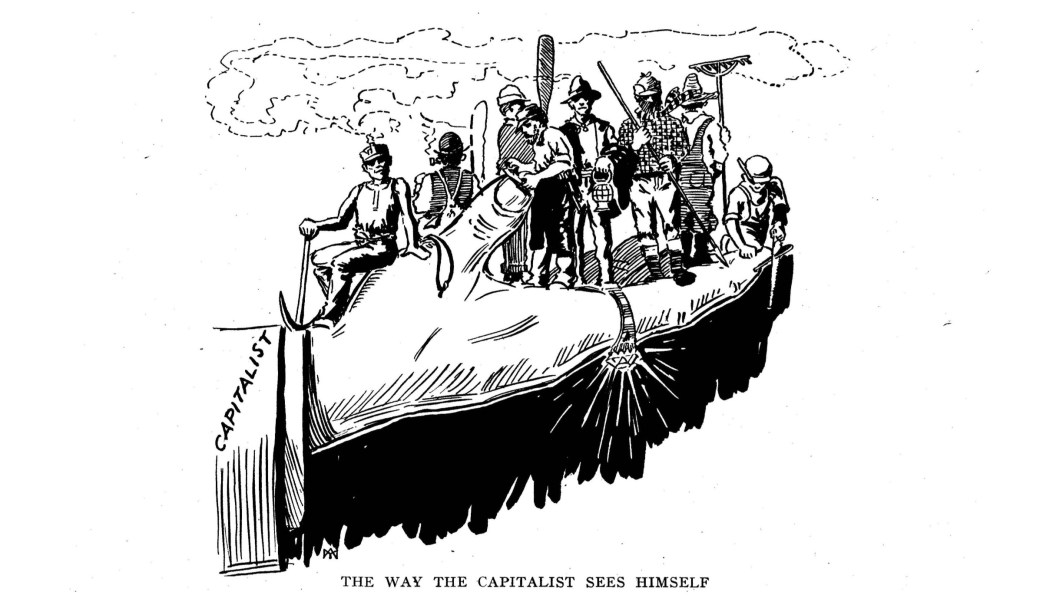
Writing as Jack Morton, Mary E. Marcy with a banger. Below, she inverts the subordinate, and inculcated, dependence of the working class to employers, the owners, in securing the means of life–a working class “acting of itself.” For Marxists like Marcy, on the contrary, it was the employer, the owner, who was entirely dependent on their employees for THEIR means of life, as well as the social power their stolen wealth exercised. For Marcy, a conscious working class, organized on that consciousness, becomes a transformed class; into a class “acting for itself.” Its role in capitalism now rejected and rebelled against, this now revolutionary working class struggles for emancipation, by which the working class becomes the ruling class, and sets about to end not only class rule, but class altogether.
‘At the Mercy of Their Employees’ by Jack Morton (Mary E. Marcy) from International Socialist Review. Vol. 17 No. 4. October, 1916.
UNTIL very recently when workingmen went out on strike, their employers have declared they “had nothing to arbitrate.” But when it became apparent that the railroad men had decided that arbitration always meant victory for the railroad companies and refused to arbitrate their demand for an eight-hour day, the very roads that had formerly insisted that “there was nothing to arbitrate” sent their bitter appeal broadcast over the land for “the principle of arbitration.” They declared that the loss of arbitration as a means of settling labor disputes and controversies meant that the railroad companies would hereafter be “at the mercy of their employes.”
The railroad companies do not realize that they and all other employers of labor are ALWAYS AT THE MERCY OF THEIR EMPLOYEES. Far from recognizing the fact that the capitalist class is merely the leaf upon the twig of the branch upon the limb of the social tree, they actually imagine that the capitalist class supports society as it is organized today.
There are many institutions for fostering this belief in the importance of the mine owners, the railroad stockholders, the mill and factory owners–in the social schemes today. Books, newspapers, periodicals propound this viewpoint.
Schools, colleges, churches regard the factory and mill owner, the railroad stock manipulator and banker as the Pillars of Society. They believe that private property is the foundation of society upon which all other superstructures rest. All classes of men and women absorb this viewpoint at every source of information, or misinformation, from childhood to old age and it is small wonder that workingmen who have never learned to think for themselves accept it without question.
My mother brought me up on Sarah K. Bolton’s “Lives of Poor Boys Who Become Famous,” which assured the innocent reader that all you had to do to reach the very top rung of the ladder of wealth and fame was to work hard, be honest, loyal and saving. And the arguments of mother and Sarah K. Bolton were reinforced at every point of personal contact till working for wages and the class struggle set me to thinking for myself.
As a matter of fact, the capitalist class, which contributes no useful service to society and which produces no value, has come to believe it is the actual basis, the actual foundation of society. It believes that the tail wags the dog; or it imagines itself to be the dog.
Have you ever known the leading manufacturer in a small town? Perhaps he employs two hundred male workers out of a population of two thousand people. He fancies himself master of the chief industry in that town. As he walks or rides down the main street he is accosted by the village minister, who asks him to make a job for one of his needy relatives. Workingmen stop him on the streets and ask for work. This small manufacturer owns the factory and hence controls the jobs. He imagines that he supports the town; that he supplies work; that the town owes its prosperity and its life to him.
In reality he owes his high (?) position, his power, his wealth and his dividends to the productive workers in his factory. They produce commodities and he appropriates them and pays wages to the workers, or the market price of their labor power. Without the workers there would be no products, no wages, no profits. He is at the mercy of his employes, for when his wage workers learn to co-operate with their class, they can demand all things–even the abolition of the private ownership of the factory and of all the other instruments of production and distribution.
The whole question involved in the struggles going on constantly between the owning class and the working class is a question of private ownership. Because we permit the factory or mine or mill owners, or the railroad companies, to privately own the instruments of production and distribution, they insist upon making the rules under which we shall labor.
One workingman cannot win in a controversy with the mine or mill owner because the boss can give the job to some other workingman. Our only chance of victory is in an ever widening organization of the workers of our class. With every mechanic in the country united in one big industrial union the mechanics can hold the bosses entirely at their mercy. With all the railroad men in one big union, fighting together in every struggle against the railroad companies, the railroad men are certain of victory.
It is only because he is unorganized, because he is not united with his fellow workers, that the workingman is ever at the mercy of the employing class. The working class produces all the food, and says that the world may eat; the working class builds all the homes, and says that the world may find shelter; the working class digs all the coal, transports all the food and clothing; it makes all the clothing. It performs all useful and necessary service; it produces all useful and beautiful things. The working class supports society from the cradle to the grave. It says always whether trains shall run, whether coal shall be mined, whether clothes shall be made and food produced.
The whole world is at the “mercy of the working class.” Kings, courts, parliaments, congresses, constitutions, laws, supreme courts—not one nor all of these–can stand before the active opposition of the working class. Whenever the workers decide to unite as a class, the world is theirs for the taking for they are the real economic masters of every society.
The idle, official, legal–the parasitical world–is at the mercy of a united, militant working class. But why show any mercy to the idle parasitical class?
The International Socialist Review (ISR) was published monthly in Chicago from 1900 until 1918 by Charles H. Kerr and critically loyal to the Socialist Party of America. It is one of the essential publications in U.S. left history. During the editorship of A.M. Simons it was largely theoretical and moderate. In 1908, Charles H. Kerr took over as editor with strong influence from Mary E Marcy. The magazine became the foremost proponent of the SP’s left wing growing to tens of thousands of subscribers. It remained revolutionary in outlook and anti-militarist during World War One. It liberally used photographs and images, with news, theory, arts and organizing in its pages. It articles, reports and essays are an invaluable record of the U.S. class struggle and the development of Marxism in the decades before the Soviet experience. It was closed down in government repression in 1918.
PDF of full issue: https://www.marxists.org/history/usa/pubs/isr/v17n04-oct-1916-ISR-riaz-ocr.pdf
 Revolution's Newsstand