Among the 175 delegates gathered at the founding conference of the League Against Imperialism held in Brussels during February, 1927 were four representing the then Japanese colony of Korea. They were (spelling from original program) Wooihang and Li Kolu from the Union of Korean Writers and Journalists, E.W. Kim from the Columbia University Korean Students Association, and Kim Pob In from the Korean Students Association of Paris. Called by the Communist International, hundreds of activists, the majority from the colonial world and its liberation movement, included representatives from the Kuomintang (soon to violently leave the alliance with the CCP), The Indian National Congress (including Nehru), the African National Congress (by its President, Josiah Tshangana Gumede), and Albert Einstein among. Radicalization and violent differentiation in the anti-colonial movement as well as the politics of the ‘Third Period’ would change the character of the League by its second congress in 1929. And while the League never attained its aspirations and did not survive the Popular Front, its efforts remain a milestone in the international struggle against imperialism and continues as an important point of reference in the ongoing struggle. The resolution on Korea as passed and published by the conference.
‘The Korean Problem’ from Resolutions of the International Congress against Colonial Oppression and Imperialism. Brussels, 1927.
KOREA
From time immemorial, as far back as history reaches, Korea has belonged to the Koreans, an ancient Uralaltaic race, which can not be considered as being immediately related either to the Chinese or to the Japanese. The Koreans enjoyed unbroken freedom in both their internal and their foreign politics for over four thousand years. They knew to create and develop a culture of their own, to assimilate that of foreigners and to carry their own into neighbouring countries. Chinese culture and Indian thought enjoyed the best reception. Japan cannot deny that her life has been enriched by coming into contact with the culture of the Koreans.
The Japanese, who in numbers exceeded the Koreans, often undertook plundering expeditions in the land of their peaceful neighbours. Once, from 1592 to 1598, they invaded the neighbouring country with an army of soldiers and then later on came as pirates and bandits among the inhabitants living on the coasts of Korea. Such events strengthened the enmity between the two peoples from year to year, till at last the Japanese, who had learnt enough of the modern European methods of warfare, ended the war which had continuously lasted for thousands of years, and Korea with an area of 220,000 sq.km. and 20,000,000 inhabitants became the property of the Japanese. This happened on the 29th of August, 1910.
The Great Powers of the period, with the United States at their head, vied with each other to recognize this annexation.
We knew what that meant for the Koreans: loss of our fatherland, loss of liberty and the prospect of unspeakable misery which has not yet reached its lowest depths.
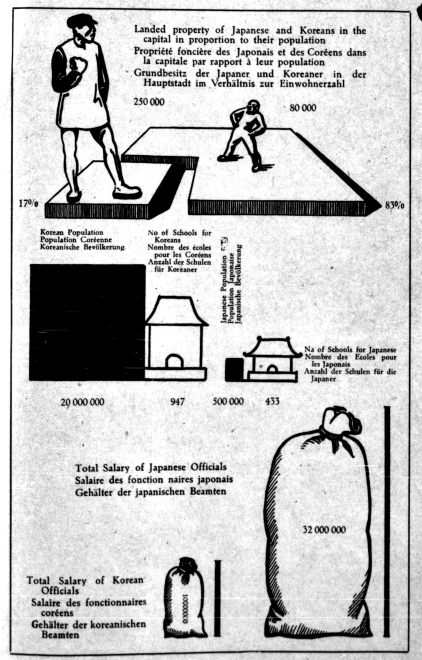
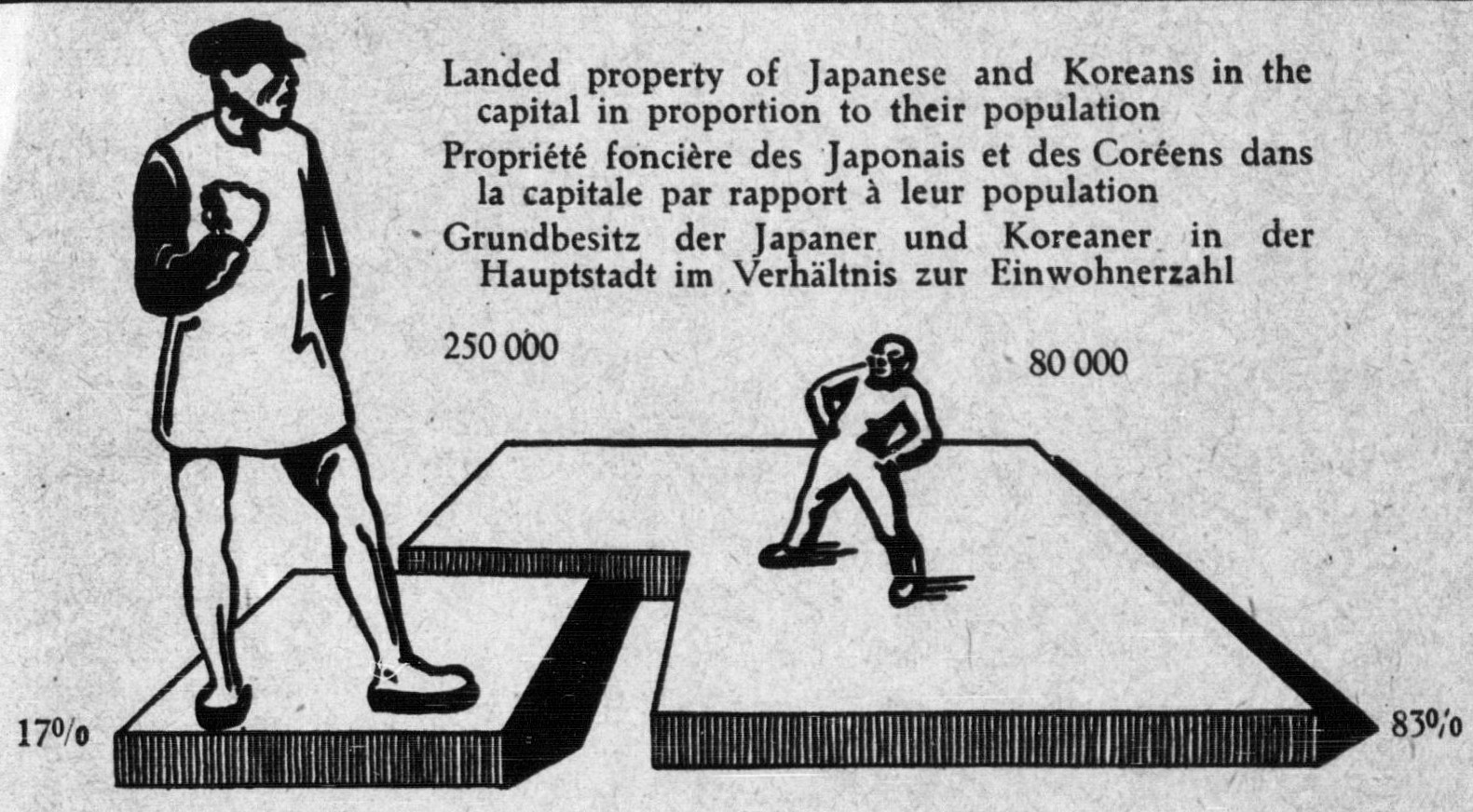
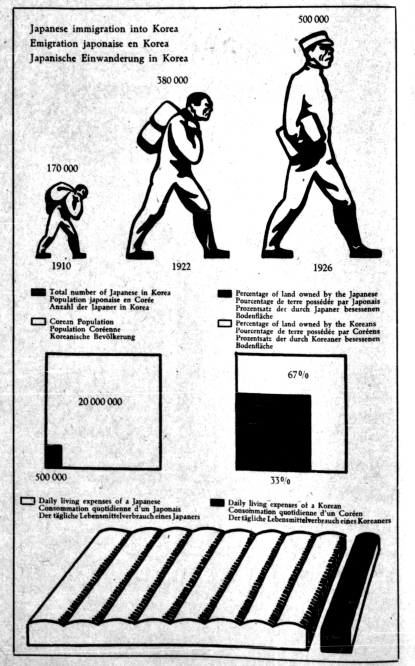
In order to show what the Japanese have achieved by force of arms in Korea since the annexation, that is in 17 years, we shall mention here a few facts from the economic life that has been forced upon the Koreans. When we consider the economic losses of the Koreans, the fact that stands out most glaringly is the expense of maintaining in Korea the parasitical Japanese, whose numbers are steadily on the increase und amounted last year to nearly half a million. Even if we take the old statistics, we find that these parasites consume £ 50,000,000 per year. As a result of the tribute they have to pay, the greater part of the upper classes of Korea have been reduced to poverty or unemployment. Three years ago the number of unemployed amounted to 997,000. This represents only a very small fraction of unemployed amounted to 997,000. This represents only a very small fraction of that which we must include under the losses to Korean economy. Connected with this parasitism of the Japanese is the fact that no national undertaking remains open to the Koreans. The principles of Japanese political economy contain a paragraph printed in bold characters, according to which every undertaking with good prospects is be reserved only for the Japanese. Not only the foreign trade but also the whole of the important internal trade is in Japanese hands. As the total turnover in the trade between Korea and the outside world amounts yearly to £75,000,000, it can easily be calculated what the Japanese profit amounts to every year through the monopoly of this market with its 20,000,000 forced customers. The very promising Korean coal mines delivered to Japan last year a net profit of £2,500,000.
The net output of agriculture, in which more than three- fourths of the total population is engaged, amounts yearly to about £150,000,000. One-third of the total soil of Korea now belongs to Japanese capitalists as their private property. The Korean peasants who are forced to work in their service are so heavily exploited that the average income of a family per year amounts to no more than £10!
Unfortunately we do not possess any sure and correctly compiled statistics for the other branches of economy. We maintain, however, that we do not exaggerate when we assert that at least half of the total Korean economic products are taken away by the Japanese.
How can a family with five members live on about £10 a year?
The wretched condition of Korean economic life is by no means due to the fact that the Koreans are not in a position to cultivate their land by modern methods; on the contrary, till the annexation, steady improvement was observable in the economic development. Those who have been to Korea know how strong is the desire for knowledge among the Korean youth.
The exploiting Japanese know how to conceal their criminal activities in Korea from outsiders. According to their allegations, Korea is a land whose population is not yet sufficiently civilised, living like the wild men of the interior of Africa, Australia etc.; at the best, the Koreans belong to those races that possessed a high culture in the past, but are at present without the strength to compete with other Powers or to defend themselves against foreign invasions. They, therefore, need the cultural and economical guidance and military protection of the Japanese. In order to create evidence in support of their allegations, all the parasitical Japanese in Korea devote themselves to describing and generalising the worst customs of the Koreans and the faults of isolated individuals. All improvements are put down to the credit of the Japanese. Thus an entirely false picture of Korean life has been conveyed to foreign countries.
The alleged well-meaning cultural policy of the Japanese is compatible with the imprisonment of all able Koreans who have taken a leading part in the economic and political life of Korea and who have faded away in dark prison cells without having committed any crime. Many have been forced to sacrifice their lives.
It was necessary for Japan’s cultural policy to crush every school, every higher educational institution and the growing universities insofar as these were being run by Koreans.
It is also the humane politics of Japan to compel children who want to enjoy the necessary school training to speak Japanese, even as early as at the age of 6 or 7.
The Koreans are not allowed to print newspapers or books in the Korean language.
No Korean is allowed to establish any industrial institution. on his own land with his own capital and with Korean workmen. Every attempt to organise Korean economic life and promote Korean culture is suppressed by sentences of imprisonment. Every man who reads Korean history or sings Korean) songs finds himself in prison, when the Japanese ruler comes to hear of these “crimes”. This is the way in which Korean culture is being promoted. Every reasonable man must admit that the existing conditions in Korea not only do no credit whatsoever to Japan nor help in removing misunderstandings, but that, on the contrary, this robbery results in the stunting of the cultural and general development of the Koreans.
Those who are misled by Japanese diplomacy believe that the Koreans are satisfied with the Japanese policy. They are wrong. The Koreans have always been enemies of Japanese rule.
It is not known to the world that many revolts have taken place against Japanese military despotism in Korea. Many parties are fighting against the oppression of Korea by her culturally primitive neighbours. In several parts of Korea, the people united to prevent by force the penetration of the country by the parasites. Every activity directed against the policy of the Japanese was answered by the latter in such a brutal manner that we do not hesitate in calling the tools of Japanese Imperialism the wildest savages on earth.
It happens not seldom that all the members of the family of a man who has been suspected of attempting anything against Japan–old men and children not excluded–are shot down. Sometimes a whole village is burnt down, including church and school, for its anti-Japanese feeling. Before this is done, the inhabitants of the village are locked up, so that they may not escape from the mass butchery.
In reality, not only Koreans who work against the robber politics of Japan, but also those in whom they see clever competitors are crushed, and every prospect of Korean development made hopeless. Prominent Korean intellectuals have been subjected to Japanese instruments of torture. The tortures have taken the following forms: in severe winter cold water was thrown on the victim, needles pushed into the flesh under the finger nails, red-hot rods pierced into the skin, the limbs stretched and the skin removed from certain parts of the body, Corrosive substances were forced into the anus. We are witnesses to the fact that such methods of torture still exist, employed by the Japanese police as a remedy against any anti-Japanese activities.
In spite of all this barbarism, the Koreans led by the student class declared their independence on the 1st of March, 1919. That is by no means the last step. We shall in the future do all we can to recover our freedom.

The Japanese are fighting this movement for freedom with force and treachery. Force is also used even where the movement is of a peaceful nature. Redoubling of the military and police forces was the first answer given by the Japanese to this Korean movement for freedom. Then the Governor was recalled and a new man brought, the reason given being that our movement for freedom was the result of dissatisfaction with the methods of the ex-Governor, whose “régime of force” had to be changed. They relaxed the press regulations for the Koreans in favour of three papers, but at the same time knew how to renders this ineffective by repeated prohibitions of their sale and by the use of bribery to prevent inconvenient publications.
After the declaration of Korean independence, the organised working men and the youth movement were strangled to suffocation.
Neither with force nor with treachery can the Japanese oppress us further. We are clearly conscious that our fight against Japan is the last and only way that will lead us to a life of freedom.
Either Japan must evacuate Korea or we are doomed to disgrace misery, hunger and death.
For a PDF of original document: https://hdl.handle.net/10622/ARCH00804.38
 Revolution's Newsstand