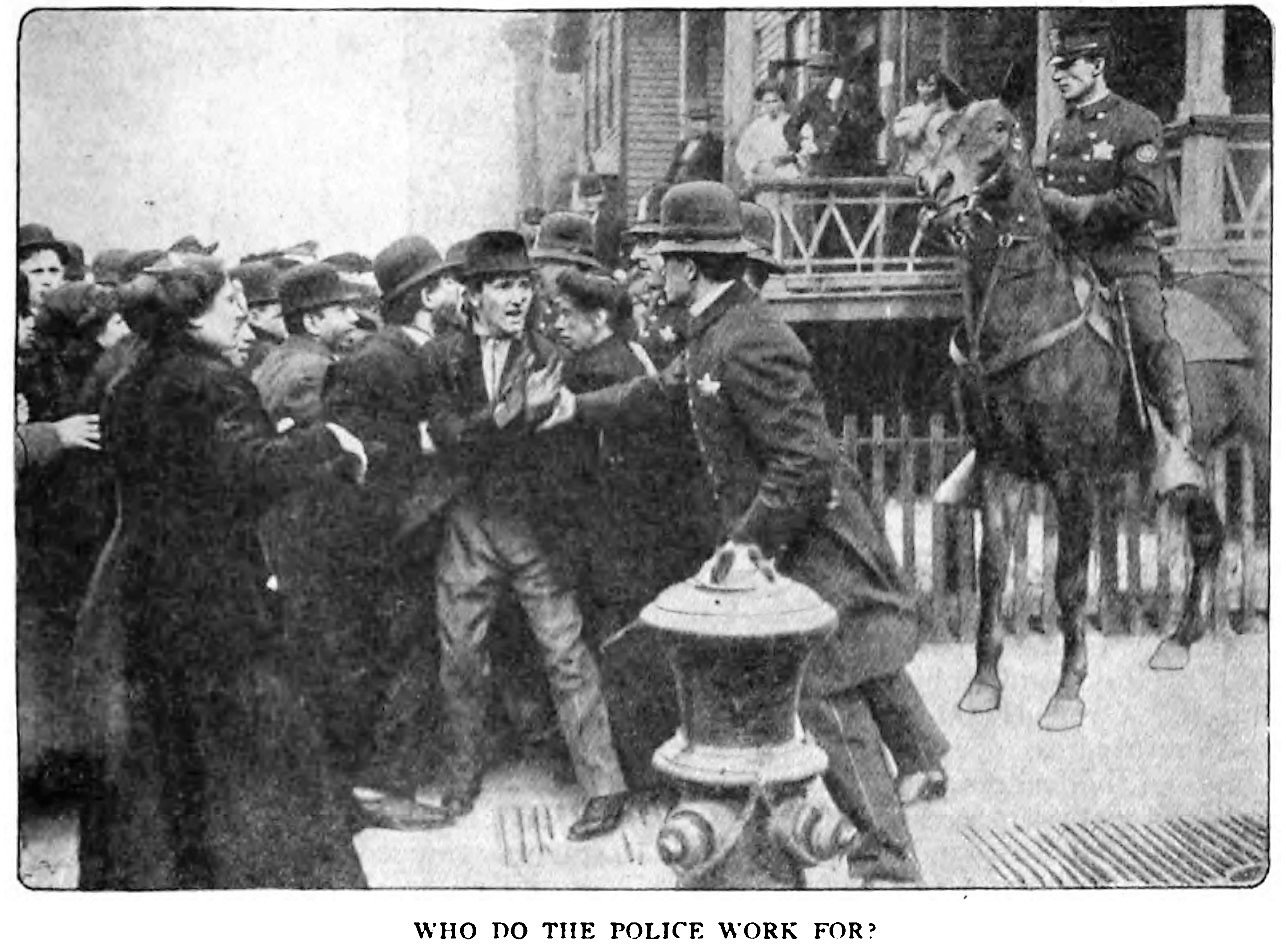
Some compelling on-the-scene reporting from Chicago’s 1910 uprising of garment workers that would help ignite a national labor movement. Until his criticism of the union bureaucracy (and their Socialist supporters) got him removed, Robert Dvorak was the strike’s lead reporter for the Chicago Daily Socialist, and because of that an essential chronicler of the struggle. Here he describes, in a wonderfully titled article, two dramatic confrontations occurring the same day between whole neighborhoods and the bosses’ police. Great stuff.
‘Thugs Beat Strikers; People Resent Action; Street Fight Results’ by Robert Dvorak from The Chicago Daily Socialist. Vol. 4 No. 301. October 19, 1910.
Ten more strikers were brutally assaulted and beaten Monday afternoon, when the police, detectives and thugs, protecting the interests of Hart, Schaffner & Marx, drew clubs and revolvers on the men, women and boys and girls who were endeavoring to notify their comrades inside the shop at Blucher and Wood streets that a walkout was ordered.
Another head breaking affair of the same origin and type took place at Market and Monroe streets, where one of the main buildings of the strike bound concern is located. The two riots Monday were a repetition of what occurred at Halsted and Nineteenth streets Saturday, and people who saw these outrages are protesting loudly against the tactics adopted by the police in the various neighborhoods.
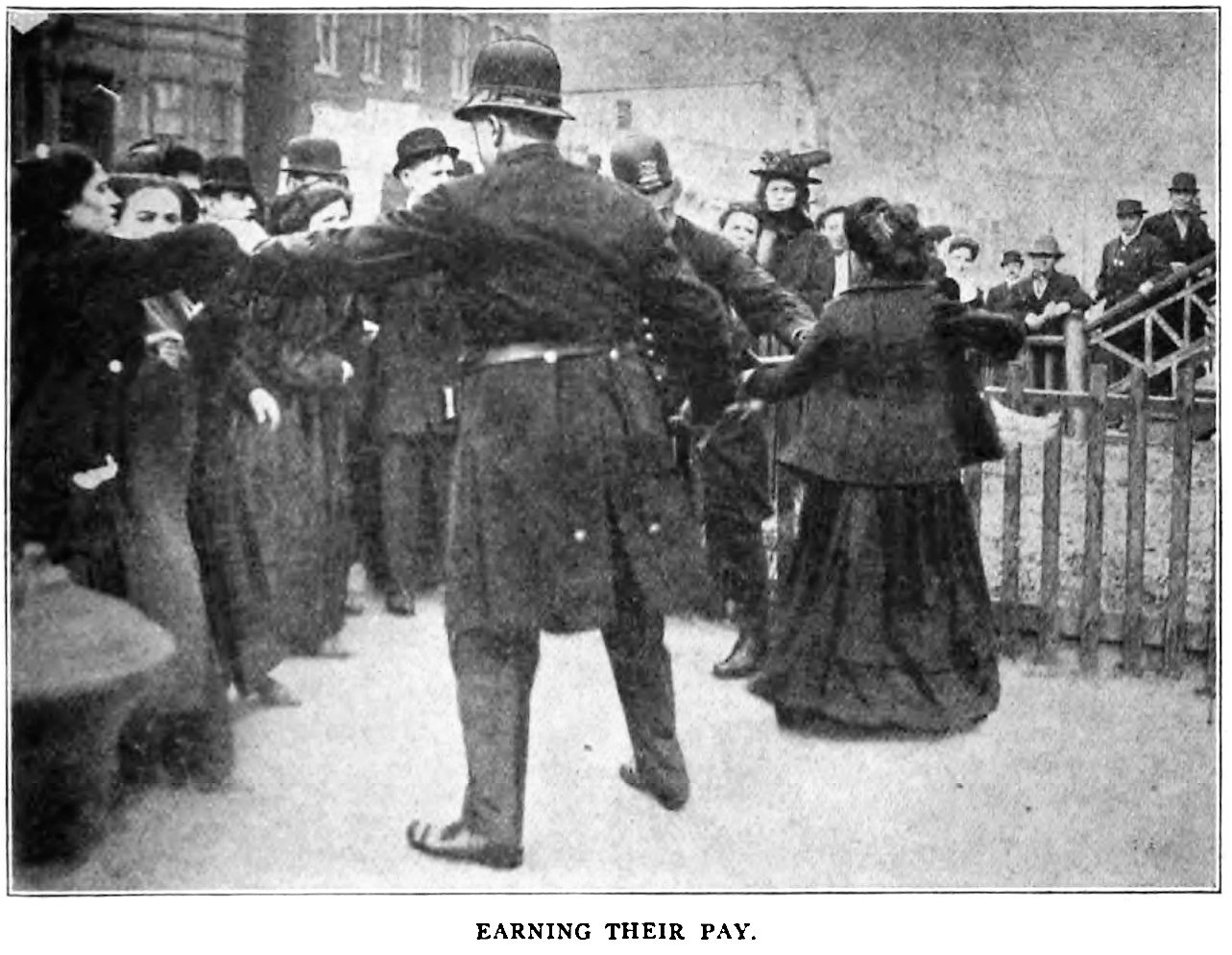
Just as was done Saturday, a hundred or so of the strikers left the Hod Carriers Hall, Monday shortly before noon for the shops at Blucher and Wood streets. They arrived there only to find the place well-guarded by police, thugs and detectives. A patrol wagon stood near the shop, ready to take away–not the rioters, but the peaceful, unarmed workers. The strikers did not stop, but proceeded up the sidewalk, the women and girls in the lead. The clubs used by the hired thugs of the benevolent concern immediately began to beat a tatoo on the heads of the workers and the men began to fall right and left.
All Ready to Quit
While the fight was on, however, the girls grappled with the police at the door and blew their whistles. At the first blast the windows flew open. Men and women employed in the shop stuck out their heads and yelled:
“Go to it, comrades, we’ll be down in a minute. Keep the doors open–they want to lock us in.”
The strikers in the street answered with a cheer and the fight then was waged to keep the door open until those on the inside had come out. Desperate efforts were made by the police to club the workers back from the door, but they stuck notwithstanding the fact that their faces and heads and even their clothes were a mass of blood. In about five minutes there was a cheer from the inside and hundreds of men and women, mostly girls and youths dashed down the stairs to the sidewalk.
Captain Sends for Aid
Meanwhile Captain Kandzia, in charge of the forces in front of the shop, sent an appeal for aid. Inspector Stephen Healy answered the appeal by sending out twenty men or more under Lieut. Custy. These appeared on the scene and energetically set to work clubbing the workers Into submission.
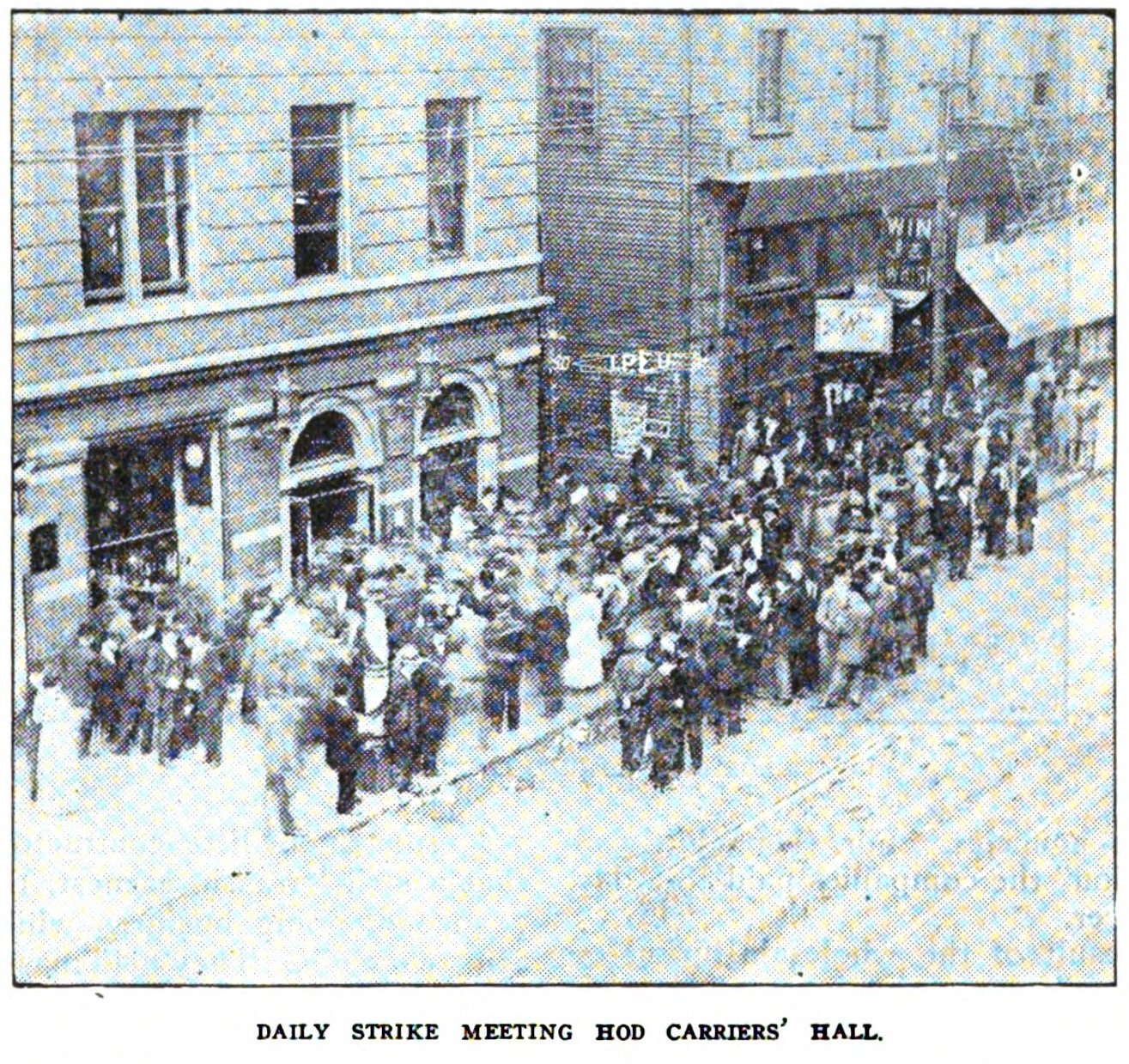
Seeing the wholesale beating of innocent, unarmed working men and the abuse of girls, people ran out of their homes armed with clubs and brooms with which to aid the strikers. A saloonkeeper in the neighborhood ran out and engaged in a tussle with one of the most brutal thugs. He was arrested.
Thugs Are Attacked
Men and women working in neighboring concerns encouraged the strikers with cheers. Imprecations and things much heavier and more damaging were hurled at the heads of the firm’s willing thugs, and as a result many of the policemen and thugs sustained broken heads from missiles thrown out of the windows. By this time the crowd had increased to over a thousand and the police were getting much the worst of the fight when new reinforcements arrived from the Rawson Street station.
Police Open Fire
The new force of Hart, Schaffner & Marx “heroes” arrived with drawn revolvers and an order was given them to shoot. They obeyed willingly and bullets began to whistle. According to the police, they shot into the air. No one was shot; therefore, it is possible that such was the case. But the shots aroused the crowd to a frenzy and people who had nothing in common with the handful of strikers left on the field took a hand in the fight.
Acts in Self-Defense
A young fellow who had just left the shop a few minutes before was set upon by the police. He was beaten over the head until in a dazed condition he sank to the ground. Just as the policeman bent over to tap him once more, the young fellow drew a pair of shears he had just brought from the shop and flung these at the uniformed brute. The shears struck him on the helmet and inflicted a scalp wound. For his daring the young fellow was beaten to almost a pulp.
When the street was finally cleared through repeated organized charges ten men were arrested. Every one of them bears vivid marks in the shape of gashes as evidence of the conflict and unnecessary police brutality. They were all placed in cells and charged with inciting a riot and disorderly conduct.
Those Hurt
The men arrested and hurt are:
Frank Lamerkewitz, 28 years old, 744 Girard Street.
Villam Ulalla 40 years old, 1775 N Wood St.
Isaac Chuples, 27 years old, 2620 Girard Street.
E.G. Peel, 26 years old, 2620 Hampden Court.
Frank Krezarsky, 37 years old, 133 W. Division Street.
John Buresky, 19 years old, 2654 W. Erie Street.
John Paulek, 19 years old, 1841 Austin Avenue.
Vladislav Wahink, 24 years old, 984 W. Seventeenth Street.
Frank Balendalis, 24 years old, 984 W. Thirty-sixth Street,
Morris Miller, 21 years old, 1637 Milwaukee Avenue.
Some Police Hurt
During the fray, while the bricks flew indiscriminately from the windows and stairways, the police sustained several injuries. Those hurt by missiles are:
Edward Binder, patrol wagon driver at the Rawson Street station; struck on the head with a brick. He sustained a flesh wound and was taken home. Charles Hultz, patrolman; helmet penetrated by a pair of shears thrown at him by a striker he was beating brutally. He sustained slight scalp wound.
The conflict at Market and Monroe streets occurred shortly after noon when six men, sick of the conditions inside of the Hart, Schaffner & Marx concern, quit work and walked outside. On the stairway they were met by Edward Green, foreman of the shops who tried to prevent them from leaving. The men told him to get out of the way and when he refused they sent him flying down the stairs. He was but slightly shaken up and after arising returned to work.
Thugs Start Fight
Outside the men committed a grave error. They stopped on the sidewalk to talk matters over. A door tender viciously ordered them away. They refused to obey him and were set upon by him and Charles Boyd, one of the paid thugs of the concern, one whom the McGuire and White agency furnished for $8 per day. The men resisted and it would have gone hard with the thugs had not Sergeant Lyons arrived from the Central Detail police station with a patrol and re-enforcements. The men seeing uniformed policemen coming dispersed. They were pursued, clubbed and arrested. The men arrested gave their names as Vincent Martin, Harry Stein, John Jones, Anton Karl, Tony Boderitz and Michael Dones. They were charged with disorderly conduct.
Strauss Slowly Awakening
Milton A. Strauss, general manager for Hart, Schaffner & Marx, quit his former story about only 300 men being out on strike and admitted that the Blucher street plant would have to be shut down as every man and woman in the place walked out yesterday. There was only one thing that puzzled Mr. Strauss, and that was the fact that the strikers had secured admission to the plant. He had been thus informed by the police, but the fact was no one had entered the place. An open window served as a means of communication. A whistle was blown and the employes who had had enough of Hart, Schaffner and Marx came trooping down. There were over 800 of these. In other words there wasn’t a soul left in the shop.
A policeman also informed Strauss that 700 had walked out at 135 Market street. The officer had seen them and could swear to it. The result was that Strauss quit his policy of denial and admitted there was “some strike.”
The Chicago Socialist, sometimes daily sometimes weekly, was published from 1902 until 1912 as the paper of the Chicago Socialist Party. The roots of the paper lie with Workers Call, published from 1899 as a Socialist Labor Party publication, becoming a voice of the Springfield Social Democratic Party after splitting with De Leon in July, 1901. It became the Chicago Socialist Party paper with the SDP’s adherence and changed its name to the Chicago Socialist in March, 1902. In 1906 it became a daily and published until 1912 by Local Cook County of the Socialist Party and was edited by A.M. Simons if the International Socialist Review. A cornucopia of historical information on the Chicago workers movements lies within its pages.
PDF of full issue: https://www.marxists.org/history/usa/pubs/chicago-daily-socialist/1910/101019-chicagodailysocialist-v04n304.pdf
 Revolution's Newsstand