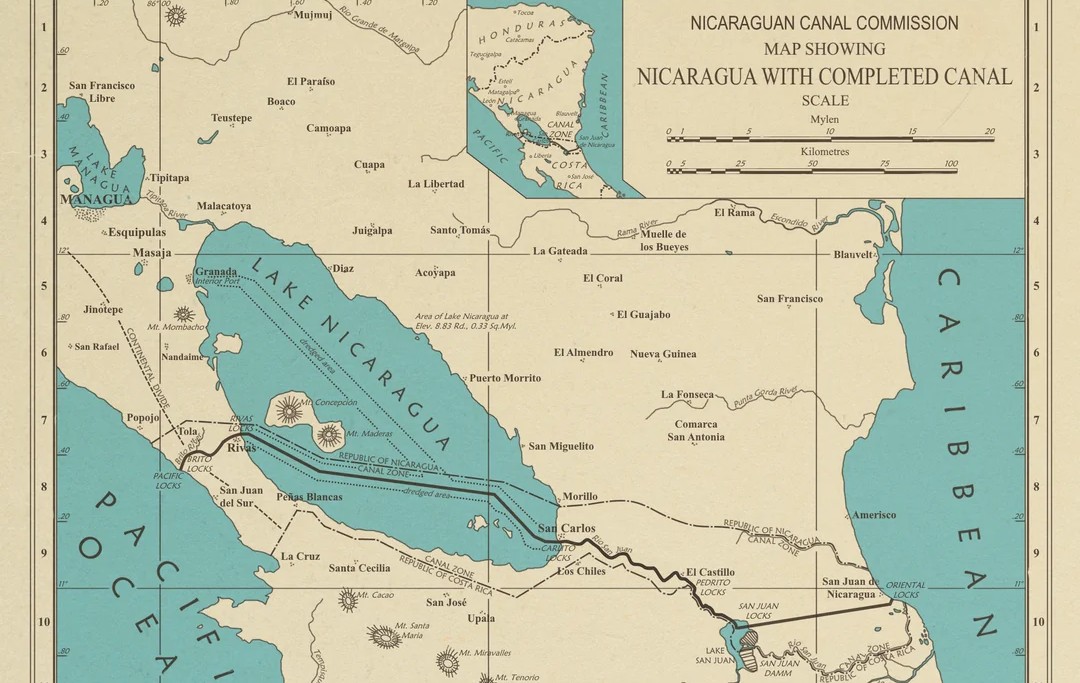
U.S. intervention in Nicaragua dates back to at least the 1850s, with Southern adventurer William Walker’s 1856 attempt at building an Empire of Slavery uniting the hemispheres in the barter of human flesh. Crucial to that project was the construction of a long-imagined canal through Nicaragua to connect the Atlantic and Pacific, facilitating the trade in the enslaved and the commodities they were made to produce. A canal through Nicaragua, which unlike Panama would not require extensive locks, has been a project in development of U.S. imperialism since. Even more so AFTER the completion of the Panama Canal, with its annoying international legal obligations of free access. With formal U.S. military occupation of Nicaragua beginning in 1912 and reasserted in 1927, the proposed canal’s purpose was seen mainly as a military resource in any potential conflict with Japan or Great Britain, the U.S.’s largest rivals at the time. The idea was again actively resurrected by Roosevelt as World War Two neared, and an updated plan surely sits on the Empire’s shelf today.
‘Wall Street Takes Nicaragua’ by Robert W. Dunn from The Daily Worker. Vol. 4 No. 93. May 2, 1927.
One of the “dependencies” included in the colonial empire of the United States is Nicaragua. It is slightly larger than Cuba but with only a fifth of Cuba’s population.
Nicaragua is chiefly important to the American empire because through it lies the route for a second canal connecting the Atlantic and the Pacific. The United States Empire needs such a canal. This explains “our” protectorate over Nicaragua and “our” military interventions in Nicaragua in 1899, 1907, 1910, 1912, 1925 and again in 1926-1927. It explains why a High Commission of three persons, one representing the State Department of the United States and one representing the American bondholders, the third a Nicaraguan, acts as a collection agency for American interests in that country. An American, appointed by the President of the United States, collects all the customs in Nicaragua.
Then Americans have investments in lumber, fruit and mining enterprises in that country. They exploit “cheap,” “native” labor. The landing of marines is necessary, if for no other reasons, Calvin Coolidge contends, than to protect those interests. He puts it this way: “If the revolution continues” against Mr. Coolidge’s and the bankers’ pet president, Diaz “American investments and business interests will be very seriously affected, if not destroyed…The proprietary rights of the United States in the Nicaragua Canal…place us in a position of peculiar responsibility.” Very peculiar.
So “we” are in Nicaragua with six thousand marines because we need a canal and American bankers and businessmen need more profits and Nicaragua is a good base from which to direct an attack on Mexico. The bankers are modest. They might even be satisfied with a 6 percent loan–that is with the proper security. The marines are that security.
This is, of course, not the first time the United State has played the marine game in Nicaragua. In 1912 the bankers’ friend, Don Adolfo Diaz, a reactionary, became president. When a revolution broke out against him American marines were landed under the command of Major Smedley D. Butler, late of China and formerly of Philadelphia. Eight American warships and about 3,000 men did the trick. Diaz was restored, a number of marines were left on guard to see that he was kept in office. All revolutions were then kept down, just as previously they had been fomented by the Americans when it served the interests of Brown Brothers & Co., to start one under the proper reactionary auspices.
The marines placed in Nicaragua in 1912 stayed until 1925, having crushed several attempts at revolution by the Liberals of the country. A few months after they were withdrawn, in 1925, a general pulled off a coup d’etat, later resigning to permit brother Diaz to be “elected” by a hand-picked congress from which all Liberals were excluded–as most of them were then in jail. Immediately upon his election the Wall Street government of Washington recognized Mr. Diaz. But the Liberals started a counter-movement threatening Diaz with force in an attempt to put in the already constitutionally elected President Sacasa, who had been forced to flee the country. Whereupon Washington rushed in the marines and proceeded to declare as “neutral” zones the important parts of the country held by the Liberals. “We” are still extending these “neutral” zones.
The situation is to be summarized in the words of Senator Lynn J. Frazier of North Dakota: “The present dictator of Nicaragua, Diaz, whose illegal usurpation of power provoked the existing trouble, is and always has been a mere pawn of the American banking interests, as was his associate and predecessor, Chamorro; and it is a curious coincidence to say the least, that for a long period of years the Department of State always has seen fit to invoke the might of the American marines to put down he Liberals and never yet has deposed one of these dictators who have betrayed their country to the American banking interests.”
There is nothing curious about this, however, when one remembers our “peculiar responsibility” and that Nicaragua is for sale over the Diaz counter to the American bankers. They might have to pay more for it if they bought it from some other party. A Diaz agent in search of a loan of $20,000,000 has agreed, “in return for the advantages accruing to Nicaragua from such a loan we are prepared to accept any measures of control by an American financial advisor and receiver general which the American Government might consider proper.”
So as American capital and its government work around toward the granting of the loan, the marines remain on the job, naval vessels patrol the harbors, the “neutral” zones are being extended, the Diaz national guard is being trained by American military men, the customs continue to be collected by a man from Wall Street, the national bank is run by American directors and managers, Americans direct the national railroad, and Mr. Diaz, the American installed president, is sitting pretty.
If you would know the full story of American intervention you must not lose sight of Brown Brothers & Co., J. & W. Seligman & Co., Baker Kellogg & Co., the J.G. White Engineering Co., The United Fruit Co., and Robert F. Loree, President of the Bank of Central and South America. These are some of the important firms and figures who have helped to determine events in that country. The Atlantic Fruit Co. and the Cuyamel Fruit Co., have also important interests as have a number of other commercial firms. Over 70 per cent of the foreign trade of the country is with the United States.
But chiefly one must remember the canal and the aims of the American Empire in the Caribbean. The United States is in Nicaragua to stay. The rights to this second canal must be protected. The usurper Diaz happens to serve best the imperialist interests of the United States and their designs on Mexico.
There is no danger of “war” with Nicaragua. It is our country now. Its military forces could scarcely cope with the police force of New York City. It is as completely a part of the American Empire as Cuba, Haiti and the Dominican Republic.
The Daily Worker began in 1924 and was published in New York City by the Communist Party US and its predecessor organizations. Among the most long-lasting and important left publications in US history, it had a circulation of 35,000 at its peak. The Daily Worker came from The Ohio Socialist, published by the Left Wing-dominated Socialist Party of Ohio in Cleveland from 1917 to November 1919, when it became became The Toiler, paper of the Communist Labor Party. In December 1921 the above-ground Workers Party of America merged the Toiler with the paper Workers Council to found The Worker, which became The Daily Worker beginning January 13, 1924.
PDF of full issue: https://www.marxists.org/history/usa/pubs/dailyworker/1927/1927-ny/v04-n093-NY-may-02-1927-DW-LOC.pdf
 Revolution's Newsstand