
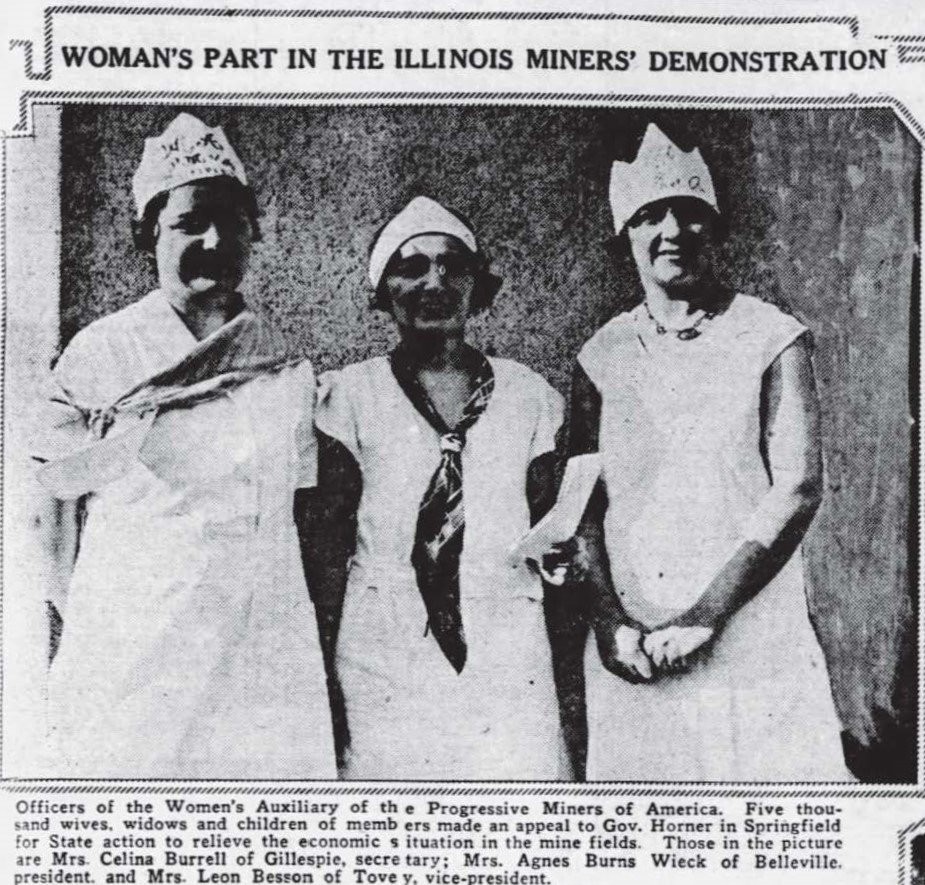
Coal strikes often involve whole communities, and the women of those communities have played central roles in nearly every miners’ struggle in U.S. history. Formed at the grassroots, ‘Women’s Auxiliaries’ did far more than assist men on the picket lines. To name a few; they created organization across union locals and geography in the notoriously fractured miners’ unions; were vehicles for militant voices and ideas that could not be expelled; they often held union leaders, from top to bottom, to account for decisions and promises the men as union members beholden to their leaders were unwilling or incapable of; and they added many social elements and demands to the labor struggle, making the movement as a whole more significant and formidable. In this internal discussion article written when the mine unions, and their 100s of thousands of members, were divided into more than a half dozen organizations, large and small, comrade A.S. urges a reversal of the neglect so far shown by the Party to building the auxiliaries, positing their importance for intervening in the larger mine union movement.
‘Work Among Women in the Mining Fields’ by A.S. from Party Organizer. Vol. 7. No. 4. April, 1934.
IN this period of decaying capitalism, and especially since the inauguration of the “New Deal,” we find that more and more women are being drawn into industry. Women do the same work as men at the machine, and are forced to work for lower pay, thus reducing the standard of living of the working class as a whole. While this has always been the conscious policy of the boss class, it is being developed even more during the present economic crisis and the deepening of the general crisis of capitalism. Not only are the women forced to work at starvation wages, they are also forced to put in long hours and extra shifts. Unemployment among women workers is increasing due to speed-up and rationalization, thus lowering their living standards to a new level. Conditions among the Negro women are even worse than among the white. They are doubly exploited, given less pay and the worst jobs. All of these things, coupled with the fact that there are no provisions for the working women under the N.R.A. not only makes work among women doubly necessary, but also has created the need and desire for organization.
Women Want Organization
This urge for organization extends also to women who are not working themselves, but who see the need of helping the men in their struggle against the bosses. This can best be seen among the miners, many of whom have not worked for years, or at best are working part time. Most of them live in poverty in the company patches, cheated on every side by the coal operators and by the relief agencies. The resentment of the miners is growing, and they are now preparing for strike struggles. In the past struggles in the coal fields the women have played an increasingly important role.
In the last strike wave they helped to close down the mines, picketed with the men and took an active part in the meetings. They were often more militant than the men (Johnstown-Lorain Steel mine, where the women without the aid of the men pulled the mine on strike). The growing militancy among the women in the mining area, also expressed itself in the organization of the women’s auxiliaries of the U.M.W.A. in the Frick territory since the last strike.

Although certain results were obtained in this work, an underestimation of its importance has hindered the consolidation of the women’s auxiliaries and the carrying of the fight for U.M.W.A. auxiliaries on the floor of the U.M.W.A. convention. The extent of this underestimation can be seen in the fact that one woman comrade carried out this work without any active help from the men comrades in the field.
Auxiliaries Formed Over Heads of Reformist Leadership
During the strike over 1800 women were organized into the auxiliaries. Because of the militancy of the women the district officials of the U.M.W.A. opened an attack against the auxiliaries with the attempt to smash them. In those towns where the Party defeated the red scare the auxiliaries were maintained. However, due to the underestimation of the work, and failure to continue it, more than 50 per cent of the organization has been liquidated by the U.M.W.A. officialdom. Local union seals were refused to the auxiliaries and the women were compelled to organize over the heads of the officials. The Lewis machine, continuing its betrayal tactics, is doing everything possible to keep the idea of organization from spreading among the women. On the one hand they openly forbid the organization of the women’s auxiliary and on the other, they demagogically ridicule the men for permitting the “women to do the fighting for them.” In spite of this, great numbers of miners’ wives are building the auxiliaries and preparing for the coming strike struggles.
The program adopted at the Mining Party Conference for the mining fields points out the importance of building the opposition within the reformist unions (P.M.A., U.M.W.A. and the Anthracite Union). It also stresses the necessity of intensifying our fight within the company unions, which applies mostly to the captive mines. Much attention must be given to convincing the men who have been betrayed by the Lewis machine and driven into the company unions. The women can play an important role in this work, through their daily contact with the men, agitating against and exposing the role of the company unions. The women’s auxiliaries are a vital factor in the building of militant and live oppositions. The women, both Negro and white, have during the strike shown their militancy and have exposed the role of the officials of the U.M.W.A. The Negro women, for the first time in the Frick territory were among the most active in the strike and in organizing the auxiliaries. With the extension of the women’s organization, their influence will be a great step forward in building a mass opposition movement and toward the building of one united miners’ union. We cannot emphasize too strongly the importance of our work among the women in the mining field. To speak of building the opposition in the U.M.W.A. without carrying on the work of building the women’s auxiliaries is merely phrasemongering.
Work Neglected by Party
The Party in the past has neglected the building of the auxiliaries especially in the Frick territory, and has failed to give support and guidance to the comrades who were carrying on this work and building the Party fraction in the U.M.W.A. with the result that where there were auxiliaries they have not been utilized to their fullest extent in building an opposition to the U.M.W.A. officialdom.
It is necessary for us to intensify our work in organizing the auxiliaries for the purpose of building and strengthening the opposition work. The Party must be mobilized to begin a drive to recruit into the Party the best and most militant women sympathizers, especially the Negro women. The building of strong party fractions among the women can be the only guarantee of successful work in the auxiliaries and the U.M.W.A.
What is to be Done?
It is necessary to immediately take the following steps:
1. To build the Party and the YCL among the women and young girls, paying special attention to the development of cadres from among the Negro women.
2. Consolidate and unify the already existing organizations and spread the movement to other districts.
3. Work towards the building of a center for the auxiliaries.
4. To immediately call a conference of existing organizations for the purpose of adopting a program of action surrounding the preparations for the coming strike struggles. The main points to be brought forward in this conference are: (a) fight for official recognition and charter from the U.M.W.A. (b) map out a program of action against unsanitary living conditions in the company patches, against high prices in company stores, and forced trading, and against the discrimination against Negroes, etc. Our aim must be a united struggle for one national miners union; to unity the auxiliaries of the P.M.A., U.M.W.A., and N.M.U. for a militant national union.
By discussing the problem of building the women’s auxiliaries in the mining fields as well as seriously discussing the most important phases of organizational tasks among women, we can begin “to get rid once for all of the underestimation of this work (among women), to get rid of the idea that this work is not part of general Party work.”
The Party Organizer was the internal bulletin of the Communist Party published by its Central Committee beginning in 1927. First published irregularly, than bi-monthly, and then monthly, the Organizer was primarily meant for the Party’s unit, district, and shop organizers. The Organizer offers a much different view of the CP than the Daily Worker, including a much higher proportion of women writers than almost any other CP publication. Its pages are often full of the mundane problems of Party organizing, complaints about resources, debates over policy and personalities, as well as official numbers and information on Party campaigns, locals, organizations, and periodicals making the Party Organizer an important resource for the study and understanding of the Party in its most important years.
PDF of issue: https://www.marxists.org/history/usa/pubs/party-organizer/v07n04-apr-1934-Party%20Organizer.pdf
 Revolution's Newsstand