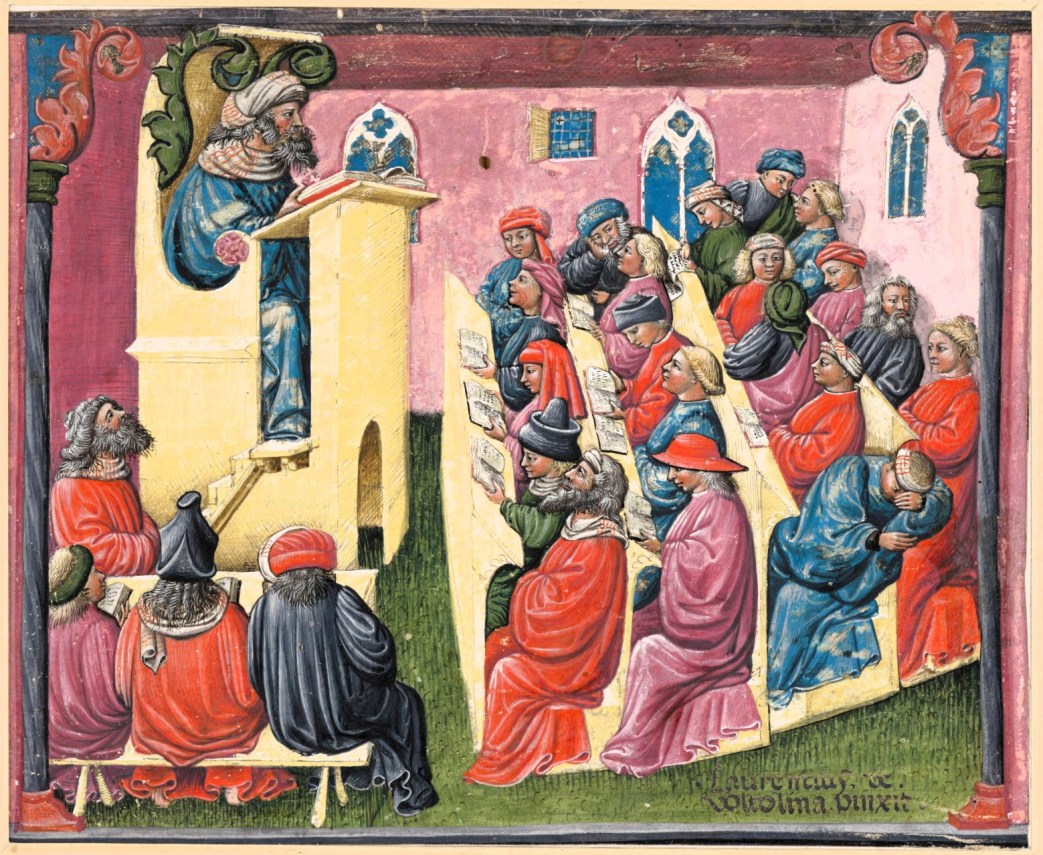
An absolutely fascinating article from Marxist medievalist Margaret Schlauch, then teaching at NYU, introducing an emerging generation of student activists to the rough and tumble world of medieval learning.
‘Medieval Students’ by Margaret Schlauch from Student Review (N.S.L.). Vol. 2 No. 7. May, 1933.
WE citizens of the modern academic world are accustomed, especially in America, to universities which are imposingly and intricately organized. A hopeful student who wishes to work under a world-famous authority on mathematical theory, Assyriology, or Hegelian philosophy, is first confronted by an embattled array of clerks and secretaries, advisers and deans, and in exceptional cases he may have to consult still loftier administrators to convince them of his literacy and general worth. Then, and only then, is he permitted to approach the world-famous authority under whose guidance he desires to study. Even in Germany, where university students are in general treated as adult human beings, there is an impressive amount of red tape connected with registration: the secretaries who demand and classify the documents (diplomas, certificates, Fragebogen, and the like) of new applicants are all too frequently disagreeable or short-tempered ; and the reverence due to authority is symbolized in the title accorded to the highest administrative officer: Rector Magnificus, or in the vernacular, seine Magnificenz der Rektor. This state of affairs is so general to-day that we think very little of it, either for good or ill.
It is all the more refreshing to consider for a time the earlier and less complicated period of academic history, when modern universities were first becoming organized. In that far-off time, they were merely, in the words of Charles Edward Mallet, “guilds of teachers or students, drawn together by the instinct of association which played so large a part in a disordered age.” These guilds followed the respective activities of teaching and studying, and upon occasion united for the protection of mutual interests. Of themselves they constituted the whole university. Very early the civil and ecclesiastical authorities accorded them special privileges and immunities. In 1158, Friedrich Barbarossa granted a constitution to the masters and students of Bologna, with the words: “We will that the students, and above all the professors of divine and sacred laws, may be able to establish themselves and dwell in entire security in the cities where the study of letters is practised. It is fitting that we shelter them from harm. Who would not have compassion on these men who exile themselves through love of learning, who expose themselves to a thousand dangers, and who, far from their kindred and families, remain defenseless among persons who are sometimes of the vilest?” The Emperor’s expression of sympathy will no doubt find an appreciative echo in the bosom of many a harassed freshman of today. In any case, it was followed by an increasing number of provisions favorable to students on the part of other governmental authorities. At Padua, a law of 1262 provided that the Podesta might not intervene in student brawls “unless, at the end of two days, the affair had not been settled by the rector and professors.” At various universities, students had the right of trial by their teachers or by churchmen rather than by civil authorities; moreover, they could claim trial, whether as plaintiffs or defendants, at their place-of residence. Many cities expressly exempted students from military service, whether in war or peace, except in case of imminent peril. Such a state was said to exist at the University of Orleans, only when the enemy’s army was ten leagues away from the city; at Paris, according to the definition by Henry III in 1577, the army had to be within five leagues of the gates. The general principle underlying these exemptions was expressed as follows: “Scholars are to be reckoned citizens only in respect to privileges, not liabilities.”
The very poverty of medieval students was an advantage to them. Their equipment was slight, their corporation or guild was innocent of the doubtful modern blessing of endowments and expensive buildings, and as a result the student body was extremely mobile. They could easily seek whatever teachers pleased them. When Abelard was forced to leave Paris as a result of the Heloise scandal in 1118, he finally received permission from Louis the Fat to establish a retreat of his own in a desert place near Troyes. Thither he repaired with only one disciple, but others found him out, and the place was soon buzzing with flocks of eager scholars. But the medieval students were apt to be correspondingly cautious about a master of whom they knew little or nothing. It was customary to “try out” obscure pedagogues, and a statute of Bologna provided that “a scholar may test the doctrine of any teacher or assistant for the space of fifteen days” without fee. There was always much discussion—varietas verborwm—rife in the corporations of masters and students, and at times theological or even political questions were referred to them. In 1169 Thomas a Becket wished to submit his quarrel with Henry II of England to the Court of France or to the members of the University of Paris. It would be difficult to imagine political disputants of today making the same offer.
At all universities the students were apparently very jealous of any infringement on their privileges and immunities. And because they were so little encumbered with equipment, they were able to take very definite action if they felt that they were illtreated. It was all very well for citizens and authorities to complain about the frequent brawls in their streets. A document of 1336 from Oxford complains—but with a noticeable lack of real moral indignation—of a brawl between the “magistros” and the “scholares insolentes,” who had disturbed the peace “more freely than usual” (liberius solito). The result of this brawl was serious: a number of persons were wounded and killed. Yet there is no record of punitive measures on the part of the long-suffering burghers. In the other hand, if civil authorities did students an injustice, the response was immediate and emphatic. The whole university body might avail itself of the right of cessatio, as it was called: that is, migration to another place. This was a comparatively simple matter in an age when change of underclothing was a luxury, and scholastic equipment often consisted of little more than a copy of Aristotle and a notebook. Sometimes a mere threat of migration was enough to bring the authorities to terms, but at other times the cessatio actually occurred. In 1407 the Provost of the University of Paris caused two disorderly students to be hanged, but a threat of emigration on the part of the entire university forced him to submit to their terms, which were sufficiently gruesome. He was obliged to take down the victims from the gallows, kiss them on the mouth, and conduct their burial. In 1229 a similar affair went much further. During a carnival riot, some students sacked an innkeeper’s house and wounded several citizens. Blanche, who was then Regent, ordered the Provost to punish the guilty, and two students were put to death. The whole university, thereupon, departed from Paris; the magistri and doctores went elsewhere to teach. In the end the Pope had to intervene and revoke the penalties imposed on the institution.
Similar situations often arose elsewhere. At Toulouse in 1832, Aimery Beranger, the squire of a noble student, stabbed an official sent to arrest him. He was executed, but at the end of a long suit the city was punished and the university received reparation. At Oxford, an unknown student of Maiden Hall once killed a woman and fled. The mayor and citizens, failing to find the real offender, arrested two or three innocent clerks who shared his rooms, and, with the permission of King John, hanged them. (This was what might be called in modern parlance a “legal lynching”, one can almost hear the citizens of Oxford insist that “we must teach those students a lesson”–even if some innocent lads had to be hanged for it.) The other students regarded this act as an attack on their immunities, and on their very lives. Both teachers and scholars migrated to Reading, Paris, Maidstone, Canterbury, and Cambridge. But by threat of interdict and excommunication the Church forced King John to capitulate, and the townsmen did public penance for the unjust execution. In addition, they agreed to reduce rent charged for students’ rooms by fifty per cent for the following decade, and to contribute a yearly stipend of fifty-two shillings for needy scholars. When in 1200 a student was killed during a quarrel between his fellows and the citizens of Paris, the Provost of the city put himself at the head of an armed populace. Unlike King John of England, Philip Augustus of France sided with the students, and the Provost was condemned to perpetual imprisonment, or if he chose to trial by water, “with the condition that if he succumbed under it he should be hanged.”
The migrations or cessationes were particularly frequent at the University of Bologne. In 1204 the students departed to Vicenza, in 1222 to Padua, in 1228 from Padua to Vercelli. In 1215 a certain Rofferdus of Beneventum seceded from Bologna to Arezzo because of severe punishments following upon riots. In 1306 the entire studium was suspended for three years. In 1316 the University migrated to Argenta, and only five years later to Siena. In 1326 the execution of a scholar provoked a cessatio to Imola. Apparently the cities to which migrating students repaired did not always look upon their arrival as an unmixed blessing. When in 1320 the clerks and teachers of the University of Orleans moved en masse to Nevers, the inhabitants of the latter town “threw the rector’s chair into the Loire, expressing the hope that, borne by the water of the stream, and ‘with the assistance of the devil,’ it might return to the city whence it came.” Nevertheless the right of cessatio was protected by nothing less than papal decree. According to Gregory IX (1231), if a serious injury was inflicted on the students and masters, unless justice were done them within fifteen days, they were permitted to suspend lectures until complete satisfaction was received.
All of this sounds like a veritable paradise of students’ rights and privileges. Ardent modern libertarians, insufficiently informed concerning the background of these cessationes, might be tempted to sigh for a return to a lost age when students and faculties were all-powerful guilds, able to combat outside interference thus effectively. But historical analogy is a double-edged weapon. It must be remembered that medieval universities enjoyed their powers and immunities because they were closely connected with the Church, and because many of the clerks constituting the student body were primarily interested in canon law. When the Pope confirmed the right of cessatio, he was really protecting ecclesiastical interests. The University of Toulouse was founded expressly to combat any survivals of the Albigensian heresy, and none of the protests and quarrels of the scholars was connected with the support of unorthodox doctrine. In fact, one migration from Bologna is said to have been caused by “fear of something new”—timore novitatis—a reason which certainly would not please a modern libertarian. To be sure, it is reported that forbidden books were sometimes read at the University of Paris. One of these, by Guillaume de St.-Armour, had a title which sounds quite contemporary to our ears: “A brief pamphlet concerning the Perils of these Modern Times.” Nevertheless it is not recorded that either the Church or the universities were particularly hospitable to dissident opinion, nor was “academic freedom” an ideal within their ken.
Students of today find themselves returning in some respects to the conditions of the medieval universities. They are certainly becoming poorer, like Chaucer’s clerk of Oxenford. They are also becoming organized, but they will never be as mobile as their medieval predecessors. You cannot tuck a physics laboratory under your arm and depart from New York to Hackensack, New Jersey, as easily as a Parisian could once migrate with his copy of Aristotle to Toulouse. Although the students now as then have a part to play in the struggles of contemporary society, the nature of those struggles has changed. The innocent clerks hanged at Oxford were victims of the contest between Church and empire for supremacy in the medieval world. That issue affects us no longer. Students of to-day have a part to play in a quite different contest: the struggle of classes in the modern industrial world. The nature of their role must be determined by that struggle, not the dead claims of Guelf and Ghibelline. Nevertheless it is indeed worth while to recall that at one time universities were composed solely and simply of teachers and students, who took pride in membership in their respective guilds, and jealously protected the rights and privileges of those guild.
Emerging from the 1931 free speech struggle at City College of New York, the National Student League was founded in early 1932 during a rising student movement by Communist Party activists. The N.S.L. organized from High School on and would be the main C.P.-led student organization through the early 1930s. Publishing ‘Student Review’, the League grew to thousands of members and had a focus on anti-imperialism/anti-militarism, student welfare, workers’ organizing, and free speech. Eventually with the Popular Front the N.S.L. would merge with its main competitor, the Socialist Party’s Student League for Industrial Democracy in 1935 to form the American Student Union.
PDF of full issue: https://archive.org/download/student-review_1933-05_2_7/student-review_1933-05_2_7.pdf
 Revolution's Newsstand