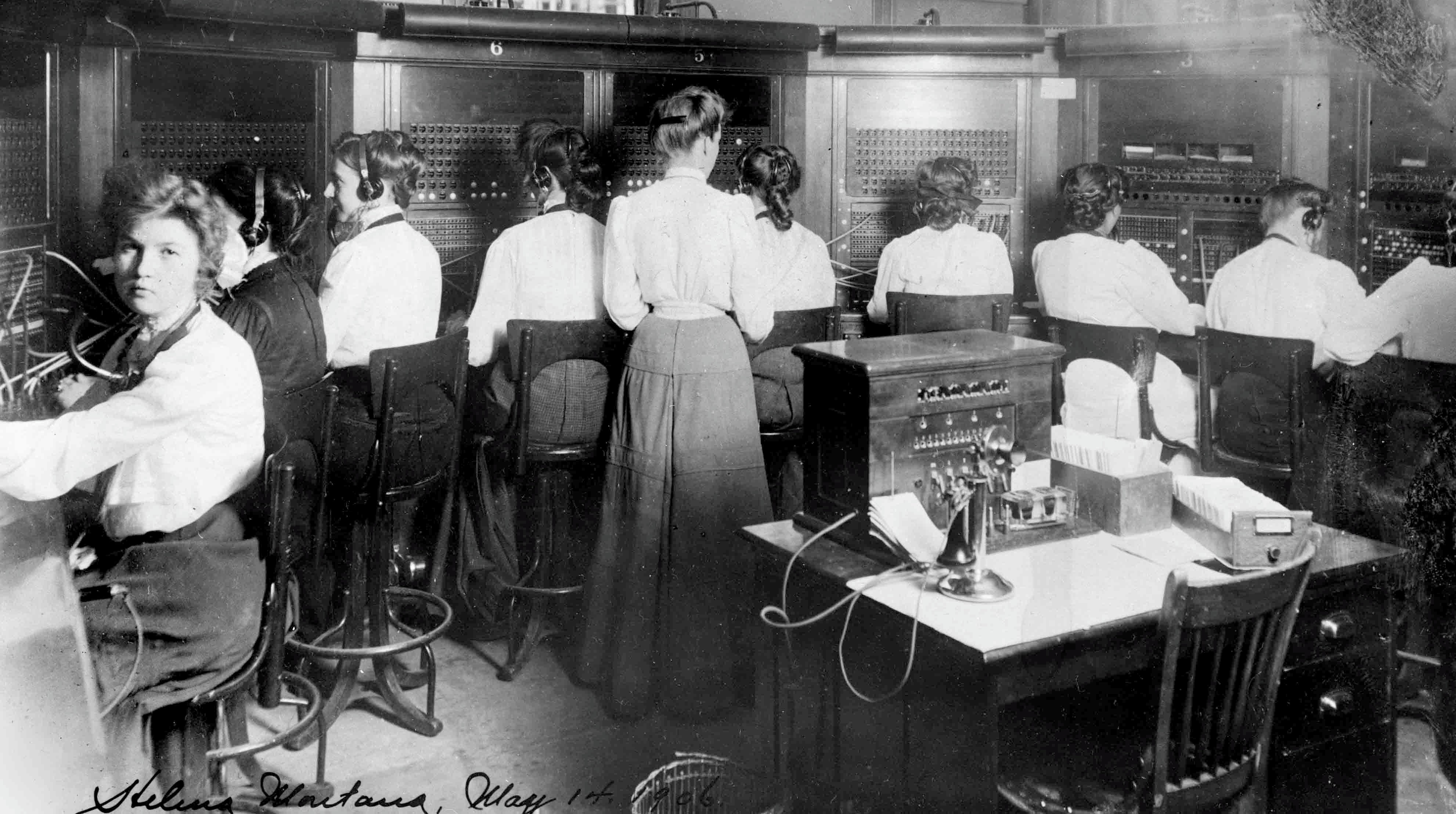
After officers of the union were dismissed in Billings for belonging to the organization, a strike in solidarity of the women telephone operators becomes general throughout Montana.
‘Telephone Tie-up General’ from The Montana News. Vol. 5 No. 18. March 14, 1907.
Company Discriminates Against Union at Billings—Girls Walk Out–Strike Extends over State
The operators of the Rocky Mountain Bell Telephone company in six cities of Montana have gone on a strike and the patrons of the telephones in the cities that are affected cannot do any ringing up and long distance. telephone communication in the state has been discontinued.
The trouble started at Billings, when the president and vice-president of the Telephone Operators union were discharged on Thursday of last week, for belonging to the union and the rest of the girls quit work.
It seems that after the strike of the Helena telephone girls that General Manager Murry for the Telephone Co. with headquarters at Salt Lake, Utah, issued orders to the local managers in Montana to discharge all girls that should join the union as soon as it was known that they belonged to the union, except those employed in Butte and Helena.
The manager of the Billings exchange lost no time in carrying the orders into effect for no sooner were the girls organizing than the president and vice-president of the union were discharged.
The State Federation of Labor got busy and presented a list of grievances to Superintendent Burdick, of the Montana division, accompanied with a proposed schedule to govern the telephone girls of the state.
The schedule is the same as the one in Butte and Helena, which is as follows: Chief operators, $60.00 per month. Toll attendants, $60.00 per month. Assistant toll attendants, $60.00 per month. Operators, $50.00 per month.
All operators shall have every other Sunday off, not to be deducted from their monthly pay.
Full shift operators shall be given nine hours work out of each twenty-four.
All operators shall work half shifts on the following holidays: New Years, Washington’s Birthday, Decoration Day, Fourth of July, Labor Day, Thanksgiving Day and Christmas at full pay.
Nine hours shall constitute a day’s work and all overtime shall be paid at the rate of time and one-half. Operators shall be relieved at least fifteen minutes twice a day.
Full pay shall be given all employees in the Billings exchange for lost time on account of the lock-out, to date from March 7, 1907.
The reinstatement of all operators in the Billings exchange who were employed prior to March 7, 1907, and who were discharged on account of their membership in Billings Telephone Operators’ Union No. 40, Montana Federation of Labor, and the reinstatement of all others who left their positions in sympathy with those discharged.
Mr. Burdick refused to listen to the grievances of the girls, saying that he would have nothing to do with their grievances and would not recognize the union in any way. Mr. Burdick was given time to consider the matter with due notice that if he would not act, a strike would be ordered throughout the state. On Tuesday the girls employed in the exchanges at Great Falls and Red Lodge walked out. The Bozeman and Livingston girls joined the strike Wednesday and the Lewiston union declared a strike today and quit work.
The strike is only started and it is expected that before long it will be general throughout the entire state. The sympathy of the public is with the girls. The Telephone company has had a complete monopoly of the phone business in the state, overworking the employes so much that the public could not get good service. Long hours and small pay has been the motto of the company to the extent of rivaling the sweat shops of the East side in New York.
At Red Lodge one girl is employed twelve hours a day, seven days, for the princely sum of $30 per month. Another girl works thirteen hours a day for seven days a week, and receives the magnificent sum of $27.00 as her month’s wages.
The average wage paid is $30 per month and the average hours worked are twelve per day.
Th average life of efficiency of the telephone girl is six years, after that they break down and become nervous wrecks.
Considering the nerve-racking work that they have and endure, twelve hours or even ten hours are too long. The company is making good profits and doing so at the expense of the girls.
The wages asked are not exorbitant and it is impossible for any girl to keep herself on $30 per month, and it is absolutely out of the question to have any girl give her life to make profits for any telephone company for less than at least a living wage.
The company is endeavoring to secure scabs for Great Falls, but it is not likely to succeed and even if it does it is not likely to do any good, for nobody will use the telephones.
The people have been robbed by the telephone company long enough and do not intend to the girls treated like sweat shop victims any more. While we are with the girls in the struggle, still we would call the people’s attention to the fact that the people should own the telephones.
The Montana News first published in Lewistown, Montana, began as the Judith Basin News published by J. H. Walsh in 1904 as the paper of the Socialist Party of Montana. The Montana News moved from Lewistown to Helena, and from 1905 was edited by Ida Crouch-Hazlett. Splits within the State Party led to a number of conflicts over the paper, which ran as a weekly until 1912.
PDF of full issue: https://chroniclingamerica.loc.gov/lccn/sn84024811/1907-03-14/ed-1/seq-1/
 Revolution's Newsstand