The largest and most successful I.W.W. union, the Agricultural Workers Organization began with an April, 1915 conference in Kansas City with that years’ harvest the first recruiting drive. The meeting below takes stock of that work and includes a speech by Bill Haywood.
‘A Great Meeting of the Agricultural Workers Organization’ from Solidarity. Vol. 6 No. 307. November 27, 1915.
Minneapolis Gathering on Nov. 15 and 16–Transacts Much Business of Importance–Haywood Speaks on Organization.
Minneapolis, Minn., Nov. 20. Much of far-reaching importance was handled by the business meeting of the Agricultural Workers Organization held here, November 15th and 16th.
The meeting was called to order by Ted Fraser. Fraser, Gordon and Thorn were nominated as chairman. Fellow Worker Fraser was elected. Harry Howard was elected Recording Secretary to take a verbatim report of the meeting and transcribe the same to become a permanent possession of the A.W.O. Communications and bills were read and subsequently, with very few exceptions handled under new business. The most important of these, from an organization viewpoint, were letters from various locals in the state of California asking that the A.W.O. invade that state and that delegate be sent to a meeting of the California locals to be held in Sacramento next month. The importance of the orange picking and that the state of California had a summer and winter agriculture in which men were continuously employed was emphasized under new business, but as a great number of the fellow workers were going into that state no regular representative of the A.W.O. was sent there, at least for the time being.
A letter from J.J. Rogers of Omaha Local was also read asking the A.W.O. to organize a branch of the A.W.O. there. Other locals in the middle west wrote making the same request, and all such requests were acted on favorably.
The cases of two expelled members seeking reinstatement was taken up but was deemed to be out of the jurisdiction of the A.W.O. as the A.W.O. did not have copies of the charges on which the members were expelled. There was considerable difference of opinion in regard to these cases and they were left to the members who knew them to make recommendations.
After the meeting was called to order in the afternoon of the 15th and while the conductors were examining cards W.D. Haywood was asked to talk on organization. Haywood said in part:
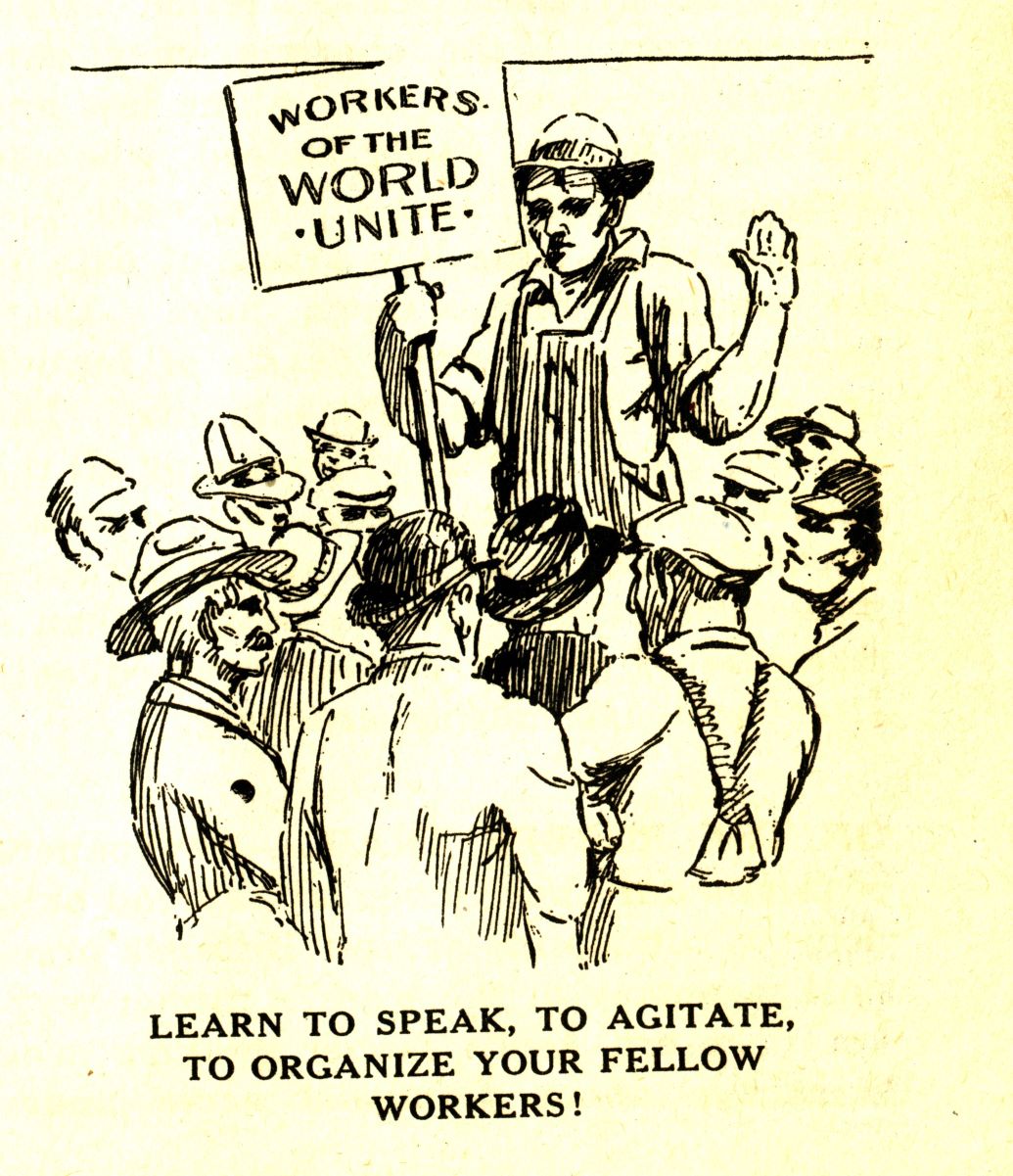
“What the I.W.W. wants is every body of workers to be able to conduct their own business without the intervention of leaders. Every member of this organization should be himself a leader. Every member should be an organizer and conduct himself in such a manner that he can influence other workers to become members of the Industrial Workers of the World.
“In the United States I find that there are 2,700,000 eligible to the A.W.O. I say this that you may see something of the work you have to do before you are well organized, before you have your industry organized, and this, by the way, is one of the most important of all industries. It is one of the cardinal departments of the organization, and one of the first departments. You take in all the men employed in food production.
“Over one billion bushels of wheat were harvested, in this country, this year. Much of this will not go to feed the working class. This winter men and women will be hungry–in need of food. And the reason will be not that there is not sufficient food to eat. The grain elevators are full. There are plenty of millers and bakers to prepare the stuff. And some of the harvest workers who brought the grain in may be among the hungry.
“I don’t think the unemployed question will be as serious as last year, however.”
“There seems to be a spirit among the I.W.W. members to get out of the jungles and onto the job. The members have come to realize that that is the place to organize. The street corner is a good place to sell song books and literature but the place to organize is on the job, just as you have done it this year. This is the message you must take with you from Minneapolis. We are not going to stay here this winter.
“From many places we are getting calls for organizers. In Detroit they are busy.
“In Pennsylvania they have done almost as good as you have in the harvest fields. Joe Smith has reorganized the local at Old Forge. I had a letter the other day saying they had taken in 115 new members in one day. There has been an awakening in the textile industry. Boston Tailors’ Union is on the job, and the last report I received showed they had taken in 39 new members in one meeting.
“The G.E.B. is five members just like yourselves–five stiffs and not any better than the general membership. I don’t like to see this stuff of expelling members, because you cannot expel them from the working class.”
New business was taken up largely with the matter of organization in California, establishing branches in various places where the establishing of such branches would retain the membership of the A.W.O. or add to it. It was decided to go into the Lumber Camps this winter. This is being written Saturday, November 20th, and already 26 delegates are in this section of the A.W.O.’s activity and more are going daily.
It was decided that branches of the A.W.O. with branch charters be placed in Kansas City, Omaha, Sioux City, Des Moines and other points, in cooperation with the recruiting locals.
A 50-cent voluntary assessment stamp for organization work by the A.W.O. was voted for.
James Riley, Joe Gordon, James Phillips, E.W. Latchem and James McPhee were elected on the organization Committee.
The most widely read of I.W.W. newspapers, Solidarity was published by the Industrial Workers of the World from 1909 until 1917. First produced in New Castle, Pennsylvania, and born during the McKees Rocks strike, Solidarity later moved to Cleveland, Ohio until 1917 then spent its last months in Chicago. With a circulation of around 12,000 and a readership many times that, Solidarity was instrumental in defining the Wobbly world-view at the height of their influence in the working class. It was edited over its life by A.M. Stirton, H.A. Goff, Ben H. Williams, Ralph Chaplin who also provided much of the paper’s color, and others. Like nearly all the left press it fell victim to federal repression in 1917.
PDF of full issue: https://www.marxists.org/history/usa/pubs/solidarity-iww/1915/v06-w307-nov-27-1915-solidarity-joe-hil-executionl.pdf
 Revolution's Newsstand