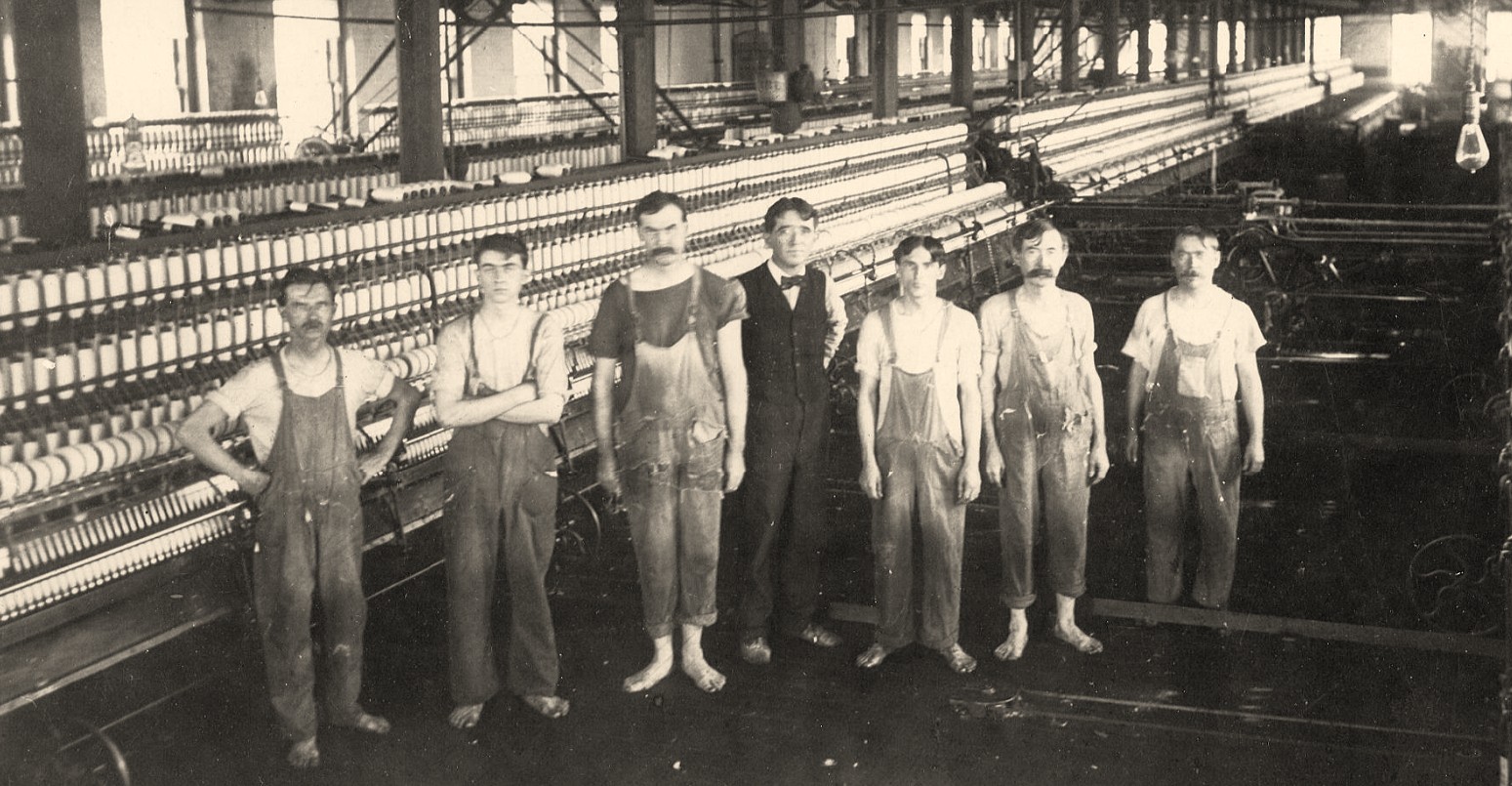
Tariffs, automation, and no unions. Welcome to the past.
‘Much Poverty in Tariff Towns of G.O.P.’ by Art Shields from The Daily Worker. Vol. 2 No. 182. October 21, 1924.
HARD WINTER FOR 25,000 IN COTTON MILLS
LOWELL, Mass., Oct. 20. For a picture of the misery of unorganized textile workers today the reader is invited to the old town of Lowell, where 25,000 cotton mill workers are entering a winter that promises to be the hardest in two decades.
About half the workers are putting in an average of three days a week in the dozen big mills that flank the Concord and Merrimac rivers. The rest have no work.
Times have been hard for a year. They are becoming desperate as savings disappear, and debts increase. A Portuguese grocer showed me his credit books with the bills his customers owe. The first was for $157.68 The little day-to-day entries he compared with those of a year ago. They are ordering less sugar, coffee, bread, macaroni, cheese and necessities generally than a year ago. And the so-called luxuries have almost disappeared from the list. He does not know how he and they will get through the winter unless times get better.
I visited a half dozen homes at random. In the first an Italian family with eight children was crowded into three rooms. A dish of stew, no bread, was on the table before them. One of the kids played a fiddle for desert. Neither father nor mother can get work in the mills. The kids are too small.
In the next place was a middle-aged Belgian couple, with a boy of 16. He left the old country long after his parents: he was in Belgium during the German occupation. He is not eating any more now than he did then. That family lives on credit and the $7 a week the boy earns on a three-day-a-week mill job. Neither parent has worked in three months. The father had a chance to get on in a mill that is trying out a few weavers on a new speedup system, with 38 to 40 looms to a man. “You are an expert weaver,” he was told, “we’ll give you a chance.” He turned it down, considering it a scab job. By scab job he meant one exceeding all the traditions of the craft–a job that meant one more weaver pushed out of doors. The mills are unorganized–that is no union has job control, but there is a measure of solidarity in resisting the attempt to push limit of endurance to the last extreme and to enlarge the unemployed army. Yet the speed-up system is coming in. Twenty-four to thirty-two looms to the weaver are no longer uncommon. The Draper loom is crowding out old equipment.
When a weaver’s looms are doubled the man displaced is sometimes given an unskilled job at the loom filling–assisting the weaver at unskilled wages. Fifteen dollars a week at full time is high for this sort of work in Lowell. There are cases of then working for $7 a week.
Like other New England textile cities the workers are from many lands. French-Canadians lead, Portuguese come next and there are many Greeks, with Italians, Russian, Poles, Irish, Finns and others.
The manufacturers are boosting Coolidge and the Fordney-McCumber tariff, which is supposed to safeguard Lowell from cheap European labor.
The Daily Worker began in 1924 and was published in New York City by the Communist Party US and its predecessor organizations. Among the most long-lasting and important left publications in US history, it had a circulation of 35,000 at its peak. The Daily Worker came from The Ohio Socialist, published by the Left Wing-dominated Socialist Party of Ohio in Cleveland from 1917 to November 1919, when it became became The Toiler, paper of the Communist Labor Party. In December 1921 the above-ground Workers Party of America merged the Toiler with the paper Workers Council to found The Worker, which became The Daily Worker beginning January 13, 1924.
PDF of full issue: https://www.marxists.org/history/usa/pubs/dailyworker/1924/v02a-n182-oct-21-1924-DW-LOC.pdf
 Revolution's Newsstand