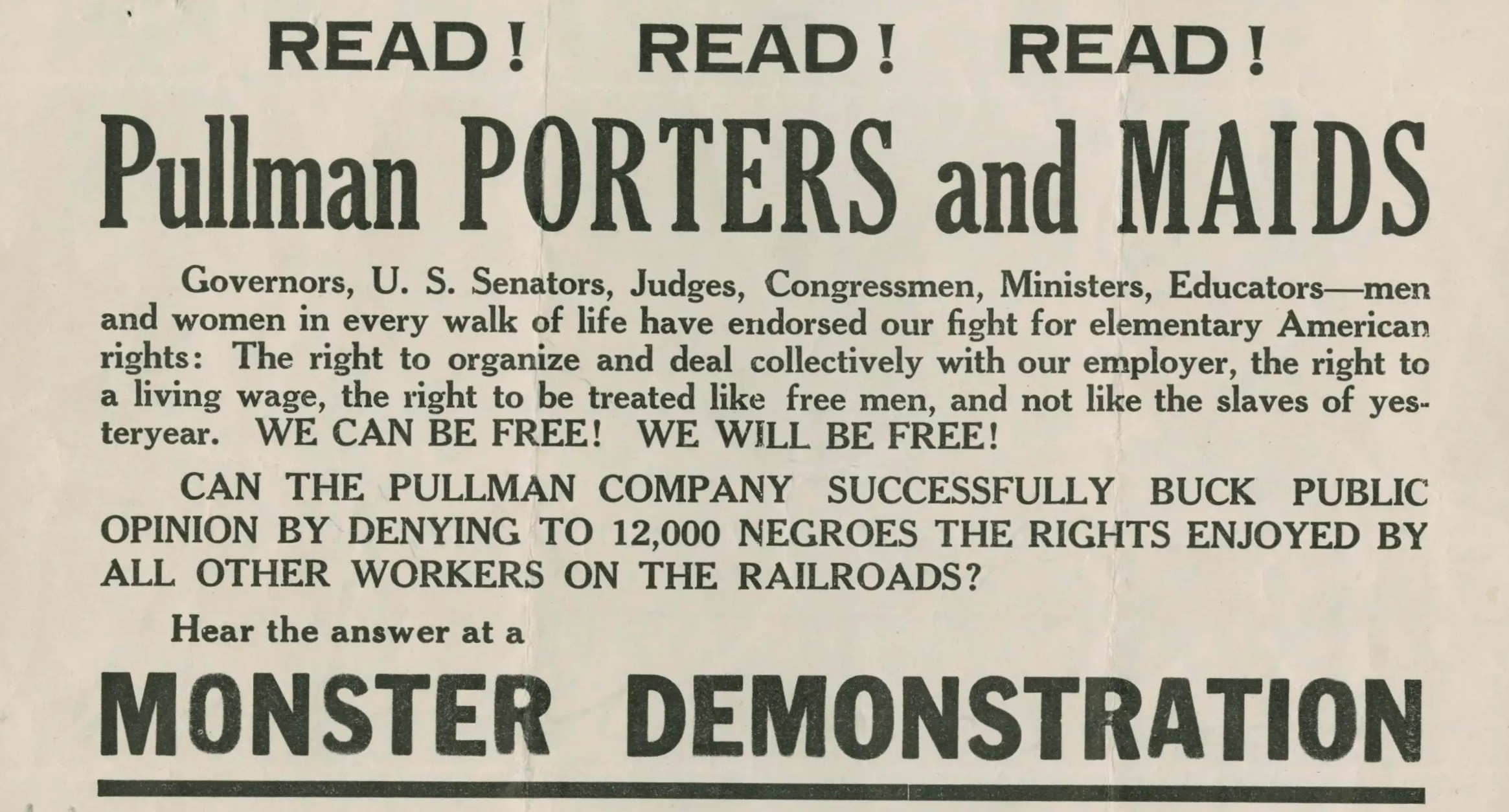
An update from the Secretary-Treasurer of the Brotherhood of Sleeping Car Porters on the campaign to win their union.
‘For the Freedom of the Pullman Porter’ by Roy Lancaster from Labor Age. Vol. 16 No. 10. October, 1927.
Battle for Unionism Reaches a Further Stage
WE pullman porters are determined to gain our freedom. We plan to do that through organization. We have made great headway in that direction; we have gone further, and have impressed the governmental agencies with the fact that we exist and are the voice of the men who work as porters on sleeping cars.
We have had to battle against the perfidy and intimidation of one of the most unscrupulous of corporations. That has not deterred us. We are gaining ground inch by inch. Before it is over, we intend to win a full-fledged victory for our Negro fellow workers.
On this July 11th the representative of our Brotherhood was advised by Mr. Morrow, member of the United States Mediation Board, to come to Chicago to proceed with mediation of the dispute between the Brotherhood of Sleeping Car Porters and the Pullman Company for thirty (30) days. Continued attempts were made by Mr. Morrow until August 9th when Mr. Morrow advised both parties that his attempts at mediation were unsuccessful and advised both parties to submit the dispute to arbitration.
Mr. Morrow recognized the fact that there was a dispute and he also recognized the Brotherhood of Sleeping Car Porters as the legal representative, hence his recommendation. The Pullman. Company knows also that the Brotherhood of Sleeping Car Porters is the legal representative but it is playing for time hoping that the men will become discouraged, and, in the meantime, they will be able to break their spirit. But the reaction has all been in the Brotherhood of Sleeping Car Porters’ favor.
The fact that immediately upon the heels of refusing to arbitrate with the Brotherhood of Sleeping Car Porters, they signed an agreement to arbitrate with the conductors, has caused a large number of hold-outs to join the organization and has also caused a large number, who were in arrears with their dues, to pay up. Some of the oldest men in the service have voluntarily sent in their signed applications stating that they realize what the future holds in store, not only for those who had joined but for all porters, should the effort to organize fail.
One old porter writes: “The Company has very little respect for us and if we fail now one porter is as responsible as another. Not only the Company but the entire world will look upon us as children, mendicants, spineless individuals. I am ashamed but I want to make good by paying from the beginning of the movement including all assessments.”
Another twenty-one year man writes from the Far West that: “I have been a stool pigeon against myself and my brother porters; now I begin being one for them. My knowledge of the inside works fits me to be of much service and by the help of God I shall make amends for my ill-advised, ignorant, maliciousness against my brother porters.”
The Company’s Putrid Record
The Pullman Company, although a party to the enactment of the Watson-Parker Bill which set up the new Railway Labor Law, is the first and only one so far to ignore it.
They do so flagrantly when they refuse to arbitrate—They claim a signed contract with the porters (through their company union) but they do not admit that they broke that alleged contract within twenty-four hours after it was made by refusing to do things they agreed to do. There were minutes of those sessions, that upon unanimous vote they agreed to give all delegates; only the management delegates received them. They. agreed in those minutes to take up immediately the question of Terminal Time and pay for it. This has not been done.
They used persuasion, coercion and threats through their Negro officials to brow-beat the delegates. On every hand the delegates were told if they persisted in demanding certain things they would find themselves out of jobs. This threat was carried out on men who were unfortunately working under unscrupulous superintendents one year after.
When efforts were made by the spokesman of the employees to call another conference to revise that agreement and call the Company to account for ignoring certain things in the agreement, the spokesman was discharged. The porters throughout the country raised up as a man to protest and when ignored, this union, the Brotherhood of Sleeping Car Porters, was the result.
They first ignored the effort, then they began doing some of the things they agreed to in the alleged contract. They paid the men who had records for the doubling they had done. Some were paid as much as one hundred fifty dollars. This would never have been done other than for the fact that the union started agitation on it. But, think of the men who left the service during those fifteen months that probably never received this pay.
When the Pullman Company saw after a year that we meant business, they, not the company union, called an election of delegates for another conference after announcing an eight per cent raise, approximately thirteen cents per day.
Eight men were selected, I say selected advisedly, for men well-known as favoring the union in four of the largest districts with between five hundred and one thousand votes in each district failed election; while men in agencies with ten or fifteen porters, hardly known outside of their agencies were elected.
Labor Age was a left-labor monthly magazine with origins in Socialist Review, journal of the Intercollegiate Socialist Society. Published by the Labor Publication Society from 1921-1933 aligned with the League for Industrial Democracy of left-wing trade unionists across industries. During 1929-33 the magazine was affiliated with the Conference for Progressive Labor Action (CPLA) led by A. J. Muste. James Maurer, Harry W. Laidler, and Louis Budenz were also writers. The orientation of the magazine was industrial unionism, planning, nationalization, and was illustrated with photos and cartoons. With its stress on worker education, social unionism and rank and file activism, it is one of the essential journals of the radical US labor socialist movement of its time.
PDF of full issue: https://www.marxists.org/history/usa/pubs/laborage/v16n10-oct-1927-LA.pdf
 Revolution's Newsstand