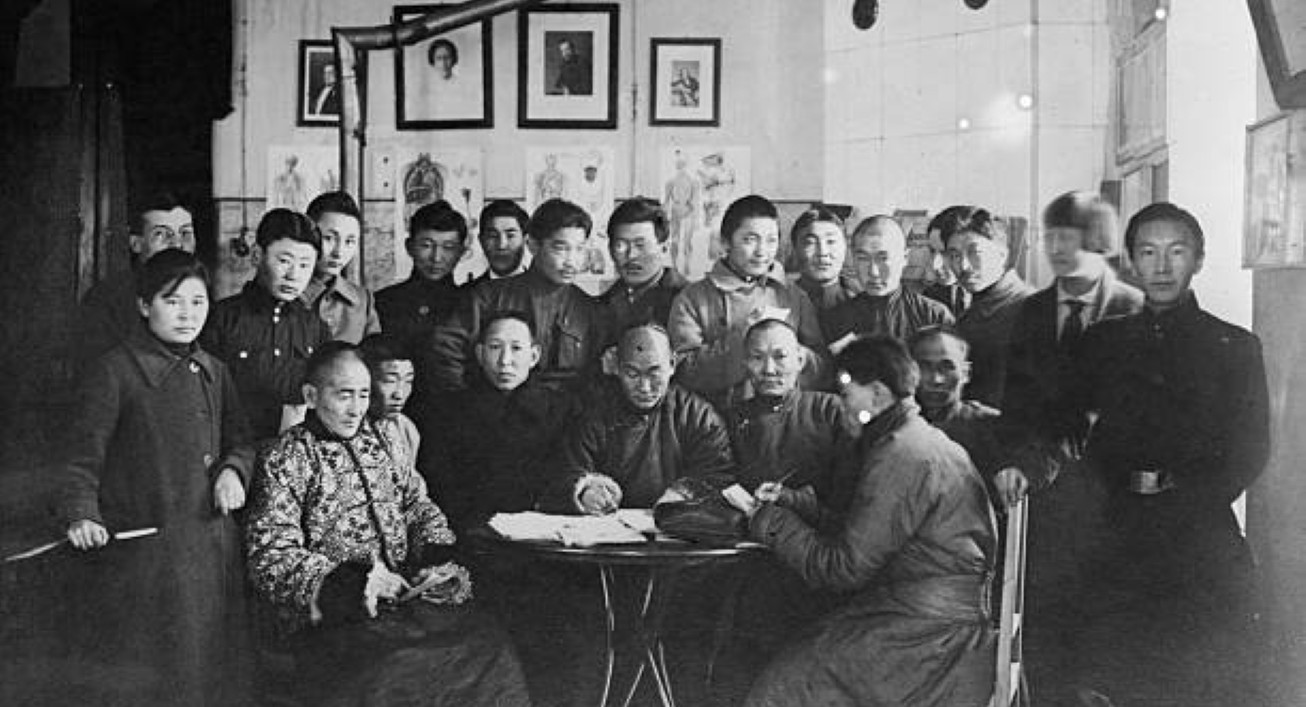
A report of the First Congress of the Revolutionary Youth of the Far East held in Moscow in early 1922 and attended by delegates from the Russian Far East, Korea, China, Japan, and Mongolia.
‘The Dawn is in the East’ from Young Worker. Vol. 1 No. 4. June-July, 1922.
The revolutionary movement in the countries of the Far East is one of the youngest movements of the awakening oppressed peoples of the world. In China and Corea the movement is about 13 years old, while the nationalist movement in Mongolia and the Communist movement in China and Corea have only been started a few years ago. Despite all this, however, the youth is playing, more than anywhere else in the world, a great role in the movement of liberation of the peoples of the East.
The first congress of the revolutionary organisations and Communist Parties of the Far East has been convoked by the Communist International in conscious opposition to the Washington Conference of the imperialist buccaneer states. Half of the delegates were at the same time delegates to the First Conference of the revolutionary youth of the Far East, which was called by the Executive Committee of the Young Communist International. In close and fraternal collaboration with the adult fighters, the youth of the Far East took part in the Conference of the revolutionary organisations and Communist Parties. It was cooperating there on the basis of the general lines of the struggles against Imperialism in the Far East. The delegates of the youth’s organisations had also a seat in the presidium of the conference of the adults and took an active part in the debates.
Immediately after the adjournment of the great conference, the Conference of the youth was opened to discuss three important questions. The participation of the youth in the general struggle, the fulfilment of their special tasks, and their participation in the international movement of the youth.
The revolutionary movement in the Far East is growing rapidly. Not only the Communist Parties and the proletarian elements, but also the oppressed peasantry and the progressive intelligentsia are turning their eyes to the leader of the world revolution, the Communist International, and when the Communist International convoked the Conference, the best and most worthy representatives of this young revolutionary movement travelled all the way to Moscow, in despite of all persecutions and difficulties. An example of the tremendous difficulties encountered, is the story of a delegate from Corea, whose house was raided by the Japanese police, in order to arrest and shoot him as a Communist. He escaped through the chimney, was arrested once more on his way together with two comrades, killed the policeman and walked all the way to Soviet Russia over 800 miles.
As can be gathered from the figures of the credential commission, the majority of the delegates—the most active amongst them—were students and intellectuals. But they are intellectuals who live in the greatest poverty and must earn their daily bread after school hours in printing plants and factories. These students have sacrificed their entire life, their possible career within the bourgeois society, their material well-being which they might have expected, in order to devote themselves to the revolutionary movement, to serve the proletariat. One could compare the sentiment of the young Chinese intellectual revolutionaries with that of the Russian students in the past decade; that of the Japanese (within the Japanese delegation there were more students than in any other) ; with those scarce intellectuals, as for instance John Reed, who joined the American revolutionary working class movement, and that of the Corean with the best of the Jewish revolutionaries who have understood that the liberation of their people is only possible through the emancipation of the world proletariat. The Mongolian League resembles most in its work and fighting spirit the Russian League, because it also participates in the government and supplies the soldiers and officers for the revolutionary republican army of the people. The manner in which the Russian League is attempting to solve the questions of cultural education of its members, the campaign against the church and the question of military training and armament, were of the greatest interest for the delegates from Mongolia.
From this can be gathered the lively spirit, the zeal and enthusiasm of the delegates of the first youth Conference of the Far East.
The first session of the Conference was opened on January 30th by a welcome speech of Comrade Shatzkin on behalf of the Young Communist International which was greeted with stormy applause. A real international presidium was unanimously elected composed of the following comrades: Mayakata (Japan), Li-ll-Gu (Corea), Non-ChoSju (China), Bujan-Nemechu (Mongolia), Simpson (Java), Li-Tshon-Suk (A Corean delegate of the girls of the Far East), Shueler and Shatzkin (Executive Committee of the Young Communist International). As secretaries of the Conference were elected: Dallin (Far Eastern secretariat of the Y.C.I.), Grodiansky (Russia), and Tsch-Kin (Corea) A hearty welcome to the young guard of the movement of the Far East was the speech of Comrade Bela Kun on behalf of the Communist International.
The secretary of the Russian Young Communist League an ex-sailor of the Baltic fleet, Comrade Smorodin, delivered with his thundering youthful voice a fiery address. Following this the representatives of the four delegations (China, Japan, Corea and Mongolia) addressed greetings to the representatives of the other Leagues and to the Communist youth of Russia and of the whole world.
The agenda was a follows:
1. The Young Communist International and its relationship to the youth movement of the Far East.
2. Reports of the different countries.
3. The tasks of the revolutionary youth movement in in the Far East.
4. Manifesto.
Comrade Shueller took the floor as first speaker on the point: The international proletarian youth movement and their cooperation with the movement in the Far East. At the same time detailed written material on the Western youth movement was distributed among the delegates. After the report was unanimously accepted, the following declaration was adopted: “The toiling youth of the Far East enters at its first convention in a close fraternal union with the working youth of the West. We, the young proletarians and peasants at Japan, Corea, China and Mongolia are one with the young workers and peasants of Russia, England, America, Germany and France—the Young Communist International is also our guide and leader, the leader of the tolling youth of the Far East”
At the second session was heard the report of the credential committee and the report of Corea, at the third session those of China, Mongolia and Japan, which we print elsewhere. At the end of the third session Comrade Dallin delivered a long speech on the situation of the youth in the Far East and its movement. He described the development of the youth movement in the Far East, which has followers even in the most remote villages of Corea and Mongolia and on the isles of the Pacific Ocean; he outlined their tasks and pointed out in a friendly spirit their deficiencies and gave advice how to overcome them. In many places of the Far East the youth organisations carry on only the general revolutionary struggle and have a considerable number of adult members within their ranks. These two features are closely linked with each other and were at the beginning necessary. The youth organisations of the Far East must continue to participate just as energetically in the general movement, but they should also conduct the special activities of a real organisation. They should accomplish educational work corresponding to the mentality of the ignorant industrial and peasant youth, they must launch the economic struggle and thus get the working youth on their side and they must learn from the experiences of the Western movement. They must also conduct in the schools a struggle against the reactionary church-school and the patriarchal school and against the colonial and Anglo-Saxon bourgeois-christian method of education and thus win the sympathies of broad masses and organisations of the students who play a great part in the nationalist revolutionary movement. Hardly any youth organisation of the Far East has up to now clearly formulated its program, tactics and methods (the program of several organisations contains on the whole only general slogans such as “liberation of Corea”, “human rights”, “setting up of Communism”). This must be made clear at any rate.
The participation of the youth organisations in the general struggle of emancipation from Imperialism is imperative for the world revolution, but it is nevertheless essential that the principal line be clarified and the youth activities be carried through.
This has been emphasised by the representatives of the various Leagues in the discussion and the theses on the report of Dallin which were unanimously endorsed by the Conference and were also approved by the Executive Committee of the Young Communist International.
After these debates, the representatives of the youth, together with those of the revolutionary organisations and Communist Parties of the Far East went to Petrograd, where both conferences were adjourned on February 1st 1922 in a joint session with the Soviet of Petrograd. The proletariat of Petrograd enthusiastically welcomed the representatives of the revolutionary peoples of the Far East. The great hall of Uritzki Palace was overcrowded. The speech of the representative of the youth organisations, Comrade Li-Il-Gu aroused special enthusiasm. It was a real fraternisation of the Russian proletariat with the young revolutionary movement of the Far East. The conference of the Far East and also of the youth of the Far East was closed by a speech of the chairman of Communist International and also of the Soviet of Petrograd, Comrade Zinovieff.
We publish the figures of the credential commission which characterise the composition of the Conference and the organisations were represented.

Following the conference, the Chinese Comrade Non-Cho-Sju was elected by the Communist youth organisations of the Far East as their representative on the international Bureau Session of the Young Communist International.
The Young Worker was produced by the Young Workers League of America beginning in 1922. The name of the Workers Party youth league followed the name of the adult party, changing to the Young Workers (Communist) League when the Workers Party became the Workers (Communist) Party in 1926. The journal was published monthly in Chicago and continued until 1927 when it moved to New York City and remained in print until 1937. Editors included Oliver Carlson, Martin Abern, Max Schachtman, Nat Kaplan, and Harry Gannes.
For PDF of full issue: https://www.marxists.org/history/usa/pubs/youngworker/v1n4-jun-jul-1922-yw-LB.pdf
 Revolution's Newsstand