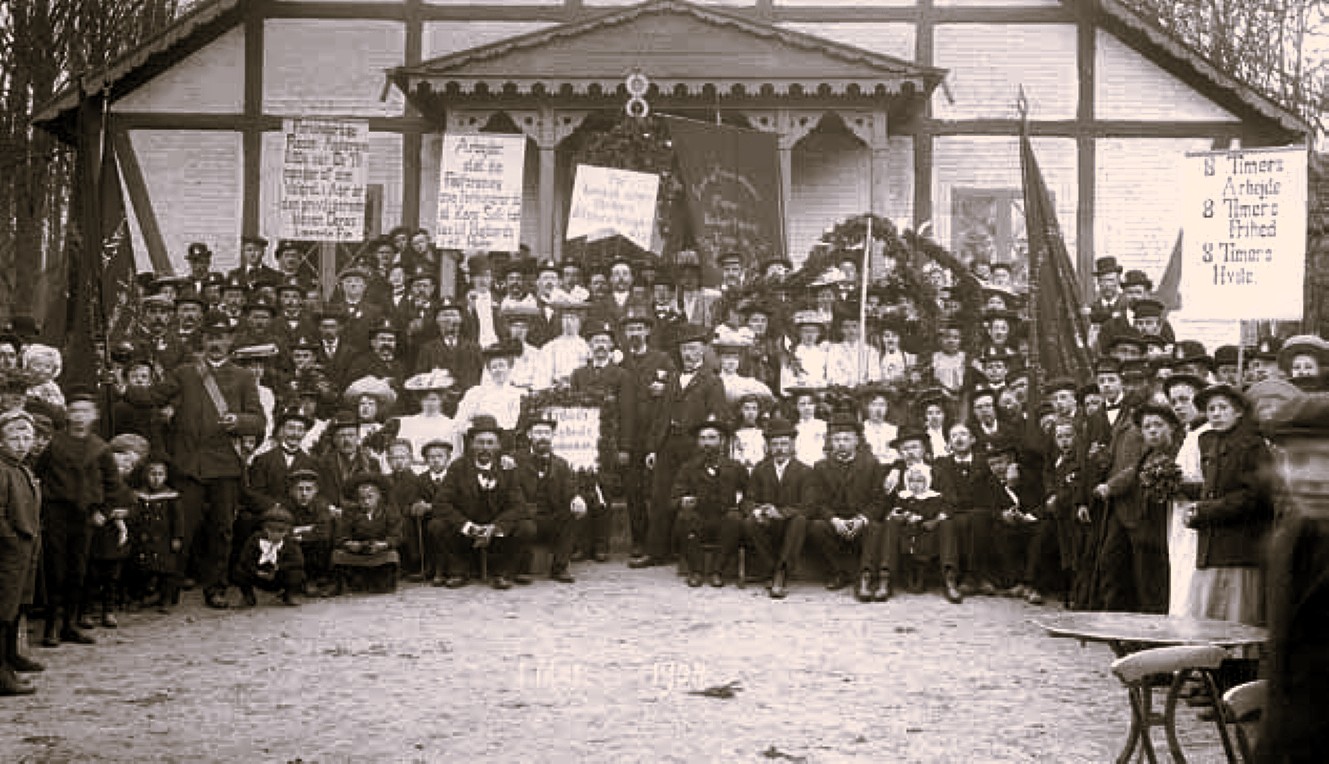
A fascinating report from Nelson as she returns to her native Denmark and exposes Scandinavian Social Democracy, the Danish craft unionism, Swedish syndicalism, and work on the dairy farms of Lolland. Danish-born, San Francisco-based wobbly, revolutionary Socialist, pioneering feminist and birth control advocate Caroline Nelson (1868–1952) wrote for I.W.W. journals and the revolutionary Socialist Party press like Revolt and International Socialist Review., as well as books and translations. She was married to fellow-revolutionary, the iron worker union activist Carl Rave, and was a leading woman’s voice of the Left Wing in the pre-war period.
‘Danish and Swedish Workers’ by Caroline Nelson from Solidarity. Vol. 4 No. 31. August 9, 1913.
The Danish worker is a curious, docile creature. As a trade unionist he is convinced that he has the best organization in the world, although through an agreement with the employing class in 1899 he has tied himself hand and foot. Therein he binds himself not to strike without two weeks’ notice, and two-thirds of the membership shall give their consent by vote before it is lawful; also that new contracts must be presented three months to the bosses for consideration before the old ones run out, and many other things that utterly paralyze all his actions. Nevertheless, the leaders can make the rank and file believe that Denmark possesses the best labor movement in the world.
This craft union movement is chiefly confined to skilled workers and the unskilled connected with them. As is well known, Denmark is a dairy and agricultural country. But the dairy workers’ organization is [word missing] that its activity is practically [word missing] regulating pay and hours. At the moment I am stopping with a relative who is managing a dairy. Every morning at half past five I hear the boys being called, and their work is not done until seven o’clock at night. And for that long day they get on the average per month from $8 to $10 and room and board, after they have served an apprenticeship of four years. Yes, even a barber and a dry goods clerk here must serve four years as apprentices. Then in every town there is a committee of respectable citizens, duly appointed to examine the journeyman’s proof work, as it is called, before he can get his journeyman’s letter. No trade union will take a member in before he is a duly qualified journeyman, according to the citizens’ committee. Here is a fine chance to kick out a rebel, when the Danish workers wake up.
These dairies are for the most part owned collectively by the small farmers. They are collectively owned and operated by them. These farmers are economically shrewd and only hire the manager. He is then paid on the basis of paying and feeding all the other help. The result is that he gets along with the least possible help to keep as much for himself as possible. Yet, the dairy workers are willing to take these managers into their organization upon the ground that the manager is also a worker; they are unable to see that as long as he pays them out of his salary he is their slave-driver. But in reality the dairy workers are anxious to get the managers in, to give a tone of respectability to them. Denmark of all countries is a land of petty snobbery among the workers themselves.
The agricultural workers are also practically unorganized and ill-paid. Many a worker on this little island of Lolland, where the richest soil is, work for two crowns a day and board. A crown is 27 cents. Butter costs on an average more than crown a pound; but in this land of butter making the workers cannot afford to eat. any. They use oleomargarine that costs one-third less than butter. Meat is sky-high, and one cannot get a pair of shoes for less than 10 crowns, so the workers keep on wearing big, heavy wooden shoes. People ask me to write something encouraging about the workers here in Europe. But I think there are enough fakirs to write fairy tales about the workers, without me. I will have to tell my friends in America that as long as I see suffering and the iron heel on the necks of the workers everywhere, I cannot make up fairy tales about wonderful progress. Let the fake socialist and fake labor leader do that.
If you want to be deceived put some high-salaried official in the field to do it. I pay my own way, and shall stick to facts, even if they are disagreeable. The Danish worker on the whole is a slow plodding animal, who takes unkindly to new ideas, and has a crude imagination. He cares little or nothing for reading. One can go into dozens of workers’ houses and never find a book or a magazine around, except the Bible. The socialists pride themselves on the fact that the socialist press has more subscribers than they have votes, whereas France there is only one subscriber to every eleven socialist voters, but that is because the socialist press here gives more news than the awfully poor capitalist press, and because it gives no socialistic material, but glowing accounts of some new law that is about to be instituted for the relief of the downtrodden; and when they succeed in getting a crumb from the capitalist table they parade it for weeks all over the country, making the poor devils believe that all they have to do is to vote the socialist ticket.
In the spring election here the socialists made up with the radical Lefts who are dead set against socialism. In several districts they withdrew their candidates and pledged their votes to the radical candidates to defeat the Rights. Thus they traded and compromised most shamelessly, to get votes, with the promise that the radicals, in turn, should vote for the socialist candidates in other districts. In some places to get the votes of the small farmer and property man in the country, the socialists took off the name “social” from their paper, and sent it to him with the name “democrat” on only. In all the Scandinavian countries they call themselves social democrats, and likewise their papers go by the same name. But in the vote-catching struggle they become “democrats” only. The socialist, by this shameless method, came in the second largest party in the Rigsdag. And they have been celebrating the great, sweeping victory ever since. The king sent for Stanning, the greatest man among them, and had a consultation with him. This was another victory they advertised, by telling that the king himself respected and recognized them as a lawful party, and that therefore it was no longer any use for their opponents to hold up the social democracy to frighten good citizens. But this was too raw for the workers; they couldn’t quite see why the king’s respect was very much of a glory; and this victory had to be strangled in its full flower. If anyone is in doubt about how a powerful socialist party will work, please come to Sweden and Denmark and be wise. And you will say, if you are honest, and not paid to tell a lie or get pie, that verily, the triumph of the socialist party is the defeat of socialism.
The Swedish workers are quite different from the Danish. They are called the French of the North, because they are more sentimental and much easier aroused. They have a lively imagination and can easily get fired with an idea. In whatever the Scandinavian worker undertakes along revolutionary lines, the Swedes will take the lead. But they, too, are hampered with a reactionary labor movement and with political fakers. Nevertheless, the “young socialists,” as they call themselves, are a lively bunch that do an immense amount of agitation and education, and they have produced quite a respectable amount of literature and are thoroughly revolutionary. Their paper, “Brand,” has a large circulation. Altogether the Swedes look promising for future rebellious work. They also have a syndicalist organization, and publish “Syndikalisten” in Malmo.
When I asked the secretary why they published the paper in this little southern town instead of in a big center, he said it was the only town where they could get the publishing done. Before the big strike of 1909 the revolutionists or syndicalists bored from within the old organizations, like they do in England and also Denmark today; but after the strike they pulled out and formed a separate organization. The reactionary labor politician and the conservative labor leader here in Scandinavia are trying to kill the syndicalists by silence. There is hardly ever any reference to them made in either the labor or capitalist press. The small bourgeois may still go frantic over the word socialist, but he will look complacently at the word syndicalism. If the syndicalist makes any fight for better conditions in the shop without the consent of the labor leader, he gets fired and blacklisted. A resolution was offered in the last craft union congress held in Copenhagen to throw out all the syndicalists, which did not carry.
The syndicalists here in Denmark have also a paper called “Solidaritet,” which is well edited by a young man who is quite enthusiastic. When I wrote to him on my arrival that I should be glad to help them, he refused to believe that there was any such being as a Danish woman I.W.W. and exhibited the letter as a new joke. But one day a fellow worker from Australia informed him that I was no joke. The editor explained to me that they are constantly annoyed by all sorts of crazy tricks by people who look upon them as so many horned devils. In the meantime, I see no actual fights. Arvid Johansson, secretary of the syndicalist local in Stockholm, told me that if they should talk on the street they would be arrested, and the Swedish worker fears arrest like poison. I don’t know how the law is in Sweden, but in Denmark if one is punished by the law he loses his citizenship and its rights, including old age pension, and must march to the poorhouse instead. The old age pension is supported by placing a tax on beer, and to date the government has collected many more millions of crowns than it has paid out. So it has made millions on this reform deal, and strengthened itself that much as a capitalist government. Besides these there are old-age homes for the “spotless” poor and others for the “spotted.” In the first they are treated like people; in the second, I am told, conditions are often brutal. Anyone that gets poor–help is spotted like the one who serves a term in jail. In many of the states’ reforms and helps it is designated that the party must be “honorable” to be eligible for the benefit.
And it is these damned reforms that take the backbone out of the workers everywhere, and which the yellow socialist points to with pride and calls for more. In the meantime, the syndicalists are getting restless, and look with longing eye to America, where something is doing. The Scandinavian syndicalist papers give good reports of I.W.W. doings and translate many of the articles from Solidarity and the Worker.
CAROLINE NELSON.
The most widely read of I.W.W. newspapers, Solidarity was published by the Industrial Workers of the World from 1909 until 1917. First produced in New Castle, Pennsylvania, and born during the McKees Rocks strike, Solidarity later moved to Cleveland, Ohio until 1917 then spent its last months in Chicago. With a circulation of around 12,000 and a readership many times that, Solidarity was instrumental in defining the Wobbly world-view at the height of their influence in the working class. It was edited over its life by A.M. Stirton, H.A. Goff, Ben H. Williams, Ralph Chaplin who also provided much of the paper’s color, and others. Like nearly all the left press it fell victim to federal repression in 1917.
PDF of full issue: https://www.marxists.org/history/usa/pubs/solidarity-iww/1913/v04n31-w187-aug-09-1913-solidarity.pdf
 Revolution's Newsstand