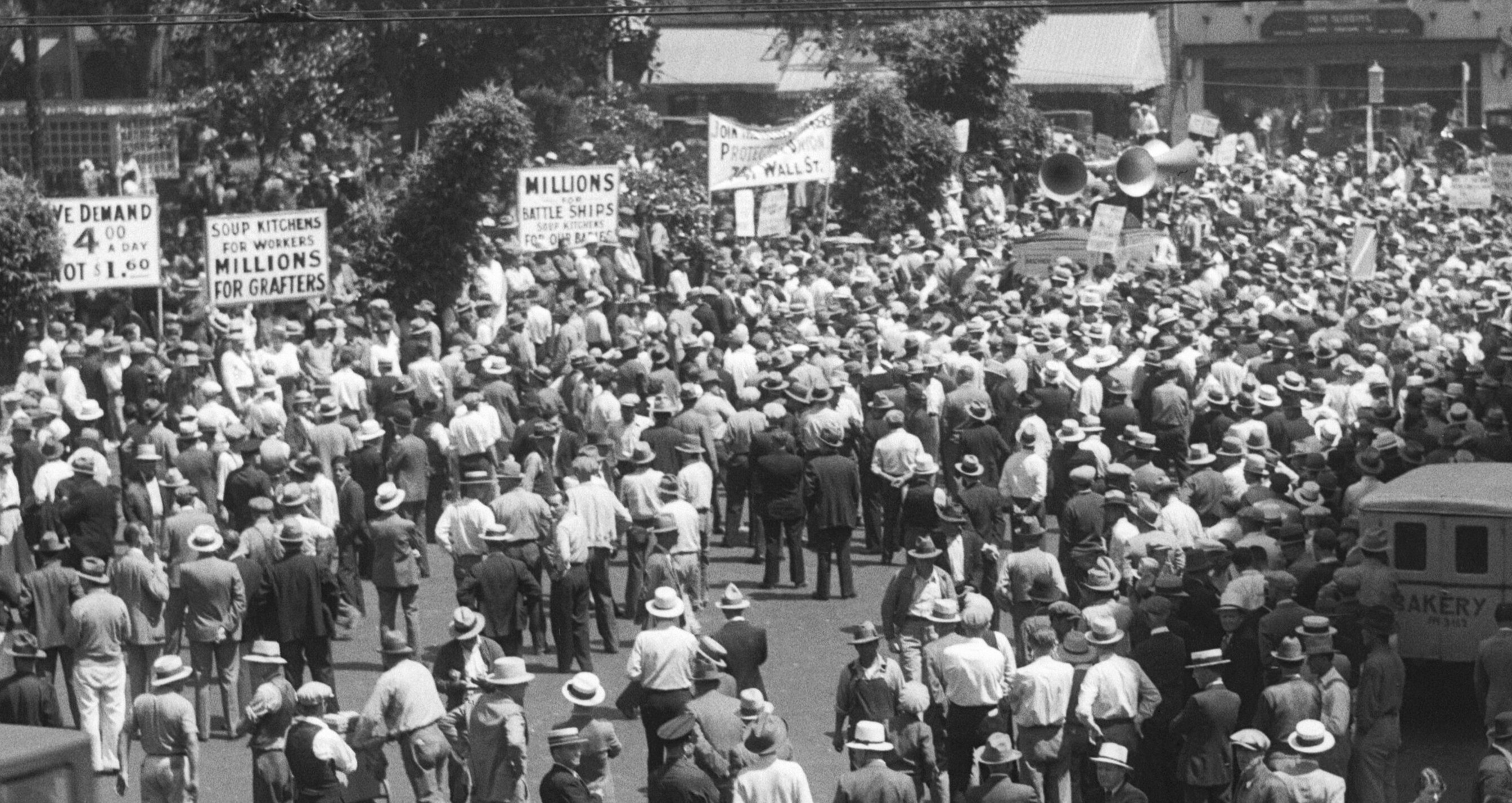
A look at how the Communist Party mobilized tens of thousands in marches against hunger and unemployment in Los Angeles during 1933.
‘How We Organized the Hunger March in Los Angeles’ by E. Hanoff from Western Worker. Vol. 2 No. 44. October 30, 1933.
Defeatist and pessimistic tendencies among some leading comrades in the Los Angeles Section of the Communist Party were dealt a severe blow on Oct. 2 when the jobless turned out in the greatest demonstration that Los Angeles ever saw.
The Communists within such organizations of the unemployed as the Unemployed Councils, Relief Workers Protective Union, Unemployed Co-operative Relief Assn., Unemployed Veterans League, Unemployed Taxpayers League, etc., had been agitating against the 30% cut in relief proposed by the county officials in August. Despite the poor relationship of the section leadership with the unemployed work, in a few days time 15,000 were mobilized at the Plaza on Aug. 22 to protest the cut. This forced the county to delay it.
The Party leadership was isolated from the problems of the jobless. For instance, the Party fraction spent hours the night before the demonstration arguing on the number of speakers. There was no Party steering committee at the demonstration, and we even witnessed the spectacle of comrades arguing at the platform about the arrangements. Organizational results for the Party were poor–about a half dozen applications. Some of the leading comrades were so pessimistic before the demonstration as to predict that not more than 3000 would respond.
The demonstration developed considerable enthusiasm among the Party members and a decision was made to follow up with further action, and although still inadequately prepared, a preliminary conference of the left wing workers organizations was called for Sept. 3. The attendance was 170 delegates of 41 organizations. This time, however, better preparations were made by the leading fraction within the unemployed organizations. It was with the help of its proposals that the conference was able to carry into effect the policy for the Hunger March.
PLAN HUNGER MARCH
Enthusiastic discussion followed reports on conditions and presentation of proposals, and a call was sent out for an enlarged united front conference. The conference was organized into subcommittees, consisting of publicity committee, enlarged speakers committee, finance committee, enlarged visiting committee to visit trade unions, mass organizations, churches, etc., and a committee to get a permit for the Hunger March. It was decided also to distribute 5000 stickers, 50,000 leaflets, 100,000 throwaways, 5000 copies of a special edition of the WESTERN WORKER, 20,000 copies of The HUNGER FIGHTER, and 600 placards and streamers. Participant organizations were to issue leaflets under their own names.
A tremendously enlarged second conference was held on Sunday, Sept. 17, at which 233 accredited delegates from 143 organizations, representing 60,000 workers, were present. In addition to the delegates 500 workers also participated.
All subcommittees reported on progress, the main report being made in the name of the United Front Conference. A comrade greeting the conference in the name of the Party received unanimous enthusiastic applause.
Proposals to intensify activities included the calling of a one-day strike on all relief jobs and the withholding of all workers’ children from school on the day of the Hunger March. All proposals and demands were unanimously adopted. All subcommittees were enlarged to involve a still greater number in the mobilization work.
A final check-up conference was decided upon, to consist of one delegate from each of the participating organizations. The conference, held on Sunday, September 24, was by far the most enthusiastic and best organized one ever held in Los Angeles, lasting from 1 p.m. until 6 p.m.
PARTY MOBILIZED
Four weeks in advance one of the leading members of the Section Committee buro was assigned to devote full time to Hunger March work. The Party units were given instructions in two organizational letters during the month preceding the March, on how to mobilize the Party and to link up all activity with the Hunger March preparations. Organize street meetings, indoor neighborhood meetings, reach factory workers, secure subscriptions, sell the WESTERN WORKER and the DAILY WORKER everywhere, recruit Party members, each unit issue leaflets in their various territories in the name of the Party, were some of the tasks outlined for Party activity. On the day of the Hunger March each unit assigned two of its leading comrades to do recruiting work and one each to sell and secure subscriptions for the WESTERN WORKER and DAILY WORKER. Hard and enthusiastic work of the rank-and-file comrades resulted in excellent organizational results. Hundreds of indoor and open-air meetings were held and about 500,000 leaflets and throwaways were systematically distributed for the March.
During the preparation over 100 new applications were received and on the day of the Hunger March more than 400 made application for membership in the Party, and 200 in the Young Communist League, making contact with many shop workers.
SOME LIVE IN THE PAST
Some leading comrades on the Section Committee, still living in the past, unable to adapt themselves to the changed situation, did not realize the significance of the Hunger March. They could not feel the pulse of the masses and obviously misunderstood the application of the Open Letter in this field of activity. Some took the attitude that a Hunger March is the property of the unemployed and they alone should be responsible for its organization. Such viewpoints were expressed in a concealed form.
These comrades were incapable of understanding the relationship between the struggles of the employed and unemployed; failed to understand the political importance of mobilizing 500,000 on relief to fight for bread, while the bosses are cutting relief to the bone, and above all, failed to fully realize the fighting mood of the workers.
At a Section Committee meeting a week following the first conference, some leading comrades devoted their time to arguing against the slogan of “100,000 Will March” instead of helping to mobilize workers to fulfill the slogan. Displaying defeatism and sectarian bureaucracy these comrades argued that the figure should be cut down to twenty or thirty thousand. Isolation from the masses, misunderstanding their problems and feelings, underestimation and lack of faith in the masses brought about this attitude. Furthermore, changing the slogan would have meant the disregarding of the desire and authority of the United Front Conference of 143 organizations, which had already adopted the slogan.
In spite of these and many other shortcomings, full mobilization of the capitalist press, the police force, “red squad,” terrorism, for two weeks prior to the Hunger March, climaxed by a last-minute refusal of a parade permit, over 40,000 men, women and children participated in the largest, most militant demonstration ever held by the working class in Los Angeles.
LAST MINUTE RESISTANCE
At a special Section Committee meeting the night before the March, called to consider the emergency created by the refusal of the permit which had already been promised, some of the comrades proposed capitulating to the police by the carrying on of a “whispering campaign” to tell the workers where to go instead of the proposal of the section buro which called for one speaker at each of the six concentration points. These comrades were also unable to understand the buro’s proposal to present a motion to the March at the Plaza for another Hunger March on November 7, if the demands were not granted. “How can we tell,” they asked; “what kind of a response we will have and what importance does the date, November 7, have for the workers?”
The night before the March some of the leading comrades were still pessimistic, remarking that “maybe there will be a few thousand workers at the Plaza tomorrow,” but the marvelous turnout of the workers demonstrated the correctness of the slogan adopted by the Conference and belied the pessimism of these comrades.
These leading comrades also objected to Comrade Ross’ speeches at the second enlarged Conference and at the Plaza to the Hunger Marchers because he included in his speeches calls to the workers to build a mass Communist Party. The Party was brought forward too “openly,” they said. This “red scare,” “hide the Party’s face” opportunism was answered by the workers by thunderous applause for the Party and hundreds of ap: plications.
Comparing the two demonstrations, held on Aug. 22 and Oct. 2, we get the following: The Aug. 22 demonstration was left to the Communists in the unemployed organizations alone, with little or no guidance from the Section Committee. The Oct. 2 demonstration was planned and organized by the Section Committee, with the full mobilization of the Party. In addition to the organizational gains for the Communist Party, and the many organizations it leads, it proved to the Los Angeles workers that it is capable of leading them.
SHORTCOMINGS
The shortcomings can be summed up as follows:
1. We failed to give enough initiative to non-Party elements, especially in unemployed organizations, and make them feel that it was their Hunger March.
2. We failed to organize job committees on the county jobs, did not hold sufficient meetings on the jobs, had no systematic leaflet distribution and very few pickets.
3. We failed to have sufficient check-up and guidance to locals of unemployed organizations and small towns throughout the county.
4. A distinct disorganizing effect resulted from the bureaucratically changing of the time of the final check-up meeting, originally scheduled for 11 a.m. on the 24th, to 2 p.m.
5. Lack of militancy and capitulation to the police on the part of some Party members at the six concentration points and along the line of march.
6. Despite endorsement by the Conference of the demand for Federal Unemployment Insurance, it was left out of the demands entirely, not brought to the fore.
7. Failure to establish a broader relationship between the Hunger March and the employed workers.
TASKS FOR NOV. 7
To raise the coming Hunger March to a higher plane we must not become self-satisfied, but rather put all our efforts to carrying out the following:
1. Activity must be more intensified on the basis of the local struggles and we should strive to establish united fronts on the basis of struggles in each locality. This should prove one of the best means for bringing all organizations of the unemployed and individuals under the leadership of the Unemployed Councils, and to cement a powerful mass movement for the struggles this winter.
2. Still broader masses and their organizations should be won for the Nov. 7th Hunger March. The central demand must be Unemployment Insurance and the forcing of concessions for the coming winter.
3. Through the unemployed organizations we should be able to organize many of the workers still working in shops or part time, yet dependent upon relief. They should furnish contact with trade union and shop workers.
4. The new applicants for the Party should be immediately activised, and through them still other workers, their relatives, friends, etc., should be won for the Party.
Western Worker was the publication of the Communist Party in the western United States, focused on the Pacific Coast, from 1933 until 1937. Originally published twice monthly in San Francisco, it grew to a weekly, then a twice-weekly and then merged with the Party’s Daily Worker on the West Coast to form the People’s Daily World which published until 1957. Its issues contain a wealth of information on Communist activity and cultural events in the west of those years.
PDF of full issue: https://www.marxists.org/history/usa/pubs/westernworker/1933/v2n44-oct-30-1933.pdf
 Revolution's Newsstand