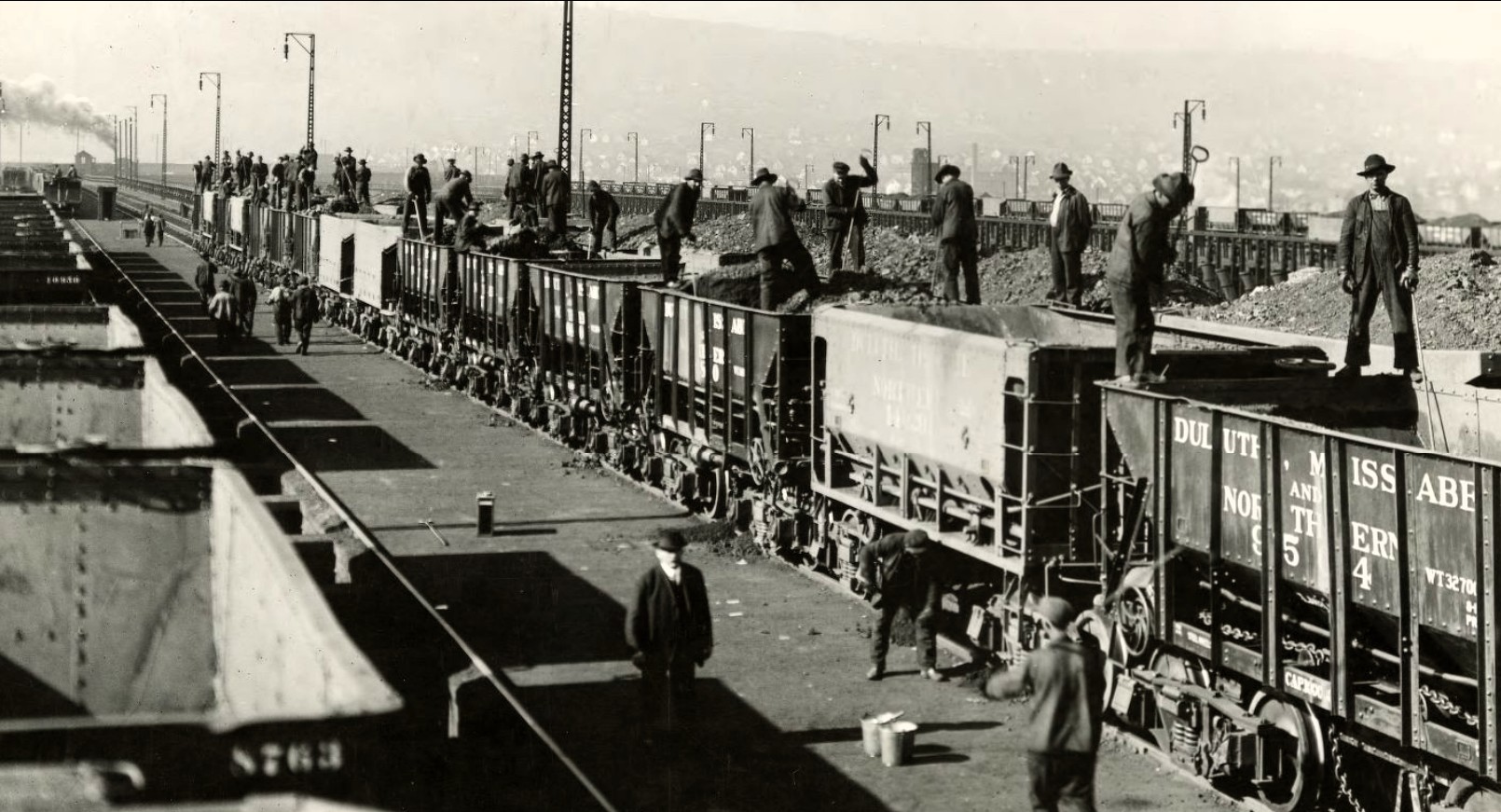
An appeal to the tens of thousands of workers on Great Lakes, a vital internal transportation node of industry’s raw materials, to organize on an industrial basis.
‘Lake Marine Workers on Ships and Docks, a Few Words to You’ from Solidarity. Vol. 4 No. 31. August 9, 1913.
Perhaps you do not know that a smooth, but dirty deal was worked upon you by the Shipping Interests, with the aid of a gang of labor fakirs. It was a game of fakiration by dividing you in craft unions, and getting you whipped one at a time.
First, a fake policy of forming separate unions for dock laborers, and those aboard vessels, was carried. Then a spirit of hostility was created between the longshoremen and seamen. Then they begin scabbing on each other.
Then the captains were made to believe they were too good to associate in the same union with other seamen, so they pulled out, formed a separate union, went on strike, and were thoroughly whipped and broken up.
Then the mates pulled away and formed a separate union, went on strike, were whipped and broken up.
Then the wheelsmen, or pilots were convinced they were of better clay than the other working stiffs aboard the vessels, and they, too, formed a separate union, struck, whipped, broken up.
Ditto the engineers.
Ditto the firemen.
Ditto the stewards.
Ditto the cooks and waiters.
Until at last only the sailors were left, and they, with the rag-tags and bob-tails of the other unions, were almost annihilated by the Lake Carriers’ Association, until every association boat is a synonym for a galley ship of slaves.
As for the International Longshoremen’s Union it has a name as though alive, but is dead, killed by a policy of mutual scabbery.
And we bet a dollar to a doughnut that the great majority of you marine workers are not yet wise to the employers’ game of “divide and conquer.”
Is it not high time for us workers to get wise to this game of splitting-up an industry into a lot of weak, and independent craft unions? Don’t you see it is disastrous to us, but profitable to the employers?
Don’t you think the time has come when the tables should be turned and instead of division all unite in ONE UNION in an industry, so as to put up a solid front to the employers?
Now, suppose all dock laborers, teamsters for shipping companies, officers on vessels who don’t hold any interest in companies, pilots, watchmen, engineers, firemen, cooks and waiters, sailors, deck hands, and all others JOIN INTO ONE UNION OF MARINE TRANSPORTATION WORKERS?
Then suppose when the employers wanted us most we stuck our demands under their noses, and unless they were granted that very day we tie up the entire lake services? Don’t you see that the lake carriers would be in a tight place? In fact if they did not want to lose millions of dollars in profits, as well as have the iron ore, coal, grain, lumber and all other commodities tied up, and business of all kinds losing millions besides, they would have to give in to our demands.
Or, if we so choose, we could strike on the job, that is, go slow, do our work wrong, let fires go down in locks, or in the middle of lakes. We could pull intermittent strikes, that is, strike say for a week or two, go back, work a week, perhaps vary our tactics by going slow and if any got fired, go out again for a week or two and if our demands were not complied with, go back and “put on the wooden shoes.”
Perhaps the machinery would go on strike, and unaccountably machinery wouldn’t work for scabs, if the company got any. Cranes and engines would get out of order, and in general inanimate machinery would buck against scab labor or employers paying small wages or working more than eight hours. Or when a union man was fired the machinery he was working with would “get up its back” and refuse to work.
Don’t you think the employers would see the justice and necessity of granting our demands after such a course of strikes?
As to our demands. Suppose we demand an eight-hour day, time and a half for overtime, Sundays and holidays, and fifty cents per hour for dock laborers. Sixty dollars per month and board as lowest pay for workers on board vessels, with an eight-hour day, time and a half for overtime, Sundays and holidays. Don’t you think that some better than the present starvation wages. Then get into THE MARINE TRANSPORTATION WORKERS UNION OF THE INDUSTRIAL WORKERS OF THE WORLD.
The I.W.W. not only says, “all workers in an industry in one union,” but “all industries into ONE BIG UNION.” Also, “one card good for all industrial unions.”
We would have the railroad workers, the marine workers, the miner, the metal and machinery workers, foodstuff workers, textile workers, farm laborers, lumber workers, and all others refuse to handle scab products or take material to scabs, haul, shelter or feed scabs or gun men. This is the only kind of unionism that counts. And this is what the I.W.W. teaches and does.
All workers on ships and docks get into the Marine Transportation Workers Industrial Union, of the I.W.W., and stick with it.
If there is no union where you work write to Vincent St. John, General Secretary Treasurer of I.W.W., 164 W. Washington Street, Room 367, Chicago, Ill., for information.
Where there is a union come into it, and get your fellow-workers to do so.
AGITATE, EDUCATE, AND ORGANIZE yourselves to be masters of your industry, and not a lot of industrial slaves for industrial pirates.
I.W.W. HEADQUARTERS
Minneapolis, Minn…220 S. Second Street.
Duluth, Minn…907 W. Michigan Street.
Detroit, Mich…285 Gratiot Avenue.
Toledo, Ohio…113 Summit Street.
Cleveland, Ohio…112 Hamilton Avenues.
Conneaut, Ohio…570 Mill Street.
Buffalo, N. Y…423 Elm Street.
Chicago, Ill…2017 Evergreen Avenue.
The most widely read of I.W.W. newspapers, Solidarity was published by the Industrial Workers of the World from 1909 until 1917. First produced in New Castle, Pennsylvania, and born during the McKees Rocks strike, Solidarity later moved to Cleveland, Ohio until 1917 then spent its last months in Chicago. With a circulation of around 12,000 and a readership many times that, Solidarity was instrumental in defining the Wobbly world-view at the height of their influence in the working class. It was edited over its life by A.M. Stirton, H.A. Goff, Ben H. Williams, Ralph Chaplin who also provided much of the paper’s color, and others. Like nearly all the left press it fell victim to federal repression in 1917.
PDF of full issue: https://www.marxists.org/history/usa/pubs/solidarity-iww/1913/v04n31-w187-aug-09-1913-solidarity.pdf
 Revolution's Newsstand