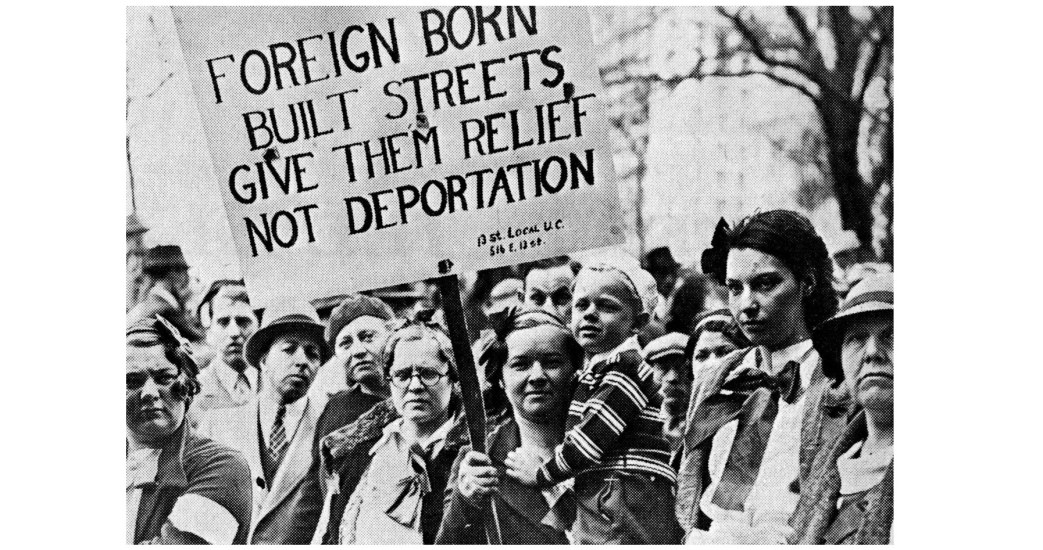
An editorial on the reasons behind the mass deportations during the Hoover Administration under the pious Secretary of Labor, and former rail union bureaucrat, William Doak. Hundreds of thousands of people were rounded up in that period, with all of the associated horrors of such a policy. Foreign-born radicals, even U.S.-born radicals, were a specific target.
‘The Significance of Today’s Deportations of the Foreign-Born’ from The Daily Worker. Vol. 8 No. 87. April 10, 1931.
TODAY the deportation of foreign-born workers is so intensive and so extensive as to be qualitatively distinct from what it was before.
During the partial stabilization of capitalist economy, the deportation, on a mass scale, of foreign-born workers was only a menace intended to intimidate these workers and prevent them from expressing their opposition to capitalist rationalization. An actual deportation of thousands upon thousands was then unpractical, because it offset or neutralized the influence of rationalization upon the reserve army—it left this reserve army as large as before, whereas it was necessary for the capitalist class to swell it through rationalization, to render it larger than it ever was, not only in order to check the Active Army and prevent it from securing during the favorable economic conjuncture (during the relative expansion of industrial activity) an amelioration of its situation, but also in order to exploit it still more and worsen its already bad condition.
Today, instead, the mass deportation of foreign born workers is more than a menace. It is more than a “possibility” arising from the impending approval of a new and more vicious legislation. Naturally, the existing legislation is somewhat “archaic” when compared with the proposed one. But in spite of that the mass deportation of foreign born workers is a dire actuality, a dreadful reality too patent to be denied.
Why? The present economic crisis with the attendant recession of industrial activity far more than triples the size of the reserve army. But that is not all. This crisis is by no means the same as the cyclical crisis which occurred nine or ten years ago. That marked the inception of capitalist partial stabilization. This marks the liquidation of such stabilization. That had as an immediate perspective a temporary solution of the post-war general crisis. This faces an intensification of the same. Not only does this present crisis increase alarmingly the reserve army. It radicalizes this army, it transforms this army into a fighting and militant section of the working class.
Today, therefore, this large reserve army becomes a menace for the capitalist class, it spells ruin. Once this army realizes, under the pressure of misery and starvation, that working class unity is necessary in the struggle against hunger and exploitation, it Is no longer a competing force to be utilized by the capitalist against the working class, but is instead a strengthening force to be hurled by the working class against the capitalist class.
The mass deportation of foreign-born workers does not turn against the capitalist class. It is wrong to think, as many do, that this mass deportation would be impractical for the capitalist class even today, that it would decimate the permanent reserve army needed by the capitalist class. Yes, it is utterly wrong to think so. This decimates the fighting militant proletarian army—without considerably reducing the reserve army which can be enlarged at any time by a new wave of rationalization.
The renovation of a long-forgotten law which authorizes the “voluntary” deportation of distressed “aliens,” shows this quite clearly. It shows that the capitalist class is determined to have a mass deportation of foreign-born workers. In fact, through the so-called “voluntary” deportation the capitalist class is endeavoring to send out of the country not only the workers who in ever greater numbers participate in the class struggle, but even those who, although dissatisfied and restless, do not as yet participate in it and express their unrest by wishing to “go back.” The capitalist class knows that very soon these workers will join in the struggle.
The working class must, therefore, close its ranks and oppose a solid, indissoluble unity of action to the mass deportation of foreign-born workers. Such unity of action must be the immediate aim of the working class in the present situation. The realization of this aim will be a powerful revolutionary lever without which it is materially impossible to defeat the well-planned and organized campaign of the capitalist class, firmly determined to press the deportation of thousands upon thousands of foreign-born workers.
The native elements of the American working class must not fall under the sinister influence of capitalist propaganda. They must not allow this pernicious propaganda to inject into their minds the false notion that a mass deportation of foreign-born workers will help them. They must understand that this mass deportation cannot but harm them. And together with the other elements of the working class they must fight against it—fight and win.
The Daily Worker began in 1924 and was published in New York City by the Communist Party US and its predecessor organizations. Among the most long-lasting and important left publications in US history, it had a circulation of 35,000 at its peak. The Daily Worker came from The Ohio Socialist, published by the Left Wing-dominated Socialist Party of Ohio in Cleveland from 1917 to November 1919, when it became became The Toiler, paper of the Communist Labor Party. In December 1921 the above-ground Workers Party of America merged the Toiler with the paper Workers Council to found The Worker, which became The Daily Worker beginning January 13, 1924. National and City (New York and environs) editions exist.
PDF of full issue: https://www.marxists.org/history/usa/pubs/dailyworker/1931/v08-n087-NY-apr-10-1931-DW-LOC.pdf
 Revolution's Newsstand