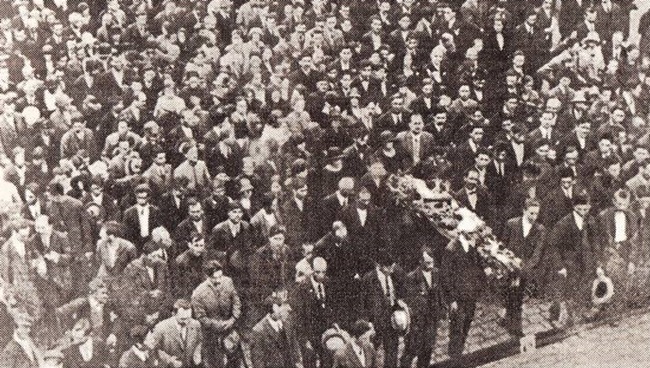
The close relationship of the Bulgarian movement with the Russian is underscored in the 1905 Revolution.
‘1905 in Bulgaria’ by G. Vakalov from International Press Correspondence. Vol. 5 No. 76. October 26, 1925.
The Russian Revolution of 1905 was greeted with enthusiasm by the Bulgarian workers, who hoped that it was the beginning of the end of the existing bourgeois order throughout the world. The Russian Revolution had always been looked upon as the prelude of the revolution of the West European proletariat.
The Workers’ Party came into being in Bulgaria under the direct influence of the Russian revolutionary movement. We imbibed from Russian literature pre-Marxian as well as Marxian Socialism. This had a very salutary effect on the development of the Labour movement of Bulgaria. The Bulgarian workers were interested in, and agitated by the same questions which were part of the life of the Russian workers. Ideologically, the Bulgarian Labour movement was an abridged edition of the Russian labour movement. Much of the Russian Marxist literature was translated, commented upon and expounded in the Bulgarian language. We lived by the ideological life of the Russian Marxists.
The Bulgarian Party sprang up at a time when the “Iskra” came into being. The progress of the labour movement in Russia was felt in Bulgaria as our own progress. Apart from the dissemination of Russian publications in Bulgaria itself, their transfer from Varna to Odessa was also organised. There was also an organisation to supply Russian comrades abroad with Bulgarian passports. The victory of revolutionary Marxism which was heralded with the first number of the “Iskra” helped us to settle our own quarrels as to tactics.
In this respect Lenin’s pamphlet, “What is to be Done” played a particularly brilliant role.
It was just during this rise of the revolutionary movement of the Russian workers that the Bulgarian Party, influenced by it, freed itself from the opportunist elements, ejected from its midst the so-called “broad” socialists, and became the Party of revolutionary Marxism. The revolution of 1905 finally determined the position of our Party.
There were no mass movements at that time in Bulgaria. The workers were unable to rise and to exact better conditions for themselves by common action. This was the time when the Bulgarian workers were severing from the petty-bourgeoisie and were establishing their own class party. 1905 could not play in the Bulgarian movement the role which 1917 was destined to play. But it did its work in Bulgaria in rousing revolutionary feeling and pointing to revolution as the only way to liberation. Through it, revolutionary Marxism became the ideology of the working class of Bulgaria.
But it would be wrong to imagine that the influence of 1905 found its reflection only in the upper strata of the working class of Bulgaria. It spread gradually to ever-growing sections of workers. There had never before been so many workers assemblies and meetings. The masses, on learning about the deeds of their Russian brothers, were filled with enthusiasm and faith in a speedy victory of labour.
For a whole year, Bulgarian comrades followed with intense attention the events in Russia. They rejoiced and were saddened in turn at the joys and sufferings of the Russian workers. I well remember with what excitement they were expecting the “floating Socialist Republic” the arrival of the “Potemkin” at the shores of Bulgaria. Night after night comrades watched on the shore in Varna, waiting in vain for the vessel which subsequently cast anchor in the port of Constance in Roumania. Many of its sailors came to Bulgaria, but the Bulgarian Government of Stambulist Petkoff issued a secret circular ordering that they be taken across the frontier of Bulgaria. At that time the Bulgarian Government was of an anti-Russian nature, which, however, did not prevent it from interference in the interests of the tsarist government. The class interests of the Bulgarian bourgeoisie were evidently stronger than the anti-Russian tendencies of the government. Our Party has always fought against the tsarist policy of conquest in the Balkans. The revolution of 1905 called for an enormous number of workers meetings in Bulgaria to protest against the tsarist policy. The attitude of the Bulgarian government to the Potemkin rebels gave the Party an opportunity to expose the class nature of the policy of this government and to call the masses to the revolutionary struggle for Socialism.
From the very beginning the Bulgarian revolutionary movement was connected with the Russian movement. 1905 strengthened this indissoluble connection for all time.
International Press Correspondence, widely known as”Inprecorr” was published by the Executive Committee of the Communist International (ECCI) regularly in German and English, occasionally in many other languages, beginning in 1921 and lasting in English until 1938. Inprecorr’s role was to supply translated articles to the English-speaking press of the International from the Comintern’s different sections, as well as news and statements from the ECCI. Many ‘Daily Worker’ and ‘Communist’ articles originated in Inprecorr, and it also published articles by American comrades for use in other countries. It was published at least weekly, and often thrice weekly.
PDF of full issue: https://www.marxists.org/history/international/comintern/inprecor/1925/v05n76-oct-26-1925-inprecor.pdf
 Revolution's Newsstand