Max Eastman at his best in this enraged essay on the reality of the United States as 1919’s Red Summer rolled on. In an article that could be written today, Eastman refutes that religiously-held notion that free speech and due process are ‘Americanisms.’ They most certainly are not.
‘Examples of “Americanism”’ by Max Eastman from The Liberator. Vol. 3 No. 2. February, 1920.
IT may be good politics, but it is poor science to say, as the New Republic did recently, that freedom of speech and a respect for the due process of law are “among the fundamentals of true Americanism.” If that rather vacant abstraction Americanism means anything at all, it must derive its meaning mainly from the qualities which American people possess in greater degree or wider distribution than other capitalistic peoples. They certainly do not possess in such a way the freedom to express unpopular opinions. England surpasses them in this respect, and always has. So does Italy, and France, and even Germany. Without reviewing a thousand cases, it suffices to state in general that where the American republic imprisons agitators for a number of years, the republics and monarchies of Europe imprison them for the same number of months.
Moreover, in Europe agitators are rarely imprisoned at all for merely saying things. The doctrine that treason requires an overt act–embedded with some other precious gems in the unexplored depths of our Constitution–is with them a tenet of everyday common sense. Only the other day in the great auditorium at Albert Hall, a sort of Madison Square Garden of London, John Maclean and Tom Mann, advocated the formation of Soviets, and openly advised the British workers to prepare for the revolutionary seizure of power. In France at the recent Congress of the Federation of Labor, Loriot said–according to a conservative labor paper–“There is only one solution possible, deliberate revolution. A violent revolutionary movement is inevitable.” Nobody thought of proceeding against him in the courts. In Germany a White Terror prevails at the moment which in some respects exceeds our own. But it is the result of actual insurrections, and even there an open rebel like Ernst Toller, who led a Communist red army against the armies of the government, has been sentenced to only three years in prison! As for Italy–there the revolutionary proletariat is too powerful for any measures of suppression.
For my part I desire that the change from a capitalist to a communist society may be as peaceful and orderly as possible, and it is not through any temperamental liking for violence that I make these comparisons. But in face of the fact that the ruling class of the United States is more intolerant, more ruthless and brutal, more inconsiderate of the rights of men and of families, less restrained by any relic or memory of the ideals of freedom which meant so much in the eighteenth century, less tempered in its tyranny by any drop of mercy or reverence for the person of the dreamer and the prophet, than any ruling-class in the world outside of Japan–in the face of this fact I object to any further propagation of the idea that a superior liberty is among the “fundamentals of Americanism.” It is not.
The truth is that our opinion that we are a “free country,” our self-complacent traditional libertarian emotion–soaring along like the Wilsonian rhetoric above all consideration of deeds or actualities–makes it possible for us to commit atrocities of repression that any people with a little saving color of shame or self-criticism in their make-up would find impossible. We are not distinguished by freedom, but by the sanctimoniousness with which we institute the grossest forms of tyranny.
As for making a regard for due process of law another of the “fundamentals of Americanism”–there is not any laughter large enough to greet the absurdity of this proposal. There is not any civilized country in the globe–Japan or any other–where in the absence of actual civil war, so little regard is paid, either by the publicly constituted authorities or by self-constituted authorities, by mobs, thugs, private gunmen, military and “patriotic” societies, to the legal rights of the people they object to, as in the United States. It is the birth-place and abode of lynch-law. On New Year’s Day I was talking to a prominent English reformer on his way back to London. “You have it harder,” he said to me–“where we go out expecting to get pummeled a bit, you have to go out expecting to get lynched.”
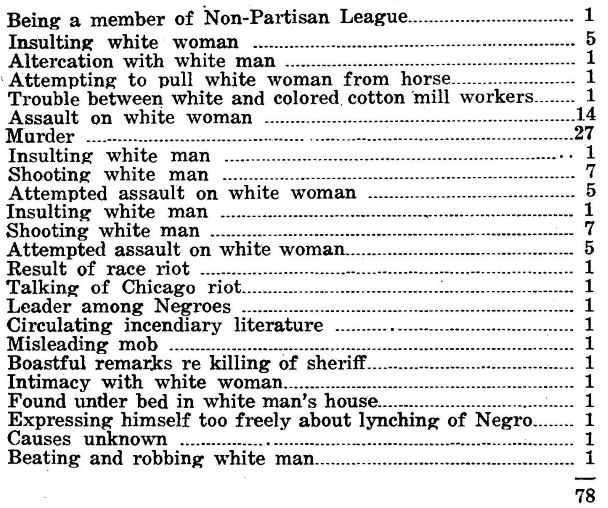
It is the common opinion in Europe. It is the plain truth. Why should we deceive ourselves about it? Where a British or a French or a German community occasionally takes the law into its hands and drives an obnoxious person out of town, an American community drags him into the public square and hangs him until he is dead. We lynched six white men last year and 72 negroes. One of the latter, a soldier, was lynched for the crime of refusing to turn out of the road for a white man to pass. Here is a list of the crimes for which, or upon suspicion of which, we have lawlessly murdered all these citizens–one every four days:
On July 25th last the French Chamber of Deputies, after debating the attempt of American officers to persuade the French authorities that negro soldiers are not to be given the respect or protection accorded to white citizens, passed unanimously a resolution which is so bitter and terrible a rebuke to the American republic that it ought to make the advocates of 100 per cent Americanism hang down their heads in shame.
“The chamber, true to the immortal principles which have inspired the declaration of the rights of man and of the citizen, reproving and condemning all prejudices of confession, caste and of race, affirms and proclaims absolute equality and the protection of all by the laws of the country. (Applause.)
“It counts upon the government to impose upon all respect for these laws and in particular to pursue with energy all the measures to prevent infractions of the penal law committed upon national territory, no matter who be the authors or the victims of these infractions, and it moves the order of the day. (Loud applause.)
“I put this order of the day to vote.”
(The order of the day is put to vote and adopted.)
The president–“I declare that the vote was unanimous.” (Applause.)
Victor Berger has been twice elected to Congress by his constituents in Wisconsin; he is not a revolutionist, a communist, or in any degree opposed to the present forms of democratic government. Yet he is deprived of the right to speak, arrested and deported from one city to another by mayors and chiefs of police. Nobody dreams of suggesting that any “process of law” is necessary in order to make a scape-goat of this “elected representative of the people.” What chance have the obscure, the destitute, those who are without influential friends and yet have some scientific opinions about the historic process we are in? Their chance of any better protection than that which is afforded to cattle, is suggested in these headlines, all from one issue of the New York Times:
ROUND UP OF REDS.
100 TAKEN IN AND NEAR BUFFALO.
RAIDS IN 17 CONNECTICUT TOWNS.
FIFTEEN TAKEN IN BRIDGEPORT.
SEIZE 150 RADICALS IN NASHUA.
65 ARRESTED IN MANCHESTER.
SEIZE 30 RUSSIANS IN BOSTON.
SEIZE EIGHT AT LAWRENCE.
NINE ARRESTS MADE AT HOLYOKE.
WORCESTER’S TOTAL EXCEEDS 50.
TAKE THIRTY AT LOWELL.
TWENTY-ONE ARRESTED IN HAVERHILL.
SPRINGFIELD ROUNDS UP 65.
SEVERAL ARRESTS IN RHODE ISLAND.
ROUND UP 18 AT BALTIMORE.
OAKLAND RAID NETS FIFTEEN.
LOUISVILLE’S BAG IS TWENTY.
These unfortunate people will be put through a cursory examination and according to the temporary disposition of the examiner, their future lives will be disposed of. If the precedent set in the case of the Buford is followed, they will not only be forcibly separated from their families, but many of them will even be denied an opportunity to arrange with their families a plan of future communication. As the Buford prepared to sail, we were treated in the press to the story that a gang of anarchist women came down to the battery, assailed and attempted to destroy the ferry-building which gives entrance to the immigration station where the “reds” were confined. These were wives and mothers and sisters and sweethearts torn from those they loved and upon whom they depended. Women pregnant and without any means of support, women with families of children thrown into the street because their livelihood had been taken away, were among them. And some of these women were not only thus left homeless and destitute, but they were left without any plan or prospect of ever meeting their husbands again. They tore at the gates and broke the windows of the ferry station in the agony of grief and despair. Whether the government that committed this atrocious thing, or the press that laughed at it as an “anarchist riot,” is the more contemptible it is hard to say. But they must both be included if we are to give any real meaning to that abstraction, Americanism. I believe there is no one of the five great nations with which America associated herself in the recent war, where such deportations, if they should be enacted at all, would be enacted in so ruthless and brutal a way.
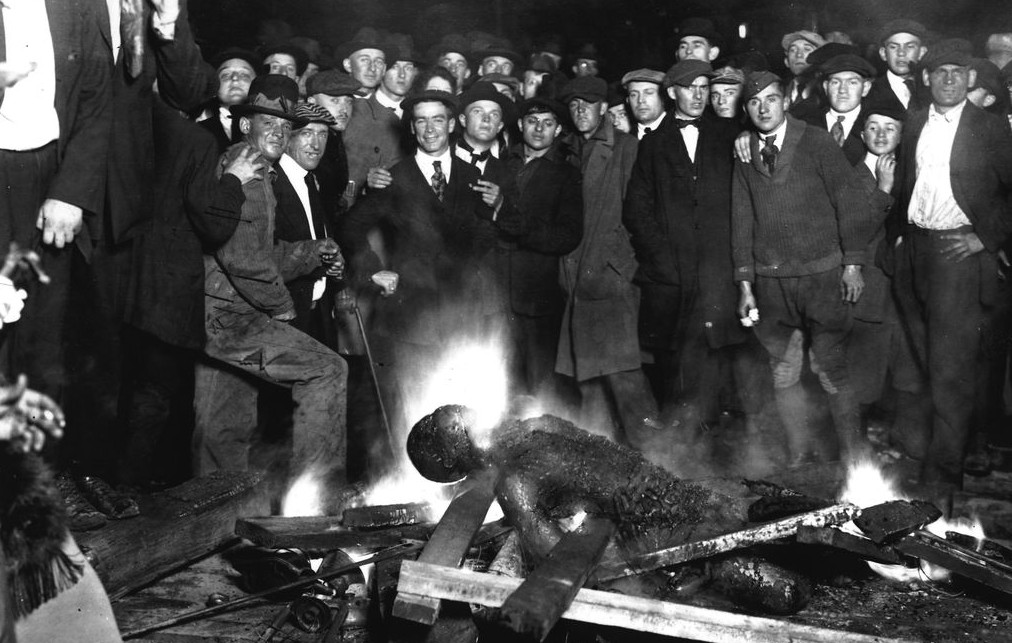
Our final tribute of devotion to “law and order” was paid last Fall in the great city of Omaha, where a mob of many thousands of representative American men and women twice attempted to lynch their own elected mayor, stringing him up to a lamp-post and standing around yelling until he was cut down and dragged away unconscious by some audacious individual, to come slowly back to life after many days in a hospital. He was lynched for the simple reason that he insisted upon “due process of law.” The citizens had assembled to lynch a negro; the negro was in the Court House; the mayor stood on the Court House steps and said he would defend the negro’s right to a jury trial with his life. Somebody yelled “negro lover,” and that was enough. After stringing the mayor up to a lamp-post half a block down the street, they came back–many thousands of average Americans–and burned their own Court House, set fire to it on all sides, in order to smoke out the little lonely company of peculiar individuals inside who were still insisting on “due process of law.” I saw that Court House the other day as I was passing through Omaha. It is not a little country-town brick building, as you must imagine. It is an immense pillared structure occupying, with the wide plaza before it, an entire block. It is twice as large as the New York public library, and has all the austerity and majesty that are traditionally associated with the idea of law and government. Standing there wrecked and smoked and gutted by the people to whom it belongs, in their anger at the suggestion of “due process of law,” it is too symbolic of the way we are going to be ignored by anyone who is seriously seeking to describe Americanism. The fact that the whole performance was instigated and steered from the office of a nationally famous newspaper, makes it all the more typical. For our newspapers from coast to coast, with hardly a dozen exceptions, make daily incitement to mob-violence, daily intimations that certain large classes of people are outside the protection of the law.
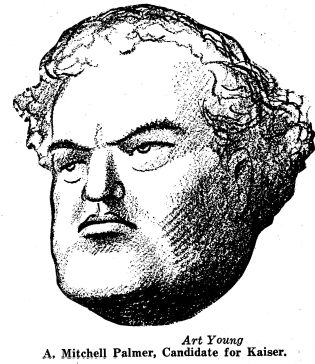
These incitements and intimations are the stock-in-trade of those who shout the loudest about Americanism. As I passed through Denver I was told by a prominent business-man that Leonard Wood, who is seeking the presidency on a basis of 100 per cent Americanism, had related to an audience the day before, a suggestion that all the radicals should be “loaded into a concrete vessel and just shipped to hell.” “Ship or shoot” is one of the mottoes upon which he expects to secure the presidency. In the Chicago Tribune I read the following account of a speech by Theodore Roosevelt, Jr., to the American legion:
“He was cheered by 3,000 listeners grouped around the Khaki and Blue club in Grant park as he told them:
“You will always find us ready to stand for the ideals of this country handed down by our fathers and tempered by Europe’s fire. First, last, and always we are 100 per cent American.
“Bolshevists, the I.W.W. and red flag Socialists,” he cried. “I see as criminals, to be treated as such. Don’t argue or temporize with criminals. Go to bat and meet ’em head on.”
I may be a little over-sensitive, but as I read these words I felt that the members of the American Legion had been advised by their most conspicuous leader to assault and if necessary murder me, and several million like me in their opinions. I am not complaining of this crime of Roosevelt’s. Complaints would be futile. A district-attorney would laugh in my face. What I am complaining of is the further propagation by intelligent people of the idea that a regard for due process of law is a distinguishing American characteristic. The opposite is true. There are crimes and pogroms and persecutions elsewhere, but America is the only place in the world where people seek office by boasting of their contempt for the legal and constitutional rights of men.
America is a great place. There is something lusty even in this recklessness of all the rights and enactments that have made organized society possible–a dare-devil devotion to economic adventure, and let all other rules and decencies perish. The same devotion might seem noble directed to a greater end. But there is nothing lusty and nothing in any way great or acceptable about the sentimental falsification of these facts, the pretense that Americans are circumspect about any kind of liberty but the liberty to do business, or any process of law but those which protect the rights of property. Their most conspicuous national characteristic, at the present time at least, is a contempt for personal liberty and an established custom of taking the law into their own hands whenever they feel like it.
As our train pulled into Omaha I spoke to a typical middle-western business man–strong, masterful, heavy in the jowl, meticulously clean and silky, but bad-mannered and noisy with his throat and nose. I spoke to him because I knew that he lived in Omaha, and because I had heard him proclaiming his “devotion to law and order” in the buffet-car. He had stated that all those who oppose the constitution “ought to be stood up against a wall and shot.’ His speech was so typically American that I suspected when he said “law and order” he meant property. I asked him about the outrage in his town, and expressed a little mild surprise that citizens should burn down their own public buildings, and string up their own mayor because he tried to enforce the law.
“Yes, it was a damn shame,” he said, “not the mayor–I guess he got pretty fresh–but it was a damn shame to destroy that building!”
The first reaction of an abstract mind to the question “What is Americanism,” would be to say there is no such thing. America has derived its population from all races and nations, and therefore no American characteristic except mere diversity itself can be found. Upon reflection, however, it appears that quite the opposite is true. Each race possesses all the human characteristics in a good deal the same proportion. But America was founded, and has been populated, by certain definite types selected from all the races–namely, the types that get up and go away from home. They are restless types, and rather hard–pioneers, economic adventurers, for the most part. A disproportionate number of criminals, black sheep, debentured servants, persons fleeing from scandal of one kind or another, are among them. It is impossible to describe them very explicitly, but in general, in the very nature of the case, they possess the aggressive masculine non-parental virtues and vices, rather than the virtues and vices of the more preserving and sympathetic side of our nature. That a population composed of these people and their descendants should have an exaggerated regard for the rights and liberties of those who get in their way, that they should have a more than usual respect for the forms of law, is incredible. They have, as a matter of fact, a very extraordinary indifference to the rights and liberties of others, and a contempt for the forms of law that is phenomenal.
The Liberator was published monthly from 1918, first established by Max Eastman and his sister Crystal Eastman continuing The Masses, was shut down by the US Government during World War One. Like The Masses, The Liberator contained some of the best radical journalism of its, or any, day. It combined political coverage with the arts, culture, and a commitment to revolutionary politics. Increasingly, The Liberator oriented to the Communist movement and by late 1922 was a de facto publication of the Party. In 1924, The Liberator merged with Labor Herald and Soviet Russia Pictorial into Workers Monthly. An essential magazine of the US left.
PDF of full issue: https://www.marxists.org/history/usa/culture/pubs/liberator/1920/02/v3n02-w23-feb-1920-liberator-hr.pdf
 Revolution's Newsstand