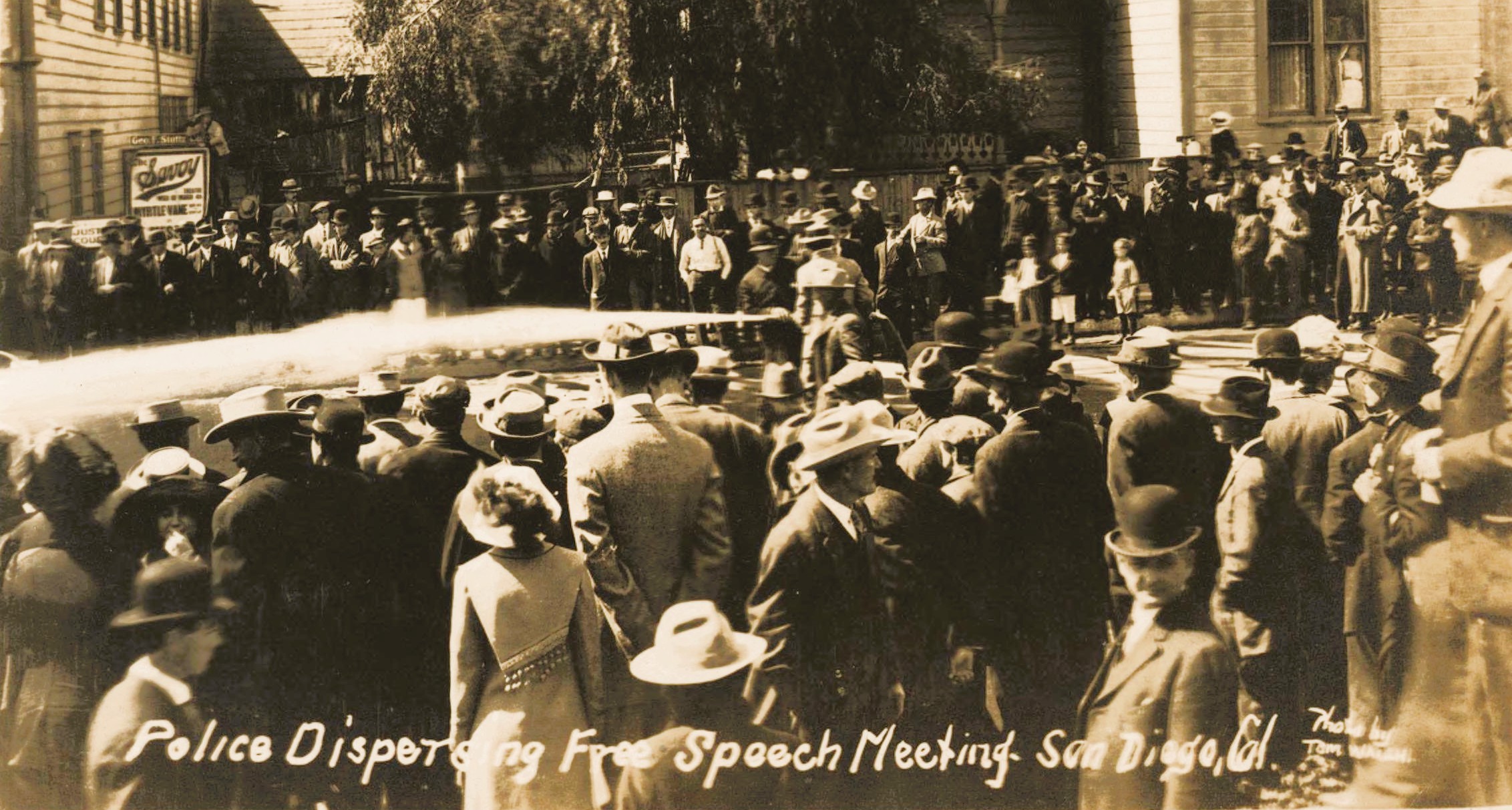
Caroline Nelson, with her usual élan, reports on the centrality of the free speech fight then under way in San Diego and a solidarity meeting in San Francisco spoke to by Austin Lewis and ‘fellow-worker Hill,’ almost certainly Joe Hill.
‘Free Speech Doings in California’ by Caroline Nelson from Industrial Worker. Vol. 4 No. 3. April 11, 1912.
The free speech protest in Building Trades hall last Sunday, was a great success; $175 were collected to carry on the fight in San Diego.
Austin Lewis delivered one of his masterly addresses. He showed that street speaking of the I.W.W.’s was an absolute necessity. Without street speaking the migratory worker could not be reached, because he would not go to any hall. Without street speaking there would have been no organization among the lumber workers and ‘section laborers, and therefore no strikes or fights for better conditions. In street speaking pamphlets, circulars and propaganda sheets are given out and find their way to camps where they do their work.
The last speaker was a released speaker from San Diego, Fellow Worker Hill. He explained that he had just come from the hospitality of the M. & M. in San Diego, that owing to that hospitality he was physically unable to make any lengthy speech. He looked as though he had just risen from a sick bed. His face was pale and pinched. Dressed in overalls he bespoke the low standard of living that our modern civilization imposes upon our most intelligent workers; for he spoke more intelligently and eloquently than many a widely heralded upper class jaw smith, who has had nothing to do all his life but to wag his tongue and to look up references. He nailed the widely circulated lie that the upper class have bought out all the workers who have any intelligence, and that every intelligent man can get work.
Fellow Worker told how they practiced sabotage in San Diego in the jail in the form of building battle ships, as they called it, by hammering on the iron doors. The court was located on the second story over the jail and terrible noise made by the hungry prisoners prevented them from holding a session in the upper region. They sent word down to the prisoners to be quiet or they couldn’t hold court. The prisoners’ replied that it was their intention that no court should be held until they were fed.
Hill brought down the house when he proposed that the army of fifty thousand unemployed of San Francisco move on to San Diego, to free the men now in jail there which the M. & M. intend to railroad to the pen. The San Diego jail and bull pen are full now. They are running up the expenses of the tax-payers fearfully, and an army of invaders would scare them stiff, and prevent the sending of the ten men now on trial to the penitentiary. But unless something was done quickly these men would be sent over the road: for there is nothing our ruling class doesn’t dare when it comes to strike terror to the hearts of the workers. They violate every law on the statute books, and trample in the dust every human right that is supposed to be sacred. They hold no law sacred except when it protects them in their piracy.
If the workers in San Diego in their fight for free speech lose, they will lose all along the line on the Pacific slope. That city has been deliberately chosen by the Merchants and Manufacturers Association to fight the I.W.W. on account of its isolation. It can only be reached overland by a stretch of desert land and only one railroad. If the workers lose in San Diego the next point of attack will be Los Angeles and then San Francisco. It is therefore the center of battle just now, and all our strength must be centered there. If the San Diego authorities found that an army of fifty thousand were on the way, they’d release everyone in jail and in the bull pen. Therefore out slogan should be: On to San Diego.
Edward Morgan was billed to speak at that meeting, but he was delayed on the road, and didn’t arrive until the next day. He then appeared and spoke to the unemployed in their open air meeting. He told them how the Coxey army was fed on its way to Washington. How in all the little towns the farmers and merchants got together the best food to give them, upon the proposition that they move on. He knew that the California farmers and merchants of the little towns would do the same thing. He reminded them that when fifty workers started from the north, during the Fresno fight, they were given food at every place, and at one place a train was placed at their disposal. The actors at one place even gave them tickets to a show. And what was more to the point, the Fresno authorities gave in when they found the workers moving in on them, and threw the town open for free speech. When Edward Morgan asked everyone in the crowd to raise his hand who wanted to march on San Diego, all hand went up of the five hundred of more. Monster meetings are being arranged for, and without doubt Morgan will move south in a short time with an army that every citizen including the chiefs of police will be glad to help in its move on order. There are no jails in California big enough to hold it, and no taxpayers generous enough to feed it for any length of time.
The Industrial Union Bulletin, and the Industrial Worker were newspapers published by the Industrial Workers of the World (IWW) from 1907 until 1913. First printed in Joliet, Illinois, IUB incorporated The Voice of Labor, the newspaper of the American Labor Union which had joined the IWW, and another IWW affiliate, International Metal Worker.The Trautmann-DeLeon faction issued its weekly from March 1907. Soon after, De Leon would be expelled and Trautmann would continue IUB until March 1909. It was edited by A. S. Edwards. 1909, production moved to Spokane, Washington and became The Industrial Worker, “the voice of revolutionary industrial unionism.”
PDF of full issue: https://www.marxists.org/history/usa/pubs/industrialworker/iw/v4n03-w159-apr-11-1912-IW.pdf
 Revolution's Newsstand