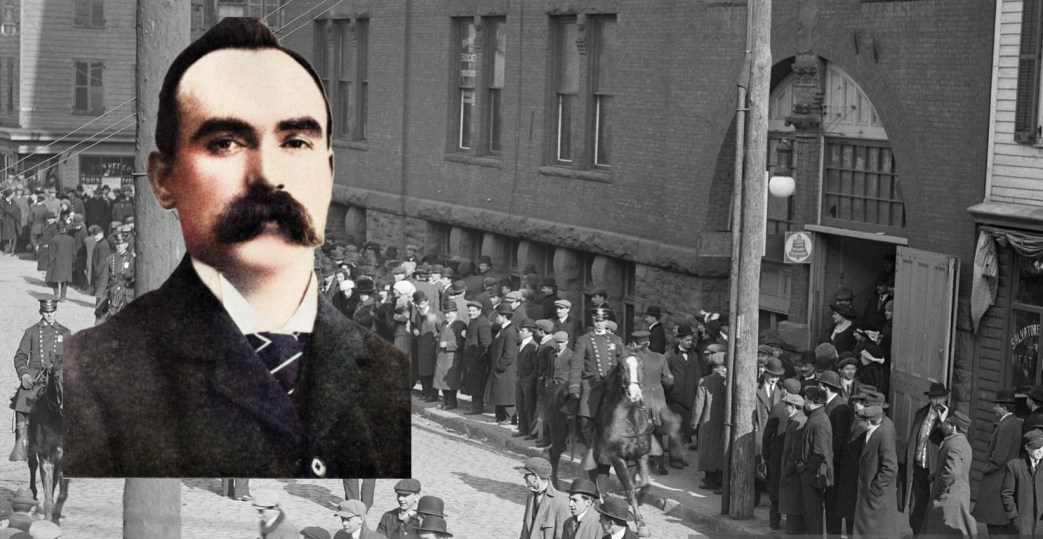
Near the start of his coast-to-coast 1902 U.S. tour, Connolly speaks to 300 workers at Paterson’s Turn Hall on the night of September 21st.
‘James Connolly in Paterson’ from The Weekly People. Vol. 12 No. 27. October 4, 1902.
Good Audience Greets Him Despite Inclement Weather–Irish Bondage Explained.
Paterson, N.J., Sept. 21. Despite the inclement weather an audience of about 300 persons greeted James Connolly in Turn Hall, last Friday night.
The meeting was called to order by the chairman, Comrade Berdan, who opened the meeting with a few remarks and introduced Comrade Geo. Herrschaft, of Jersey City, as the first speaker.
Herrschaft showed the workers the necessity of voting for their class interests, and in so doing, made clear how the capitalist class is careful to elect their emissaries, the Democratic, Republican and Reform parties to office, thus securing control of the police, the courts, the militia, in fewer words, all the powers of government, which are used to advance capitalist interests.
Comrade Herrschaft also spoke on the trust and pointed out the fact that it was an inevitable growth against which it was a fallacy to howl, The only solution for the trust is its collective ownership by the working class.
Chairman Berdan then introduced James Connolly, the Irish agitator. Connolly, after a few introductory remarks, proceeded with his address by showing the antagonism of interests between the capitalist class on one hand and the working class on the other, and proved by illustration the existence of the class struggle wherever the capitalist system exists.
Connolly then traced the condition of the Irish workingmen for the last one hundred years and showing the bondage of that class, which was traced to the capitalist ownership of the land, backed by an intolerable foreign government. The Irish agitator showed how, owing to the capitalist development going on in society, it is absolutely impossible for the Irish farmer, with his small farms and puny tools to compete successfully in the Irish and English markets. As a result his condition is as bad to-day as any time in recent history. The dependence of the farming and working classes on the Irish landlord and capitalist classes was then shown, and the collective ownership of the land the modern means with which to operate it, as also the collective ownership of industrial capital, were emphasized and demanded.
Connolly closed with an eloquent appeal to workingmen to join the Socialist Labor Party and become independent of the capitalist class through the collective ownership of land and capital.
Over two hundred Weekly Peoples and a large number of leaflets were distributed. About twenty-five pamphlets, such as “What Means This Strike?” etc., were sold. Seven subscriptions were secured for the “Workers’ Republic” of Dublin, of which Comrade Connolly is the editor.
C. Romary.
New York Labor News Company was the publishing house of the Socialist Labor Party and their paper The People. The People was the official paper of the Socialist Labor Party of America (SLP), established in New York City in 1891 as a weekly. The New York SLP, and The People, were dominated Daniel De Leon and his supporters, the dominant ideological leader of the SLP from the 1890s until the time of his death. The People became a daily in 1900. It’s first editor was the French socialist Lucien Sanial who was quickly replaced by De Leon who held the position until his death in 1914. Morris Hillquit and Henry Slobodin, future leaders of the Socialist Party of America were writers before their split from the SLP in 1899. For a while there were two SLPs and two Peoples, requiring a legal case to determine ownership. Eventual the anti-De Leonist produced what would become the New York Call and became the Social Democratic, later Socialist, Party. The De Leonist The People continued publishing until 2008.
 Revolution's Newsstand