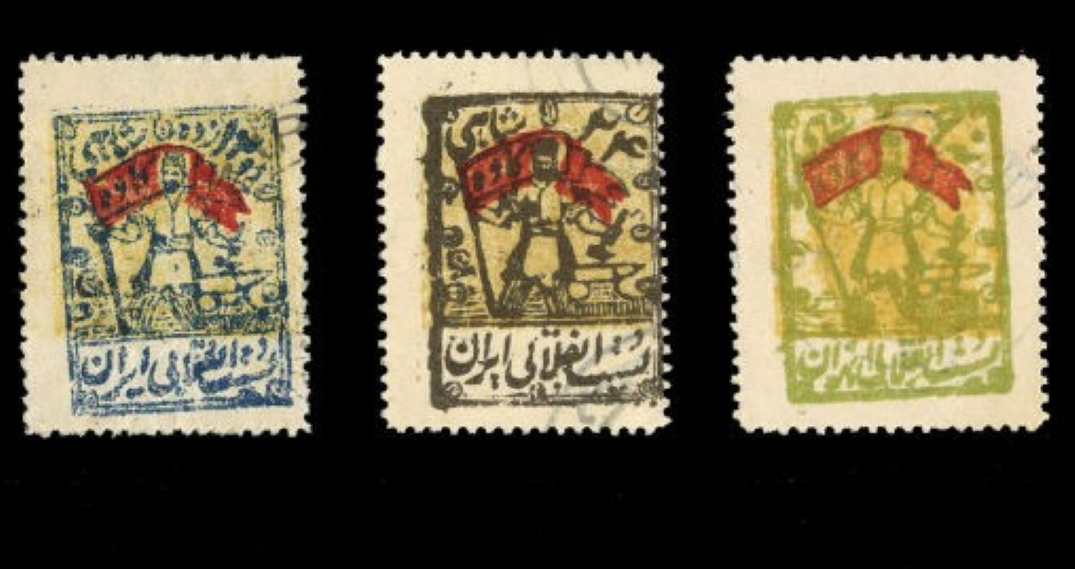
The small, underground Communist Party of Persia reports on the movement in Iran under Reza Shah and a dominating British imperialism to the Sixth World Congress.
‘Report of Persia’ from The Communist International Between the Fifth and the Sixth Congresses, 1924-28. Published by the Communist International, 1928.
THE ECONOMIC SITUATION.
PERSIA is a purely agrarian country, dependent for its resources on the extent of the harvest and the export of agricultural products. The manufacture of carpets is the only industry of any importance. In 1927 the export of carpets was 27 per cent. of the general exports; the following were the most important agricultural products exported: opium, cotton, fruit, wool, rice. The attempts that are being made to industrialise the country are almost negligible. The first step in this direction was made recently with the installation of a blast furnace for the exploitation of the ore in Simnan. A small quantity of machinery is being imported, which in 1927 amounted to 3.7 per cent. of the gross imports. Transport machinery, motor-cars, etc., are being imported which indicates the re-organisation of the means of transport. Motor lorries are taking the place of the camel caravans. A German-American firm has secured a concession to build the Trans-Persian Railway to connect up the Caspian Sea and the Persian Gulf. This railway has a certain strategic importance. The subdivision of the land in Persia provides a picture of its social-economic structure:
Sixty-six per cent. of the land suitable for tillage belongs to the big estate owners (Arabs).
Fourteen per cent. belongs to the heads of the tribes.
Ten per cent. to the clergy.
Four per cent. to the State (“Chalisse”).
Six per cent. to the peasants (private and communal ownership).
The peasants often possess such a small piece of land that there only is just enough space to build a hut.
The peasants are little more than serfs, although feudalism has been abolished. They must pay about 50 per cent. of the proceeds from their land to the clergy and landlords who have given them the land to till, besides the toll on water, cattle, and seed.
The position of the large mass of the peasants who do not receive their land from the clergy is still worse; they receive their land from the landlords and must pay them for the land, water, cattle, and seed, and in addition undertake to put their services at the landlords’ disposal. The peasants who are thus forced to give up four-fifths of their harvest have also to pay taxes to the State, including very heavy military taxes.
Up to the middle of the nineteenth century the feudal lords owned the land. Later the decline of feudal ownership set in with the change from agricultural production to commodities. Then the commercial bourgeoisie, the bankers in the towns, and also officials began to invest their money in land and in this way the capital of traders and money-lenders combined with whatever feudal forces still remained. This marked the beginnings of a new type of landowner, whose methods of exploitation resembled a wholesale extermination of the peasantry. These new landowners made use of all the old methods of exploitation in vogue in feudal times and brought back feudal conditions to the countryside, thus giving new strength to the feudal regime.
There is no industry to absorb the capital amassed by the commercial and money-lending bourgeoisie, the peasants are robbed almost entirely of their earnings, which makes it impossible for the home market to develop and consequently agrarian conditions are extremely backward. The majority of the peasants live in the greatest misery and robbed of their land are entirely at the mercy of the big land-owners. The various sporadic attempts which the peasants make to try to improve their intolerable position have hitherto failed, or merely ended in the formation of insurgent bands, so that these terrible conditions have made the problem of the agrarian revolution imminent.
The only big industrial centre in Persia is the South Persian oil fields, which belong to the Anglo-Persian Oil Company, and employ about 25,000 workers (Persians, Indians, Arabians, Armenians and about 1,000 European employees). The working conditions are bad and the majority of the workers do not earn more than 8-9 tuman (1 tuman=one dollar) a month; whilst the annual profit of this company is over 35 million dollars.
Besides the workers in the oil fields there are also in Persia a few thousand workers engaged in fishing on the coast of the Caspian Sea, and in the towns there is a small number of textile workers, leather workers, builders, etc. The twelve-hour day is the rule, only the printers have been able to secure the eight-hour day after repeated strikes. The monthly wage of a skilled worker is from 10-15 tuman, with the exception of the printers, who get from 20-30 tuman. Women and children are employed in all branches of work; children begin to work at the age of ten and get on an average 10-20 kran monthly (1 kran=10 cents). Women are mostly employed in manufacturing concerns and carpet weaving and earn an average of from 30-40 kran monthly.
The position of artisans is not over brilliant for the import of cheap foreign goods ruins their trade. Their working day is from 15-16 hours.
THE POLITICAL SITUATION.
Persia is to all appearances an independent state, but in reality it is a semi-colonial country. The British own practically all Persia; all public. bodies in South Persia are controlled by the Anglo-Persian Oil Company and are absolutely dependent on it. ‘The company, in order to be able to be in a better position to defend its interests, actually has its own police and safety service. The “Security Office” has 1,000 paid agents, who are distributed throughout all the southern towns and among the Arabian, Luristan, and Bakhtsarian tribes.
The main object of the British is to get Riza Khan under their influence and to this end have assisted him in every possible way to crush the revolutionary movement which arose recently in the Cilan Republic.
Riza Khan’s attempts to avoid getting into the clutches of the British brought to light the great hold British Imperialism has on Persia. In order to strengthen its position Britain brought pressure to bear through their controlling interests in the State Bank, and encouraged the attempts of the non-Persian peoples in the Persian border lands to break loose from Persia. For this purpose the British agents developed great activity amongst the Arabs and Kurds, the Persian-Arabians were invited to join up with Irak, though Britain’s chief aim is to secure the Province of Arabistan and the southern ports of Persia.
The British pursue similar tactics in respect of the Kurds, who live in the border territory of Persia and Turkey and also in Irak. The slogan to amalgamate all the sections of Kurdistan into a united Kurd state is very popular amongst the Kurds, the British Imperialists make use of this fact and promise the Kurds autonomy in Irak, and at the same time encourage the Persian and Turkish Kurds to rise against the government. Should the British plan to create an autonomous Kurd state under the protectorate of England succeed, it will serve to ensure a “peaceful” exploitation of the Mosul oil fields to a still greater extent than at present. Whenever Riza Khan’s government rejects any British proposal unrest and risings ensue amongst the Arabs and Kurds.
Vital economic interests drive Persia towards Soviet Russia. In 1927 Riza Khan decided to conclude a trade agreement with the Soviet Union and neutrality agreements with Turkey and Afghanistan.
THE WORKERS’ MOVEMENT.
Up to the time when Riza Khan took power into his hands through overcoming the old Kad Khan Dynasty and certain sections of the old feudal lords, especially in the north, internal policy was marked by loud-sounding phrases about democracy aimed at the neutralisation of the peasantry. But when the peasants attempted to realise this democracy and tried to shake off their oppressive bonds of slavery, Riza Khan crushed the movement mercilessly with the help of the feudal elements and the British Imperialists.
The social force which supports Riza Khan consists of the new landowners—this peculiar mixture of former feudal lords and trading bourgeoisie. This class, unlike the former feudal owners, carries on an economy based on the supply of the world market with raw material, but at the same time, continues the methods of the feudal lords in respect to the exploitation of the peasantry—if anything in a more intensified form. It is this class which helps Riza Khan to entrench his power and he in his turn extends to them the protection of his armed forces.
1. In this manner the Riza Khan coup d’etat worked in with the national movement and was also assisted by the British Imperialists, who considered Riza Khan a new and effective tool in strengthening their influence in Persia.
2. The social basis of Schah’s government is essentially like the Kad Khan Dynasty: the big feudal lords, the old officials, the leaders of the national bourgeoisie. Recently Riza Khah has made certain concessions to the Mahommedan clergy in order to win their support.
3. The few political liberties, which Riza Khah granted before the coup, as a result of joint work with the national revolutionary elements, the trade unions, etc., have since been abolished and the present political regime of Persia is absolutely devoid of the slightest political freedom.
The only organised political party in Persia is the illegal Communist Party. The democratic party which at one time played a great role has fallen completely into decay. Attempts were made during the elections to organise parties, but these Parties disappeared again after the elections. In 1926 one of Riza Khah’s ministers formed a party, “Iran-i-Niu” (The New Persia), composed mainly of members of parliament and officials. The programme of this party contains the following points: (1) The defence of the Riza Khah Dynasty; (2) the introduction of reforms. There were about 400 members in this party, but it is now dying out.
In the countryside there are still traces of the Socialist Party, which at one time had a membership of 700. It was really a democratic party for the name was all it had in common with Socialism. Only about twenty members remained in this party after the destruction and persecution of all opposition organisations by Rizha Schah.
Trade Unions in the real sense of the word hardly exists, the majority of the unions are more on guild lines. In 1920 the tendency to organise became more pronounced amongst the Persian workers; this was a result of the October Revolution. In 1923-25 certain new attempts at organisation were made and new Trade Unions and a central council were formed. The task which the latter undertook was the centralisation of all workers’ Trade Unions and artisan guilds in Persia. At that time these organisations were strongly influenced by the Communists.
When Riza Khah was engaged in the struggle with the Kadscher Dynasty he made advances to the Trade Unions and pretended to be a Republican, intent on improving the economic situation and the position of the workers. But when he came into power he had the Trade Union leaders imprisoned at the end of 1925, and closed down all workers’ organisations under the pretext of a state of war; he forbade any new Trade Unions being formed. Not until 1927 was it possible to found new unions in Teheran and in provincial towns, but all these Trade Unions carry on their work illegally. Notwithstanding the difficulties of the political situation they succeeded in organising the majority of the workers in several trades, viz., the printers. The newly-formed Trade Union central bureau, which also works illegally, is engaged in uniting all existing Trade Unions and forming new ones. So far there is no Trade Union for the workers in the southern oil fields, though in spite of this a strike broke out in 1927, and large numbers of the workers were dismissed.
The Iran Communist Party began to recover in 1927 from the wholesale arrests that were made in 1925-26 following on the revolts against British and their agents, the Kadschers and Rizha Schah; these arrests deprived the Party of some of the best members.
The second Party Congress was held at the end of 1927, it condemned the opportunist point of view of certain comrades who declared that the Riza Khah regime denoted progress and that the Party could not undertake his downfall, because the Party was too weak, and such action would therefore be equivalent to assisting reaction. The Congress decided on the organisation of the masses of the workers, the peasants, and the petty bourgeoisie for the struggle against Riza Khah and on behalf of the peoples republic, the establishment of revolutionary, democratic dictatorship of the proletariat and peasants.
The new C.C. has succeeded in rallying all comrades during the few months that have elapsed since its election and the Party has already been able to carry out some of the Congress decisions successfully.
 Revolution's Newsstand