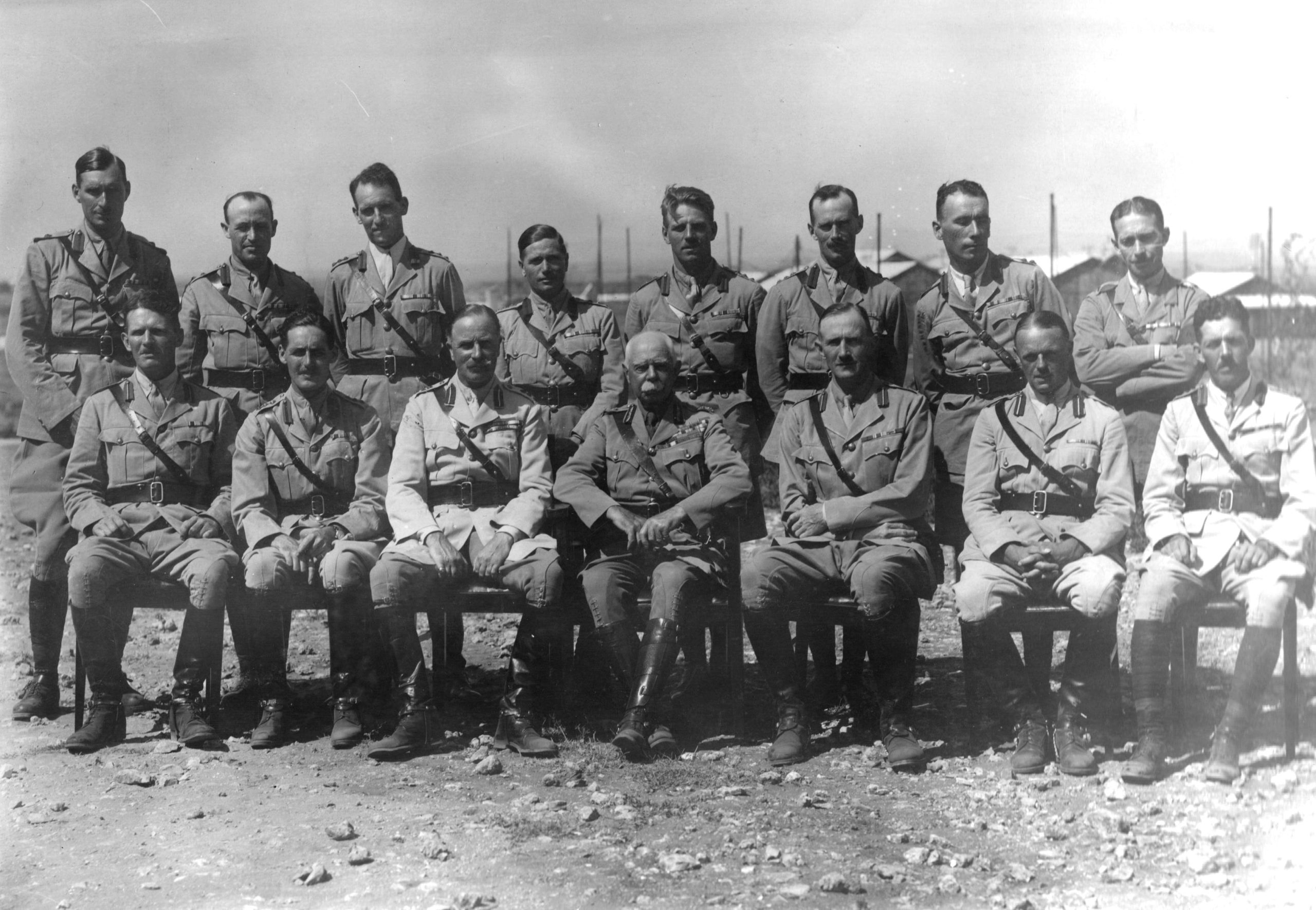
Taken as a whole, Joseph Berger’s extensive reporting from Jerusalem for the Communist press in the 1920s and 30s is an unrivaled primary source for understanding Mandatory Palestine and the larger context its conflicts were played out in. Here he analyzes the role of Britain’s new proconsul for the colony.
‘Palestine under Lord Plumer’ by Joseph Berger from International Press Correspondence. Vol. 6 No. 19. March 11, 1926.
The English system of colonial policy is superior to the French in that considerations of home politics are not allowed to influence it. Even though the Liberals be at daggers drawn with the Conservatives or the leaders of the Labour party with both other parties on questions of “principle”–where the inviolability of the British Empire is concerned, they hardly differ from one another.
Thus it comes about that the English colonial apparatus changes very little. Herbert Samuel, the first British High Commissioner in Palestine, was appointed under a Liberal Government and remained in office for five years in spite of four changes of government (Liberal-Conservative-Labour-Conservative). The end of his term of office and his replacement by a military governor–Lord Plumer–by no means signified a change of system, but only took into account the military significance of Palestine and, on the other hand, was intended to subordinate the country more definitely to the English Colonial Office than had been the case in Herbert Samuel’s time.
The hopes of certain Arabian politicians that the appointment of a “Christian” High Commissioner would put an end to Great Britain’s Zionist policy, were disillusioned in the first weeks of Lord Plumer’s rule. Everything remained as it had been and Lord Plumer did not even meet the most elementary wishes of the Arabs for representation of the people in Palestine. The fact that nevertheless there was no disturbance in Palestine is chiefly attributable to the tactics of the Arab national movement, which regards the liberation of Syria from French imperialism at its most immediate task and does not consider the forces at its disposal sufficient to fight against France and Great Britain at the same time.
One of the reasons why the anti-French insurrection in Syria not only cannot be extinguished rapidly but is in the position at any moment to receive new nourishment and support from the foreign insurrection committee, is doubtless the exploitation of the imperialist contradictions which, in spite of all agreements between Chamberlain and De Jouvenel, in spite of all official and semi-official assurances of sympathy and “holy” treaties, are strong enough to ensure that England will observe loyal neutrality with regard to the Syrian revolt. The Arab national movement is right when it considers it of little importance that the English should for a time have peace in their mandatory territories if in consequence a firm basis can be created in a liberated Syria for the coming great Arab revolution, especially as the inevitable fate of a simultaneous revolt in English and French territories would be a rapid suppression.
The British Government naturally makes the best possible use of this favourable situation. British Imperialists are clever enough to understand that the conflagration in their neighbour’s house will sooner or later spread to their own territory and they are therefore doing everything in their power to be prepared for so serious a contingency.
In the first place the Government is endeavouring to disintegrate and disorganise the Arab national movement and, if possible, to smother it altogether. The Arab population is to be humiliated, to be disarmed in every respect, it is to be inoculated with faith in British omnipotence. Never in the past, did the British Government indulge in such rough and brutal treatment of the Arab national movement, never did it so openly carry on a campaign against the Arab Nationalists as it is doing to-day.
In the course of the last few months, the blows against the Arab national movement have followed in quick succession: the prohibition of a demonstration of sympathy for the victims of Damascus, the throttling of the Arab Press by special postal rates, the prohibition of Arab newspapers, prohibition of demonstrations of mourning for Fuad Selim, a Nationalist who fell in Syria, the banishment of esteemed Arab politicians from Palestine, the annulment of the elections for the “Supreme Council of the Moslims”, because the Nationalists had received the majority–the official answer to the memorandum of votes and finally of the Arabian Executive Committee to the effect that its aggressive tone made it “undeserving of an answer”!
The object of each of these measures is to make the Arab national movement contemptible and to weaken its authority. To these must be added a multitude of small insidious attacks on the Arab intelligentsia, workers and peasants, a memorable example of which is the recent sentencing of four poor peasants because they would not voluntarily clear land sold by a large landed proprietor. The Arab press emphasises that, even under the Turkish Pashas, the population of Palestine never had to endure so much injustice and oppression as under the Englishman Lord Plumer.
it would however be erroneous to suppose that the English policy of force is directed only against the Arab population of Palestine, and that the Jewish population enjoys special privileges, though it is true that, just in recent times, the relations between the British imperialists and the Zionist organisation have been consolidated.
The Zionist organisation receives thousands and tens of thousands of certificates on the basis of which it is entitled to introduce thousands and tens of thousands of Jewish immigrants into the country. The Government, however, is not moving a finger to help to provide these immigrants with bread and work, still less with land. Of the 25,000 migrants who came to Palestine in 1925, only about 1% (300) have been settled on agricultural land. The great mass of the immigrants has remained in the towns, where the modest beginnings of an industry which lacks experience, credit and capital could only absorb a small number of the arrivals. The great mass of the new immigrants, as indeed a large number of the immigrants from the years 1919-1924, is far from being in a firm economic position.
A Jewish Meeting of Delegates which met in Jerusalem in January, gave a picture of the terrible distress among the Jewish population in Palestine which now numbers 140,000. The Meeting also showed how difficult it is to find an issue from the crisis, as the wealthy Jewish bourgeoisie will not hold itself responsible for the “inflation immigration” and the Zionist fund, after the high hopes in the summer, is hardly in a position to cover the deficit on the existing colonisation enterprises. (In the two months November and December, there was a deficit of about 40,000 pounds in the Zionist “stock-capital”).
The–very moderate–demands placed before the Government by the Meeting of Delegates in the hope that they would receive at least some slight assistance, was rejected en bloc by Lord Plumer. No wonder that in such a situation, the large strata of the Jewish population are disenchanted and recognise the great obstacle which British Imperialism forms to the development of Palestine.
The Communist Party with its slogan: “Arab and Jewish masses of workers, unite in a common fight against British Imperialism!” received more than 1000 votes in the election for the Meeting of Delegates, and the attitude of its fraction roused considerable sympathy among the workers, in spite of the raging bourgeois and Social Democratic Terror. There are now even in Zionist circles, individual (especially German) Zionists who aim at an understanding with the Arab national movement for liberation instead of an alliance with British Imperialism.
The British Government, however, whilst oppressing and exploiting both Jews and Arabs, is always doing its best to fan once more into flame the national hatred between the two parts of the population. The antagonism between Jews and Arabs remains, apart from the other imperialist methods of oppression, the main pillar on which the English rule in Palestine rests. Preparations are being made to bring these contradictions to a head by creating two national legions (an Arab and a Jewish one, each with English officers): When once the “equilibrium” is established, England can calmly proceed to carry through its plans in the Middle East, at which Amery recently hinted in his speech. These plans concern the development of the direct lines Haifa-Bagdad, Haifa-Mossul, the security of the air route Kantara-Karachi and the transformation of Palestine into an English commercial colony for petroleum and cotton with Irak as hinterland.
International Press Correspondence, widely known as”Inprecorr” was published by the Executive Committee of the Communist International (ECCI) regularly in German and English, occasionally in many other languages, beginning in 1921 and lasting in English until 1938. Inprecorr’s role was to supply translated articles to the English-speaking press of the International from the Comintern’s different sections, as well as news and statements from the ECCI. Many ‘Daily Worker’ and ‘Communist’ articles originated in Inprecorr, and it also published articles by American comrades for use in other countries. It was published at least weekly, and often thrice weekly.
PDF of full issue: https://www.marxists.org/history/international/comintern/inprecor/1926/v06n19-mar-11-1926-Inprecor.pdf
 Revolution's Newsstand