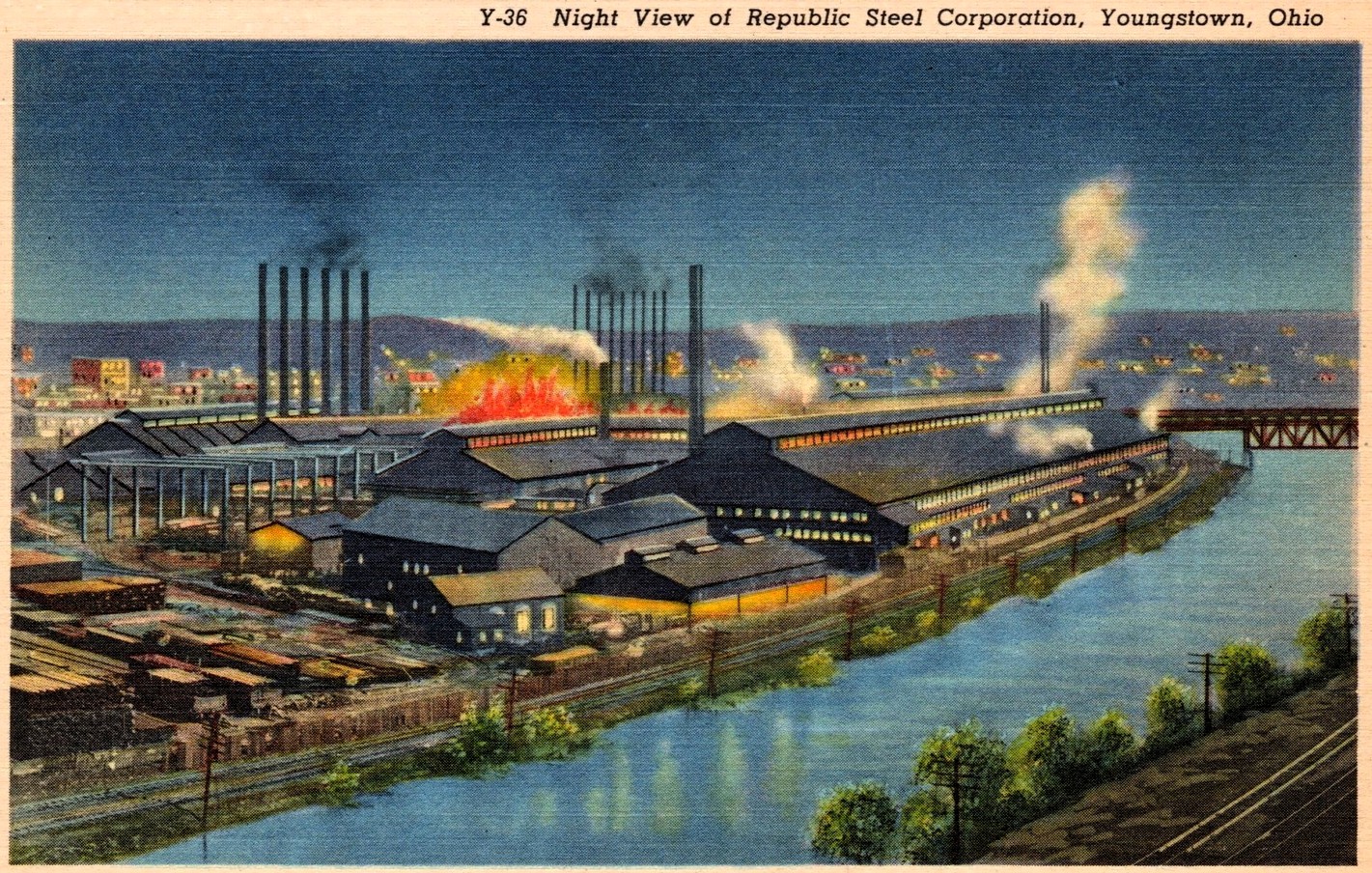
Valuable insights into Communist Party union organizing during the T.U.U.L. years from this internal report on the concentration of Party forces at one of the country’s most important steel plants.
‘Some Experiences in Concentrating on Republic Steel, Youngstown’ by J.D. from Party Organizer. Vol. 7 No. 3. March, 1934.
BECAUSE Republic Steel in Youngstown is one of the few “concentration points” at which there has been some actual concentration, its experiences should be summarized and the lessons digested.
Republic has been in theory at least a “concentration point” since the middle of 1932. At that time there were about 8 Party members working in the mill, who occasionally gave the Party section organizer information on the basis of which he wrote a shop bulletin. There were about 100 workers in the union, but no functioning local. According to reports of our comrades, the union meetings were places where the organizer made a general agitational speech, some dues were paid and invariably a collection was taken. There was little effort to work out the demands in the departments. Naturally no struggles were developed. In spite of this the union had grown, showing the tremendous will of the workers to organize. Some efforts to develop department form of organization were unsuccessful, primarily because we did not convince the workers that that was the best means of developing struggle and building the union. The result of these methods of work was that the whole organization collapsed following the firing of a few members for union activity.
Following the Warren Strike (Sept. 1932) a “concentration school” was held in Youngstown with a C.C. comrade in charge. But not one student at the school worked in the main concentration point, the Youngstown Republic mill. A splendid young and inexperienced comrade was appointed “concentrator.” He was given a $5 weekly subsidy and told “concentrate on Republic.” Neither District or Section Buros seriously took up his work with him. Nor did he receive help from the leading bodies of the union. Party units and language fraction were not mobilized for Republic work. The result was no progress and a badly demoralized comrade. The separation of the Section Buro from Republic can best be seen when we record that the Buro representative strenuously objected to the shop unit taking time at its meeting to discuss the main grievances in the mill as a basis for a first draft of demands around which struggles could be developed.
At the beginning of 1933 we began to help this comrade a little more. There followed months of sporadic activity—quite a few leaflets into the mill, a campaign developed in the chipping department which won the workers’ demand for posting of working schedules, but which we conducted so unskillfully that we got nothing out of it organizationally. We made agitation around Republic, but up to July we still had no organization. In the meantime the C.C. “concentration subsidy” stopped, and the “concentrator” was put on other work.
Every Party conference decided to concentrate. Everyone agreed in theory. But we didn’t plan our work in such a way as to guarantee systematic development of a campaign in and around Republic.
Following the Open Letter we made a plan of work to insure concentration involving Party units, fractions, etc. We decided to concentrate first on the chipping department. After many failures we finally got three chippers to a meeting. We drafted tentative department demands and issued simple half-page leaflets inviting the chippers to discuss the demands. We worked systematically, both inside the mill and visiting the chippers at their homes, popularizing the demands and the idea of struggle for them, and our union. In the meantime we were exposing the N.R.A. Steel Code, popularizing our own code, and sharply exposing the A.F. of L But we found that many of our mass meetings were less successful than the A.A.’s meetings, because we relied entirely upon leaflets while they had committees preparing the meetings inside the mill.
Meanwhile concentration on the chippers began to bear fruit. We got enough chippers interested to hold separate meetings of each of the three shifts. Sometimes we met with them at the union headquarters when they left the mill at 11 at night. Other shifts met at 7 a.m. when they quit work. (The union office is only 3 blocks from the gate). We met at these hours so as to get the men before they scattered to their homes in all parts of town. We were unsuccessful in signing up many for the union (only 20), but developed a strong sentiment for united action for our demands. At least a dozen different leaflets or pluggers went into the mill during August, and a union organizer was at the gate at almost every change of shifts. In addition to this, union and chippers committee members took small typewritten slips into the mill, giving time and place of chippers meetings to those whom they trusted.
Struggle Developed
Sentiment for strike developed very high, but we held back because our union was so weak—only 20 members of 200 in the department. Finally the sentiment for strike was so strong that some action was imperative. We got out petitions with our 5 demands and 189 chippers signed them with their check numbers. These were sent to the company by registered letter with the demand that we get an answer within 48 hours. No answer came. At the meeting called to hear the company’s reply only 18 chippers attended, but the sentiment was unanimously for strike and the men reported similar sentiment in the mill. Since we could not stand still, but had to go either forward or backward, the meeting elected a committee of 5 to go to the company. It was arranged that if the committee didn’t get out of the company office by 11 a.m., or if the report was unfavorable before then, the day shift would walk out and picket the next turn. In event the demands were granted of course work would go on.
The company refused the demands. The chippers refused to listen to the superintendent’s speech telling them to leave “the Bolsheviks” alone and wait. As one man they threw down their chipping hammers and walked out, marching to the union hall where all registered and some 40 signed up for the union. They elected a strike committee representing their turn, sent a committee to the open hearth gate to notify and pull out the open hearth chippers and burners, elected picket captains and then returned in a body to the Bessmer gate to picket the afternoon turn. This turn struck solid, as did the open hearth chippers.
Strike Won
Meanwhile word came that the company was ready to compromise. A committee went down, got the company’s offer of a 16 per cent increase, recognition of the chippers committee, equal division of work, etc., reported to the packed strike meeting and, after a lengthy discussion, it was overwhelmingly voted to accept the offer, go back to work, and build the union stronger than ever. The mass meeting called for that night (originally called in support of the strike) was turned into a victory meeting. Enthusiasm was high. Many mere chippers joined the union, and some from other departments. The mass meeting voted endorsement of the chippers actions and to prepare similar actions in all departments of the mill.
On the basis of the membership gains, we reorganized the Republic Local, elected new officers, all of whom, by the way, were non-Party workers, and most of whom had taken active part in leading the chippers strike.
Tasks of Union
The tasks before us were clear: (1) Consolidate organization among the chippers. (2) Use the victory, news of which had spread like wild-fire, to conduct a campaign of mass recruiting, and preparation for struggle in all departments of the mill. (3) Establish a strong local leadership in the mill and train it carefully. (4) Rapid scale recruitment of the best of the union members into the Party and Y.C.L. (in the whole campaign up to the strike we only recruited 2 chippers into the Party and both of them had been close to us for years. The shop unit as such played no role at all in the strike.). (5) Popularize the victory in the other mills of the district.
In other words, we recognized that the next period would make or break us. The company was sure to attack us. It was clear that our systematic activity had been the main factor in the success (with all that it was not as systematic as it should have been), But it was precisely at this, period, when the previous methods should have been used, but on a mass scale corresponding with the situation, that we fell down.
Union Driven By Events
This was the period of rising sentiment everywhere. We got calls from Farrell, Newcastle, Sharon, Sharpsville, Hubbard, Salem, Campbell, Lowellville, Struthers, for speakers. and organizers. Our forces were few and overworked. Although we did to a certain extent, draw some of the leading chippers into activity in other departments and in other mills, it was done too slowly and on too small a scale.
We decided to make a job next on the galvanizing department, and got pretty solid, but failed to get any of the 34 Negroes in the department. Still we won demands in that department without a strike. Open hearth department was next on our list, but we failed to give it the systematic leadership required, with the result that the A.A. (which was concentrating there) made considerably more headway in the open hearth than we did.
We were dissipating our forces and energies over too broad an area. Although realizing in the abstract that with our forces we couldn’t organize the whole district at once, we were infected with the spontaneity of the workers, we “allowed ourselves to be driven by events,” with the result that, in effect, we abandoned our concentration. We tried to answer every call. We recruited 1000 members in 12 different mills in 5-6 weeks. But we couldn’t give proper attention to any one mill, and most important of all, it meant neglecting the proper development of the Republic drive to do even what we did elsewhere. We didn’t consolidate sufficiently the 200 members in Republic, we didn’t spend enough time developing the splendid new forces in Republic, we failed to build the Party and Y.C.L. in Republic (also due to a heavy dose of “Red Scare” in the earlier stages, when we were afraid to bring forward the Party and even the Daily Worker openly as a paper supported by our union) and worst of all, when the tempo at Republic should have been faster than ever before, we didn’t give the necessary leadership.
The Second Chippers Strike
All this played right into the hands of the company. When the Bessmer department started up after a ten day shutdown, they didn’t call back (and in effect locked out) 100 of the most active chippers. The men were furious. Close to 100 chippers met, sent a committee demanding reinstatement of all chippers and equal division of work. They were turned down. The men voted unanimously to strike the department, but they raised no demands for the men on the job, they didn’t organize the strike inside the mill, they didn’t even consult more than a few handful of the men on the job—the strike vote was taken primarily by laid-off chippers. The whole thing developed so quickly (380 hours) that neither the District Board of the union, the fractions, the shop unit or the Party section committees met to discuss the plans. The District Secretary of the union was away in Weirton when it developed, and only reached Youngstown as the strike vote was being taken, when he allowed himself to be swept along with the tide. At no time before the strike was there a calm objective analysis made of the situation. From this flowed all the mistakes committed.
The result of the mistakes was the company’s success in blocking the effectiveness of the strike in a few ways—one group of chippers was turned against another group. When we saw this, we withdrew picket lines and adopted a policy “on paper” of working inside the mill. But production was low and by then our best forces were considerably demoralized, many of the men on the job who were not against us, but didn’t see the possibility of success, were afraid to come to the hall and especially, we, the leadership, failed to personally lead every detail of the reorganization work, visiting the employed chippers at their homes, talking, convincing, etc.
When on top of this the company laid off all our active men in the galvanizing department (primarily the result of a stool-pigeon in the department), terror swept the local and the mill. We were temporarily. broken in the two departments where we had been strongest. Just at this period general layoffs took place throughout the mills, leaving most departments with skeleton crews, and we failed to react quickly enough to the changed situation with a broad campaign against layoffs, for dismissal wages, etc. The result was increasing instead of overcoming our isolation from the masses.
The mistakes of the second strike were: (1) violation of all principles of trade union democracy by not consulting the men on the job; (2) going into such an important action hastily, without preparation, yielding before the spontaneity of the workers. Had we built the Party in the preceding period, things could not have happened this way. But our Party unit played no role in either strike. Had we continued to concentrate on Republic (at the expense of some of the work elsewhere), we would have been able to call out other departments in support of the chippers and galvanizing department workers. But failure to concentrate and to carry cut the plans we ourselves had made, allowing ourselves to be driven by events—this put us in the position where the company was able to badly damage our organization in the mill.
We still have members in all departments of Republic. But complete reorganization of the local is now necessary. Just as we can hold the blacklisted members with us only by fighting for relief, against the grievances on the C.W.A. jobs, and for unemployment insurance, so we can hold our membership in the mill, rebuild our local, win hundreds and thousands of new members only by facing the hard fact—that now we must start all over again, building from the bottom up. But now we have the advantage of more and better forces and experience than we had before. Simultaneously we must really commence opposition work in the small A.A. organization in the mill.
To base ourselves in Republic on the blacklisted members of the union would be a suicidal policy (as has been proved repeatedly in mining, textile, etc.). Our Republic Local must and will be rebuilt from the workers inside the mill. That is the test to which we now are put.
The Party Organizer was the internal bulletin of the Communist Party published by its Central Committee beginning in 1927. First published irregularly, than bi-monthly, and then monthly, the Organizer was primarily meant for the Party’s unit, district, and shop organizers. The Organizer offers a much different view of the CP than the Daily Worker, including a much higher proportion of women writers than almost any other CP publication. Its pages are often full of the mundane problems of Party organizing, complaints about resources, debates over policy and personalities, as well as official numbers and information on Party campaigns, locals, organizations, and periodicals making the Party Organizer an important resource for the study and understanding of the Party in its most important years.
PDF of issue: https://www.marxists.org/history/usa/pubs/party-organizer/v07n03-mar-1934-Party%20Organizer.pdf
 Revolution's Newsstand