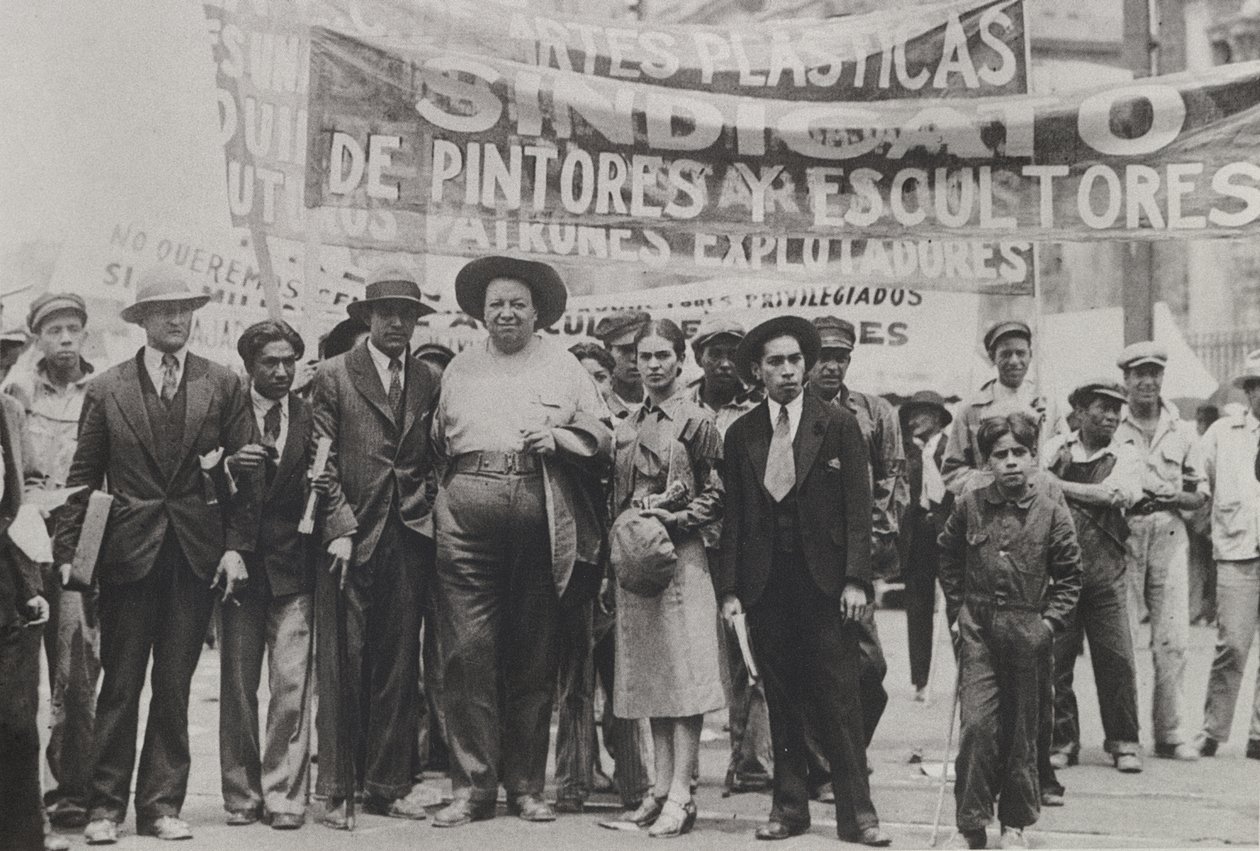
Rivera, who had been on the central leadership of the Mexican Communist Party, reports on the country to a meeting of the Executive Board of the Red International of Labor Unions while spending nearly a year in the Soviet Union.
‘The Mexican Labor Movement’ by Diego Rivera from The Daily Worker. Vol. 5 No. 14. January 18, 1928.
The latest statistics show that there are about 7,000,000 workers in Mexico, of whom 5,000,000 are peasants, and 2,00,000 industrial workers. These statistics must, of course, be accepted with great caution, remembering that the ties between the industrial workers and the villages are still very firm in Mexico, and the difficulty often experienced in placing workers in either of these groups. The Mexican workers are fairly well organized in the following organizations: Mexican Confederation of Labor (C.R.O.M.), General Confederation of Labor and Independent Oil-Workers’, Miners’ and Railwaymen’s Unions. In addition to this there is a National Peasants’ League, uniting agricultural communes, most of which arose after the introduction of agrarian reform. The Crom leaders claim that their organization has a membership of 2,000,000, but this is not the case. Although it has been found impossible to arrive at exact figures indications are that it has a membership of slightly more than half a million workers and peasants. The foundations of the Crom were laid down by the so-called “Home of the World Worker,” a one-time revolutionary organization under anarchist and anarcho-syndicalist leadership.
Mexico and P.A.F. of L.
The Crom has now relinquished its revolutionary traditions. Its leadership is in the hands of a group of reformists, openly supported by the government in their seizure of leading posts in the Confederation. The Crom is getting into ever closer touch with the Pan-American Federation of Labor (P.A.F. of L.), until it has practically become nothing but a docile tool in the hands of this agency of American imperialism. Quite recently disagreements arose between Crom leaders and the P.A.F. of L-,–caused by the support of the Mexican Clericals by the A. F. of L., the real controllers of the P.A.F. of L. Morones, Minister of Labor, Commerce and Industry in Calles government, the unofficial head of the Crom, entered upon negotiations with the Amsterdam International, in order to gain reinforcements in possible internal P.A.F. of L. conflicts. In his desire to insure himself from all sides Morones even coquetted a little with Moscow. The rank-and-file members of the Crom have long lost all faith in its leaders, who are only able to keep the reins in their hands with government assistance. The influence of the Communist Party in the Crom is steadily on the increase, and “El Machete,” the Communist organ, whose circulation has lately grown from two to eight thousand, has a circulation of 5,000 among organizations belonging to the Crom.
Anarchist Unions.
The General Confederation of Labor (G.C.L.) has not more than 10,000 members. Since 1922 its leadership has been in the hands of pseudo anarcho-syndicalists. Both the government and the Crom wage a campaign against the G.C.L., endeavoring to identify their members with the Communists and to prove that “the Left Wing of the Labor Movement is playing into the hands of reaction.”
The G.C.L. belongs to the anarchist Berlin International, with which fairly regular relations are maintained.
Transport Workers Pay.
The independent organizations unite about 64,000 members. Of these 9,000 are members of the oil workers’ unions, 10,000 are members of the Miners’ Federation and about 45,000 members of the Transport Workers’ Federation.
That of the transport workers would be the strongest trade union organization, were it not for the internal breach between the working-class aristocracy and the rank-and-file. The remarkable labor conditions prevailing in Mexico, while admitting of wretched pay for lower-grade employees and workers, have promoted engine drivers into a sort of aristocratic caste, in receipt of fabulous wages. The minimum pay established by the union for engine drivers comes to about $225 per month. The cause of this high pay is to be found in the fact that during the frequent revolutions the various military authorities required engine drivers for the transport of their troops.
At the close of the civil war Calles government was forced, under United States pressure, to return the railways to their former (private) owners, leading, of course to a great fall in wages. The Transport Workers’ Federation decided to counter with a strike which was lost owing to the federation’s internal weakness and bad strike leadership, the Crom playing no small part in its suppression.
As a result many railwaymen were thrown into the streets and formed several political groups aimed at the support of Obregon’s candidature for the presidency, in the hope that he will get work for his electors. The most important of these political groups is the “United Railwaymen’s Party.”
Revolutionary Elements.
Although the autonomous organizations are for the greater part in close touch with local politicians and sometimes under the influence of the governors of states, they are not without reliable revolutionary elements. Indeed many of the unions are completely under Communist leadership. Aspirations towards trade union unity are comparatively strong in the autonomous organizations and the Communist Party is doing its utmost to aid the practical realization of this unity.
The Daily Worker began in 1924 and was published in New York City by the Communist Party US and its predecessor organizations. Among the most long-lasting and important left publications in US history, it had a circulation of 35,000 at its peak. The Daily Worker came from The Ohio Socialist, published by the Left Wing-dominated Socialist Party of Ohio in Cleveland from 1917 to November 1919, when it became became The Toiler, paper of the Communist Labor Party. In December 1921 the above-ground Workers Party of America merged the Toiler with the paper Workers Council to found The Worker, which became The Daily Worker beginning January 13, 1924. National and City (New York and environs) editions exist.
PDF of full issue: https://www.marxists.org/history/usa/pubs/dailyworker/1928/1928-ny/v05-n014-NY-jan-18-1928-DW-LOC.pdf
 Revolution's Newsstand