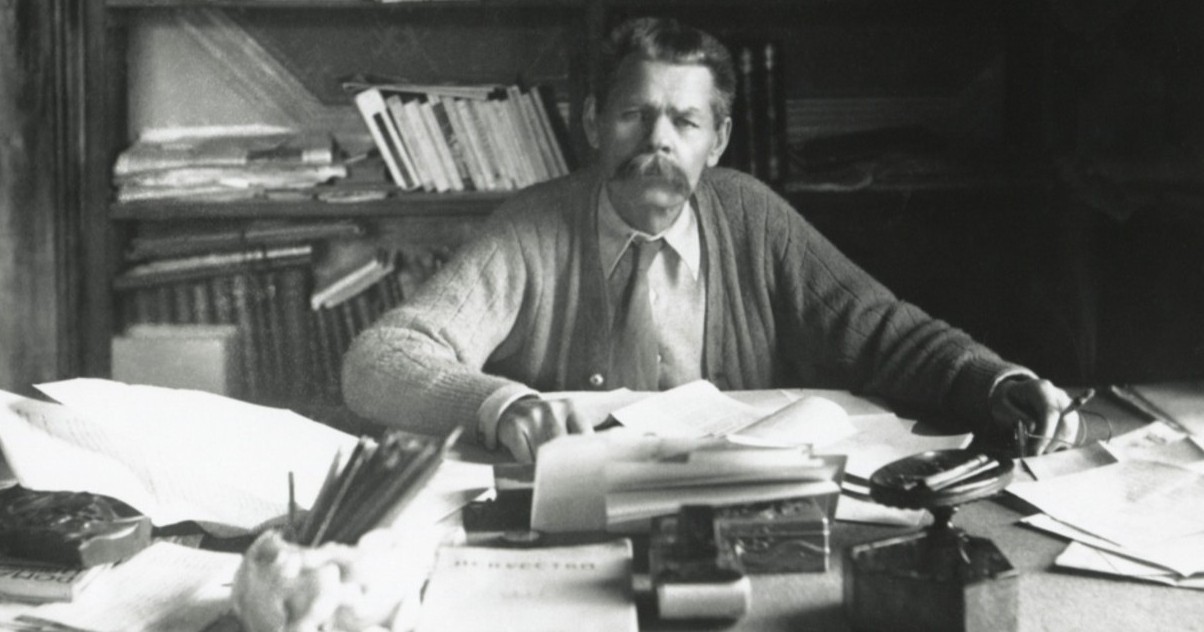
From over a century ago, the voice of Gorky tells us a story for today.
‘The Sage’ by Maxim Gorki from New Review. Vol. 2 No. 3. March, 1914.
Once upon a time there was a sage who understood the mystery of life. It filled his heart with a heavy gloom and terror, and in the shadow of it all happiness and joy died sadly within him. With the clear eye of reason he gazed into the depths of time and saw only darkness there. He wandered through its towns and villages. His wise head was bowed in loneliness, and in the midst of the turmoil and glamour of life his message rang out like the melancholy sound of a death knell.
Men! You live between darkness and darkness. You have been born of the depths of ignorance. You are spending your lives in the mists of ignorance. And the terrible darkness of ignorance awaits you!
The people listened to his sad message and understood its bitter truth. They sighed, and looked silently into the face of the sage. But after they had seen him depart, setting forth on that lonely path of wisdom, they returned to their business and to their banquets. And in eating and drinking merrily, and in the happiness of seeing their children at play, they forgot the distress and misery of which they had just heard. They fought with each other for riches and possessions, and while their hands were still red with blood they listened and were moved by sermons of love! Those who were fair to them they caressed, and their friends they betrayed with traitors’ kisses.
They robbed each other, and then passionately defended the riches they had thus acquired. They betrayed and defrauded each other unscrupulously, but they all said that Truth was the master of life. There were some, however, who believed in the charitable power of truth, and who suffered for this belief. And the people loved music, and were moved to tears by it; they were enraptured by its beauty, and yet they allowed ugliness and depravity to exist in their lives. They made slaves of each other, and yet they cried out that, they longed for freedom. They treated with contempt all those who were beneath them, and yet like cowed animals they secretly hated their rulers. They imagined that goodness must come from without, and did not understand that it must be created from within. For they were concerned about the petty cares and comforts of life.
They wasted their intellect with hatred and deceit and with clumsy cunning in order that they might satisfy their insatiable desire for luxury and good living.
Thus these strange people lived in a world of their own, like unclean animals, though they believed themselves to be little less than deities. Their lives resembled a volcano, an inexhaustible volcano, and the cries and complaints were like its pestilent fumes rising against the sky, while the suffering and the sorrow were like its clinging ashes and the animal desires like its suffocating stenches.
And the solitary sage wandered over the wide world and spoke with the voice of infinite knowledge: What is your life? You do not tell. Why are you here? Even this you do not know. Look! This is your misfortune!
When he saw a lover embrace his beloved he said unto them sadly: Death awaits thee and thine. When he saw the people erect magnificent dwelling places he said reproachfully: All this is ready for destruction. When he saw little children playing like flowers in a meadow—little children who were themselves like flowers, he sighed, and said unto himself: My eyes see death’s harvest. And when he heard one of the wise men teach the youth of the temple of sciences, one of those wise men who could not comprehend the soul of the sage, who could not comprehend that the sage had realized the dark truth of death, he said to him contemptuously: Narrowness is the name of thy wisdom. For the earth will come to an end, and all its temples and all its sciences and their truths and their lies will end, and thou dost not even know the day and the hour of thine own destruction.
* * *
But one day on the outskirts of a great town, in a dark narrow street full of filth and poverty and the stenches of decay, the sage saw a great number of workmen gathered around one of their number who spoke. And it astonished him to see their rapt attention. Never had the people listened to his words with such eagerness, and a pang of envy entered his heart. “Comrades,” said the speaker to the workmen, “we are like stones lying at the bottom of a river, while above us flows the life of our oppressors. We are only a means to them, and they step over us as they do over dead bodies. They go onward into a brilliant existence, and from there they endeavor, with their greater intellect, to still further enslave our souls. They know everything and we know nothing. They live and we have not yet lived. They are wise while we are in darkness. Enlightenment is in their hands while we have nothing. We have nothing, not even enough bread to eat. They have enslaved us, and they are satiated. But see, our hunger will defeat those who are overfed and who have enslaved us. For their spirit is weak, and our spirit is strong, and we live by the fervency of our spirit. We must live. We must have knowledge. We must be human beings. We must fill our hungry souls with the wisdom of the earth. We must be the possessors of all that which already exists, and we will work for that which does not yet exist.”
Man, said the sage, with a condescending smile, error is the name of thy words. Narrow is thy understanding of mankind. It will never grasp more than it is capable of grasping. And will it not be the same to thee when thou hast ceased to exist, whether thou art hungry or overfed like those against whom thou art now uttering the words of thy wisdom? And is it not the same whether thou liest down in thy grave in ignorance, or whether thou art wrapped in the shroud of useless teachings of thy oppressors? Think of it, everything on earth, and even the earth itself, will disappear into the immeasurable depths of oblivion, into the bottomless whirlpool of death!
The workmen gazed at him in silence, and motionlessly they listened to his wise speech. Coldly, unfeelingly and indifferently they rejected his words. Then said one of them to his comrade:
“Matvei, my hand hurts me. Strike this old fool!”
That is all! Yes, of course, I agree. They are a little rude, these workmen, but it is not their fault. Has anyone ever taught them manners?
(Translated by Maurice Magnus)
The New Review: A Critical Survey of International Socialism was a New York-based, explicitly Marxist, sometimes weekly/sometimes monthly theoretical journal begun in 1913 and was an important vehicle for left discussion in the period before World War One. Bases in New York it declared in its aim the first issue: “The intellectual achievements of Marx and his successors have become the guiding star of the awakened, self-conscious proletariat on the toilsome road that leads to its emancipation. And it will be one of the principal tasks of The NEW REVIEW to make known these achievements to the Socialists of America, so that we may attain to that fundamental unity of thought without which unity of action is impossible.” In the world of the East Coast Socialist Party, it included Max Eastman, Floyd Dell, Herman Simpson, Louis Boudin, William English Walling, Moses Oppenheimer, Robert Rives La Monte, Walter Lippmann, William Bohn, Frank Bohn, John Spargo, Austin Lewis, WEB DuBois, Arturo Giovannitti, Harry W. Laidler, Austin Lewis, and Isaac Hourwich as editors. Louis Fraina played an increasing role from 1914 and lead the journal in a leftward direction as New Review addressed many of the leading international questions facing Marxists. International writers in New Review included Rosa Luxemburg, James Connolly, Karl Kautsky, Anton Pannekoek, Lajpat Rai, Alexandra Kollontai, Tom Quelch, S.J. Rutgers, Edward Bernstein, and H.M. Hyndman, The journal folded in June, 1916 for financial reasons. Its issues are a formidable and invaluable archive of Marxist and Socialist discussion of the time.
PDF of full issue: https://www.marxists.org/history/usa/pubs/newreview/1914/v2n03-mar-1914.pdf
 Revolution's Newsstand