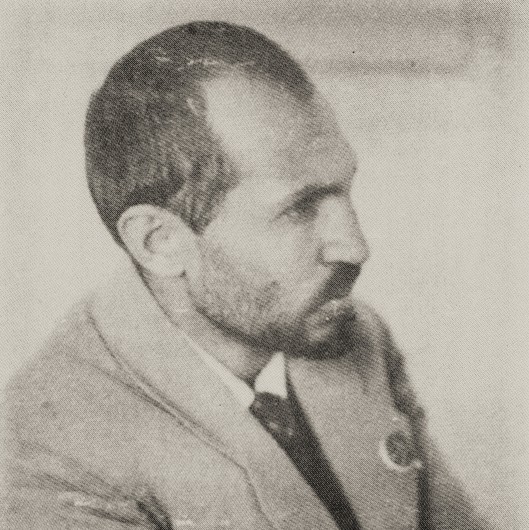
Avetis Sultan-Zade, an Armenian Iranian from Maragheh was educated in Yerevan where he joined the Bolsheviks in 1912. A was founder of the Communist Party of Persia, on the Executive of the Comintern from 1920 and a leading figure in Congress of the Peoples of the East, Sultan, here is a report to the Third world Congress in 1921. A Left Communist, he would be side-lined through much of the mid-20s for favoring land collectivization and hostility to the Comintern’s orientation to progressive nationalists, spending much of the time writing on Marxist economy. He returned to leadership as the Comintern moved to the ‘Third Period’ only to again lose his positions in 1932. Later a victim of the Purges, Avetis Sultan-Zade was executed on June 18, 1938.
‘The Economic Position of Persia and the Work of the Iran Communist Party’ by Avetis Sultan-Zade from Moscow. No. 36. July 8, 1921.
Persia is one of the riches countries of the East but because of the criminal competition between England and Czarist Russia It is now in an extremely serious economic situation. The colonial policy of these two countries not only maliciously prevented the development of our national industries, but under the pressure of the import of cheap goods completely destroyed our never-too-brilliant small industry.
As a result of this unequal competition between machine and hand production, hundreds and thousands of destitute and hungry tradesmen were thrown on to the streets. faced by death from starvation in their own country and with a curse on their lips deserted their native country and sought help in other lands; in Turkestan, Caucasia, Baku, America and others. They were followed by the hundreds of thousands of the land proprietor and Shah-Governor exploited peasants, who with their own “sweat and blood” created the wealth of other countries. Such is the fate of all other colonial or semi-colonial countries.
The war and the Russian revolution somewhat altered the situation. The continual shortage of goods and the large demand again set our small industry on its feet in many regions of Northern Persia many varieties of locally produced articles appeared in large quantities. Even in the South, where the English continue to import their goods, the small tradesmen are meeting with tremendous success.
Many small private producers are making their appearance and hate with all their heart the economic supremacy of the foreigners.
The English imperialists however are not relying on the bourgeoisie or small industry owners of Persia, they acquire their power through the rich landed aristocracy, which is the most corrupt in the whole of the East. 3,000 feudal landowners control 3/4 of all the useful land in our country. Over 10,000,000 peasants suffer under the yoke of these unscrupulous agents of the English bourgeoisie and are directing their growing hate equally as much against these native idlers supported by the Iran Shah of Shahs.
As a result of its economic backwardness the country lacks industrial workers, especially in the Northern provinces, where now and again one finds factories having from 15 to 50 workers, but nevermore. In this respect things are a little better in the South. In the oil fields, owned by the Anglo-Persian Trust and some English firms, there are over 250.000 workers, scattered over 8 large centres: Suleiman, Shuster Mohamer etc.
Under such conditions it is evident that the Iran Communist Party cannot be, and is not trying to be, a mass party. It is attempting to gather around it the more advanced elements of the peasants, workers and artisans, organising and educating them under the banner of the III Communist International; at the same time creating trade unions in the towns and peasant labour unions in the villages.
Recently, after the congress of our party in Enzeli on June, 23d 1920 in spite of the unheard of difficult conditions the Executive Committee of the Communist Party has accomplished a colossal organising work. We now have 4 district and a whole series of county branches with a total membership of 4,500. Last year we had more, but as a result of the provocation of a group of adventurers, disguised in a cloak of communism, our party work has come to a stop in some regions. This also explains the temporary cessation of our party organ “The Communist”. This has made us much more cautious and conspiratory. However we have managed with the participation of our party to create workers and artisans trade unions having a membership of about 4,000.
The Iran Communist Party is soberly examining the semi-feudal conditions under which it has to carry on its work.
In comparing the class forces in our country, where the English imperialists together with our landed aristocracy exploit almost the rest of the other classes, the party has placed as its immediate and minimum aim the overthrow of the Shah-proprietor rule and the liberation of Persia from the economic and political yoke of the English brigands, and securing more democratic conditions to enable our party to carry on intensified party work. We are convinced that only by this means can backward country be brought into the sphere of development of the world revolution without which the oppressed nations cannot be finally freed from the exploitation of world capitalism.
Moscow was the English-language newspapers of the Communist International’s Third Congress held in Moscow during 1921. Edited by T. L. Axelrod, the paper began on May 25, a month before the Congress, to July 12.
PDF of full issue: https://www.marxists.org/history/international/comintern/3rd-congress/moscow/Moscow%20issue%2036.pdf
 Revolution's Newsstand