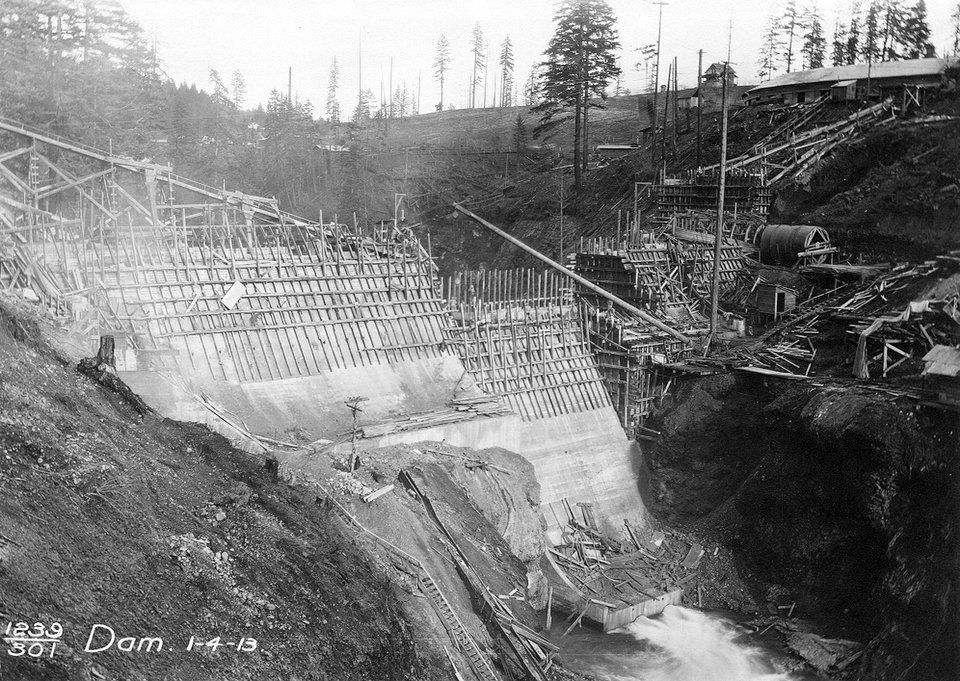
An appeal for help from workers striking the White Salmon dam building project in Washington State.
‘I.W.W. Must Win at White Salmon’ from Industrial Worker. Vol. 4 No. 14. June 27, 1912.
White Salmon, Wash., June 23. The class struggle which is forever and ever going on between the bourgeoisie and the proletaire was vividly emphasized by one of its aspect when the community of White Salmon, Wash awoke on Thursday morning, June 13, and became aware of the fact that the 242 men who were working on the construction of the Northwestern Electric Company’s power dam struck in a solid body after their demands for higher wages and better accommodations were not granted.
Demands presented to the superintendent on the eve of the strike were as follows: First, flat increase of 25c per diem; second, better food and accommodations; third, no discrimination to be made against the workers.
Greeks, Italians, Croatians, Bulgarians, Americans, Austrians, etc., unanimously voted for the I.W.W. to conduct and manage the strike.
Owing to the fact that the company owns large tracts of land on both banks of the river, the strikers were evicted from the premises and given their checks. Some of the strikers were compelled to take their checks at the point of a gun.
A lease on ground for camping purpose could not be obtained from the surrounding diplomatic “hoosiers,” a fact which compelled us to shift our center of operation to White Salmon, four miles from the dam.
Hall, mess room, sleeping quarters were rented, and a general plan of camping, imitating that of our fellow workers on the Canadian Northern, was then adopted.
Net of pickets and scouts were spread over the surrounding country by the captain of pickets and our own police to patrol the town appointed.
A number of the strikers went to Portland and other towns and are awaiting for the first signal from us in case the strike is settled.
Not many scabs so far. Two bosses were sent to Portland to act as “mancatchers.” They were seen by our pickets buttonholing men in saloons and on the streets, with the result that only 18 scabs, bosses with them, were reported coming in last night.
It was obvious to everybody present that the scabs wished to turn back and would have done so if the gunmen had not seized them, one by one, and thrown them like a lot of “dead sheep into an automobile truck.
According to the last report there are 60 scabs, this number including cooks, flunkies, engineering and office force, bosses, 12 gunmen (one parading continually on horseback).
The tunnel work is at a standstill, not even the muck having been shoveled out since the last round was blasted before the strike.
The strike took the company by surprise. It was carefully prepared by some of our active members. The company cannot afford to lose time and money in delaying the operations. They are already behind with the contract.
In order to win we have to fight; in order to fight we have to “stick;” and in order to stick we must be fed. So far we fought the company upon our own resources, appealing for help to our local in Portland, which responded nobly. But there are many of us to be fed and the struggle is likely to be long one. It is not only the notorious Stone & Webster we are fighting, it is the whole master class. So all of you who wish us success in our fight send contributions to our treasurer, Abner E. Woodruff.
Remember the first principle of Solidarity is MUTUAL AID
The Strike Committee.
The Industrial Union Bulletin, and the Industrial Worker were newspapers published by the Industrial Workers of the World (IWW) from 1907 until 1913. First printed in Joliet, Illinois, IUB incorporated The Voice of Labor, the newspaper of the American Labor Union which had joined the IWW, and another IWW affiliate, International Metal Worker.The Trautmann-DeLeon faction issued its weekly from March 1907. Soon after, De Leon would be expelled and Trautmann would continue IUB until March 1909. It was edited by A. S. Edwards. 1909, production moved to Spokane, Washington and became The Industrial Worker, “the voice of revolutionary industrial unionism.”
PDF of full issue: https://www.marxists.org/history/usa/pubs/industrialworker/iw/v4n14-w170-jun-27-1912-IW.pdf
 Revolution's Newsstand