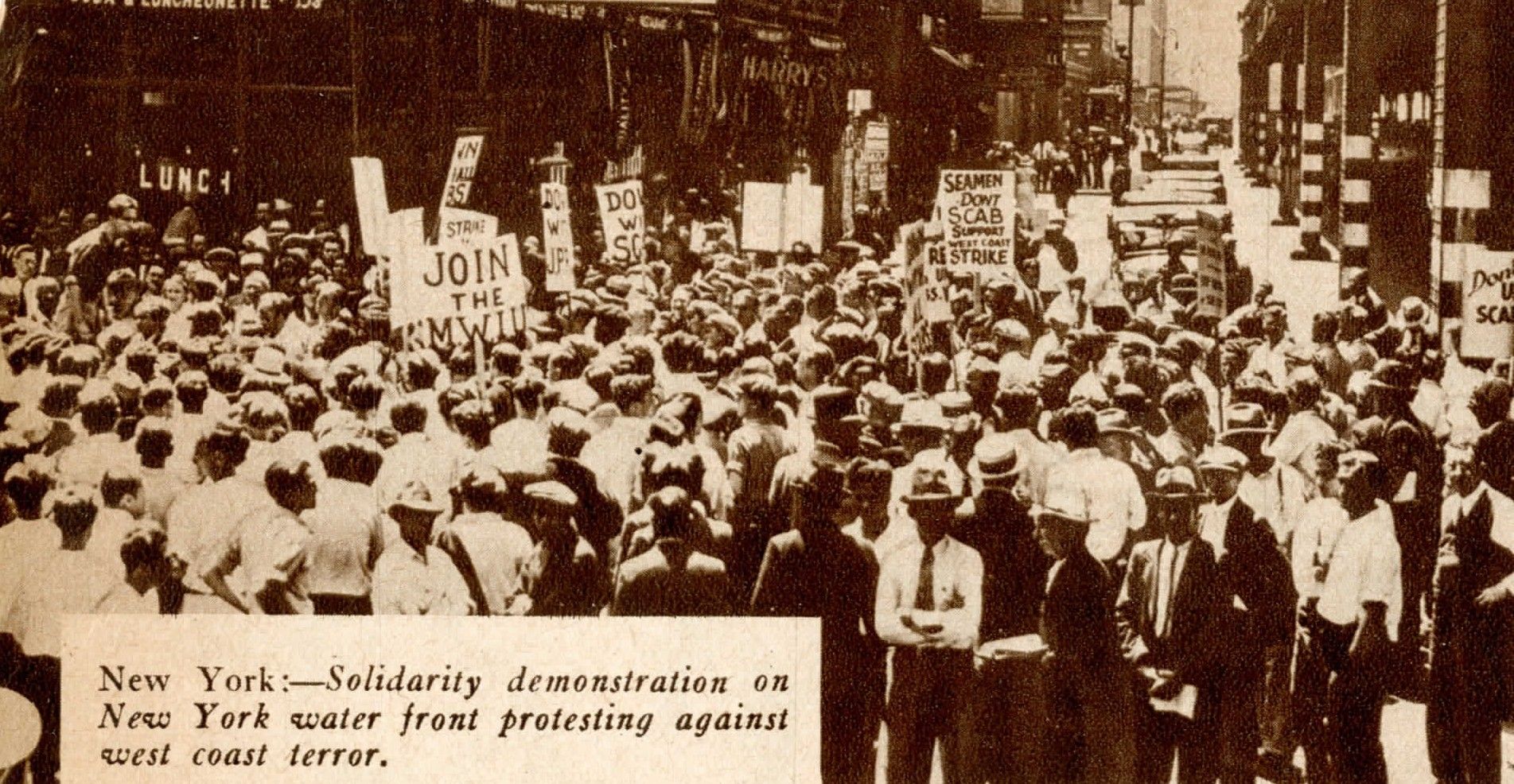
The International Labor Defense had their work cut out for them in the aftermath of 1934’s San Francisco General Strike.
‘The I.L.D. and the Dock Strike’ by Bruce Minton from Labor Defender. Vol. 10 No. 7. July, 1934.
During the first three weeks of the Pacific Coast Longshoremen’s Strike, the police made 265 arrests in San Francisco. And of all the strikers dragged into court, only one was convicted. Now the courts are tightening up. Convictions grow more frequent. Bail mounts, becomes increasingly difficult to raise with each arrest. The San Francisco branch of the I.L.D. meets this emergency–by fighting police brutality, by fighting for jury trials for workers unjustly arrested and more unjustly imprisoned.
The viciousness of the San Francisco police is hard to imagine. At first, workers thought the cops were “good guys”, anxious to protect property and lives. Then the shipowners put the screws on Police Chief Quinn, and the attitude of the police suddenly changed. Terror broke out overnight. When the pickets, 2000 strong, marched along the Embarcadero as they had marched every morning since the strike began, they were confronted by mounted officers and ordered to halt. Without arguing with the strikers, without warning, the cops charged the workers, raining blows right and left, throwing gas bombs, shooting. The longshoremen resisted, trying to protect themselves with bare fists. Unarmed men cannot fight armed terror. The strikers were forced back. The police singled out the leaders for particular attention, beat them unmercifully. John Shoemaker of the Strike Committee was taken to the station, charged with “rioting”. Christianson was forced against the wall by a mounted officer, kicked in the stomach till he was seriously hurt. The papers screamed “Communist Riot!” But testimony received by the I.L.D. proved embarrassing to the guardians of the law. The police had tipped off the Call-Bulletin that a “riot” would take place. The paper appeared in the waterfront with over a column of hazy news of the battle just fifteen minutes after the field day ended. It is physically impossible to set-up print, and deliver newspapers in fifteen minutes. The police had tipped off a reporter, given him a good scoop, that a “riot” was impending. And at the same time gave away the fact that the “riot” had been planned by the police, and had been started by them.
The I.L.D. held an investigation. Henry Schrimpf, delegate from the International Longshoremen’s Association saw the riot from the window of strike headquarters. “I’ve been all over the world,” he testified, “except in China, and I’ve seen all kinds of fighting. I was in the World War. But I will say that never in my life have I seen such beastly brutality as the San Francisco police used in their insanely ferocious attack on the National Youth Day demonstration on the waterfront.”
HOW ABOUT MOONEY?
The investigation lasted all afternoon. The injured who were not in the hospital told their stories. The police order not to beat women on the head but only on “the soft parts of the body” was read from the Press. The statement of Lieutenant Mallinari that those guys (the strikers) “got away with something today. Next time you’ll be cases for the morgue” was presented. The liberals Could this sat with open mouths. happen in San Francisco? they asked each other. Could police victimize anyone and get away with it? (Apparently they had forgotten about Tom Mooney). The liberals were horrified: they’d protest, they’d bring the whole episode before the Grand Jury, have Chief Quinn removed from office. But when they got home, their ardor cooled. They still thought things outrageous, but many of them telephoned the I.L.D. requesting, “Don’t use my name.” Some cooperated, a few organizations joined the protest, yet the brunt of taking action fell on the I.L.D. They presented the testimony to the foreman of the Grand Jury–pictures, records, names of officers–and demanded an open hearing and an indictment. He promised an investigation. So far the Grand Jury has not responded.
THE COURTS COOPERATE
On one hand, police cooperate with the shipowners in attempts to break the strike; on the other hand, the courts cooperate. Oh, justice is impartial! That is why bail for unarmed strikers arrested on charges of “inciting to riot” or “rioting” is set at $1,000, while armed strikebreakers, arrested for carrying weapons, have bail set at $50. That is why Elaine Black, head of the I.L.D. in San Francisco was arrested in the Hall of Justice for vagrancy while trying to find out on what trumped-up charge two workers were being held. That is why her bail was set for $1000, and she was kept in jail almost twenty-four hours, for being in the Hall of Justice attempting to assure legal protection to workers.
The I.L.D. cooperates with the Defense Committee of the Longshoremen. The strikers made the mistake of not selecting their lawyer with care: they found that he betrayed them, refused to let them testify in their own defense in court, refused to fight the court’s attempt to railroad leaders to jail. John Shoemaker of the Strike Committee received a sentence of 60 days for “rioting”; he committed the hideous crime of getting in the way of a policeman’s club. The Defense Committee changed lawyers, has now found a more militant, sympathetic man to handle their cases.
Mass pressure counts. Every morning the I.L.D. packs the courtroom with workers who watch “Justice” administered. Men who come off picket duty at six in the morning go to court at nine to support their fellow workers. These spectators demand some show of impartiality. Their presence is felt.
INTIMIDATING SCABS?
The I.L.D. has asked the International Seamen’s Union, on strike also, to accept aid in defending their members who are jailed. So far the Seamen have not accepted the offer. At the present time, the I.L.D. handles all cases for the Marine Workers’ Industrial Union, the only independent union on strike. Judge Dunn criticized the Union from the bench, “The M.W.I.U. is not a recognized union but a ‘red’ A. F. of L. union.” This impartial statement seems to lack meaning. All unions are striking for recognition. The M.W.I.U. is no different in this respect than any other union now on strike–except that it is not affiliated with the A.F. of L. Judge Dunn doesn’t like the M.W.I.U. because this organization has provided militant leadership and as he quaintly put it, they intimidate scabs. He cannot understand the necessity of such action. When police intimidate workers–Judge Dunn has nothing to say about this.
The strike enters the sixth week. The picket lines remain solid, the workers are determined to win. Despite police brutality, hostile Press and courts, union officials who urge sell-out methods, Chambers of Commerce and Industrial Associations that scream “red terror” and pledge their organizations to break the strike despite killings, convictions, false arrests, the strike continues on a solid mass basis. Beside the strike stands the I.L.D.–to give assistance to the rank and file, to uphold their legal rights.
The result of this struggle will be felt throughout the United States. Such a strike is the best defense against Fascist terror that has swept over Europe and now threatens the American worker. The I.L.D. supports the worker in this battle, carries the fight for worker’s rights into the courtrooms.
Labor Defender was published monthly from 1926 until 1937 by the International Labor Defense (ILD), a Workers Party of America, and later Communist Party-led, non-partisan defense organization founded by James Cannon and William Haywood while in Moscow, 1925 to support prisoners of the class war, victims of racism and imperialism, and the struggle against fascism. It included, poetry, letters from prisoners, and was heavily illustrated with photos, images, and cartoons. Labor Defender was the central organ of the Scottsboro and Sacco and Vanzetti defense campaigns. Not only were these among the most successful campaigns by Communists, they were among the most important of the period and the urgency and activity is duly reflected in its pages. Editors included T. J. O’ Flaherty, Max Shactman, Karl Reeve, J. Louis Engdahl, William L. Patterson, Sasha Small, and Sender Garlin.
PDF of full issue: https://www.marxists.org/history/usa/pubs/labordefender/1934/v10n07-jul-1934-orig-LD.pdf
 Revolution's Newsstand