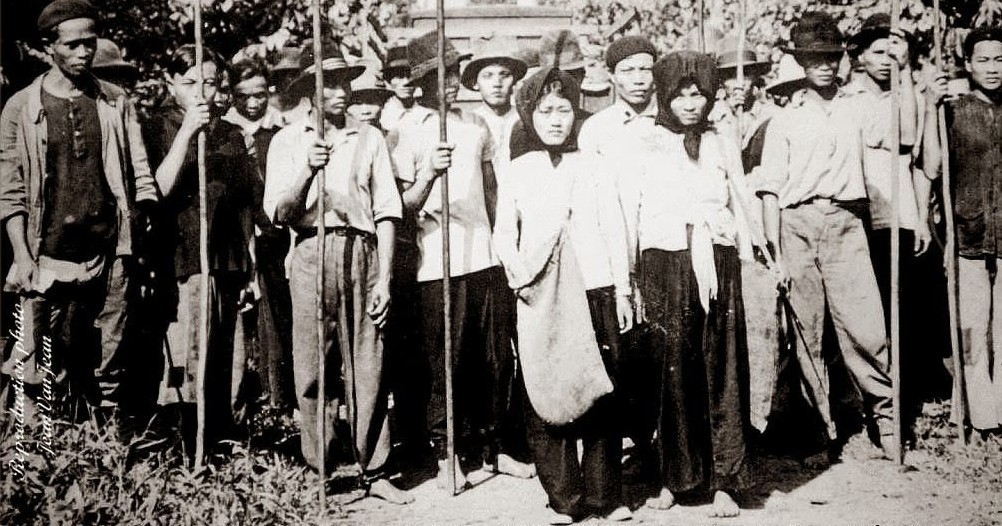
After exterminating much of the indigenous people of the New Hebrides, today’s Vanuatu, French imperialism kidnapped tens of thousands of its Vietnamese subjects to replace decimated native labor on the island’s plantation hells.
‘Fresh Crimes of French Imperialism in Indo-China’ by Wang from International Press Correspondence. Vol. 7 No. 56. October 6, 1927.
After French imperialism took possession of the New Hebrides, the native population of these isles was almost exterminated through alcohol, venereal diseases and forced labour, the scourges with which the carriers of “civilisation” visited the colonial countries. This has been admitted officially in the French Parliament by Deputy Archambault, reporter upon the colonial budget.
The native population is almost wiped out. The soil of the islands, however, remains very fertile. It promises rich profits to the French colonists. As, however, they cannot themselves cultivate the plantations, they need slaves for doing this, and they are now obtaining these slaves from Indo-China.
In former times, the method of recruiting solved the difficulty. The workers and peasants of Indo-China, who had been ruined by enormous taxation and were at a loss how to keep themselves going, were allured by the promise of high wages and took ship for the “Land of Promise”. But they were not able either to stand the cruel treatment they had to endure on the part of the planters or the tropical diseases. As a result, most of them perished. Since that time the natives of Indo-China have refused to emigrate to the French Polynesian plantations, preferring to starve to death in their own country.
The French imperialists are now beginning to resort to criminal measures in order to supply their plantations with hands. Firstly, the French colonists demand that the functionaries of the French administration in Indo-China, who work hand in hand with them, should force the Indo-Chinese villages to put a certain number of coolies at the disposal of the planters. If the villages do not obey these orders at once, penalties are inflicted on them. Another method of the colonists is that of lending money to the Indo-Chinese who are constantly suffering the most horrible want, nay, famine, in order later, when they are unable to pay their debts, to have them arrested and compelled by brute force to embark for Australia. A third method of brute force is the following: they pretend to employ coolies at some work or other on board a ship, and when they are once aboard they are suddenly chained, locked up in the hold of the ship which is about to put to sea and transported to the islands. Fourthly, they deceive the Indo-Chinese who are out of work by promising them work in an adjacent province. When their victims are safely on board, they change the course of the ship. Finally, they simply carry off the Indo- Chinese by force or by craft and transport them to the New Hebrides in iron cages.
On board the ship, the Indo-Chinese are stowed away in dark and airless cells. They are kept like animals, nay, worse than animals. They get hardly any food and drink. Those who fall ill, are simply thrown overboard “to prevent their infecting the others”. They are constantly guarded by armed men. After arrival on the islands, they are interned in a camp. This camp is a sort of slave market. The planters go there to inspect the victims, to select and buy them. In order to induce them to get their wives to join them, these latter are graciously permitted to bring their children with them; when, however, the women have gone on board with their children, it frequently happens that the children are simply thrown overboard “in order to get rid of superfluous mouths”. This is what actually happened to the Tonkinese.
In July of the current year a ship entered the port of Townsville. There were 400 Indo-Chinese on board who had been locked up in cells in the dark hold of the ship. The Chinese of Townsville, who had found out what cargo the ship was carrying, tried to come to the rescue of the victims, but they were prevented from helping them by the armed guards on the ship. In an appeal which got into the hands of the Chinese and was published in the “Daily Standard”, the unhappy Indo-Chinese reported that they had been drugged with poisoned cigarettes. In an unconscious condition, they were carried off to the French concession of Kwangchouwan and placed on board ship. In their cells they suffered terribly from hunger and thirst. They were cruelly ill-treated by their guards. Sick persons were simply thrown overboard. The barrels of machine guns were constantly directed on them.
When these facts became known, the Board of Missionaries in Melbourne raised a protest. J.B. Jaffray, a missionary, informed the “Daily Standard” that there were at present more than 5000 Tonkinese in the New Hebrides who had been transported there in this barbarous way, and that a ship with a similar human freight arrives every three or four months. The workers and Chinese of Townsville organised a meeting in order to protest against these new and infamous crimes of the French colonists, in order to show the victims their solidarity and to demand that the Australian Government should take suitable measures to stop the slave trade between the Australian port and the New Hebrides.
Such are the heroic deeds of the French imperialists for the cause of civilisation.
International Press Correspondence, widely known as”Inprecorr” was published by the Executive Committee of the Communist International (ECCI) regularly in German and English, occasionally in many other languages, beginning in 1921 and lasting in English until 1938. Inprecorr’s role was to supply translated articles to the English-speaking press of the International from the Comintern’s different sections, as well as news and statements from the ECCI. Many ‘Daily Worker’ and ‘Communist’ articles originated in Inprecorr, and it also published articles by American comrades for use in other countries. It was published at least weekly, and often thrice weekly.
PDF of full issue: https://www.marxists.org/history/international/comintern/inprecor/1927/v07n56-oct-06-1927-inprecor-op.pdf
 Revolution's Newsstand