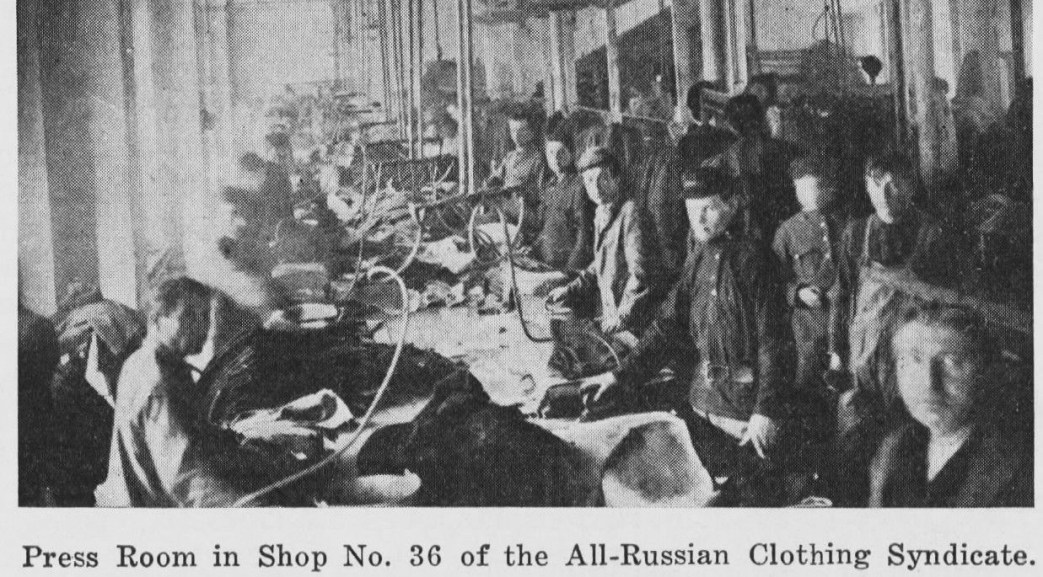
Robert Dunn reports that workers running a Moscow clothing factory receive far more in remuneration than wages.
‘How Workers Run a Clothing Factory in Soviet Russia’ by Robert W. Dunn from Soviet Russia (New York). Vol. 8 No. 11. November, 1923.
WHEN the American worker invests money in such enterprises as those to which the Russian-American Industrial Corporation is extending its Industrial Credit, he need have no fear that he is thereby assisting in the soulless exploitation of Russian labor. Nor if he happens to be a “money-grabber” should he entertain the thought that he is going to gain a dividend because “his corporation” pays miserable wages and thrives on the literal slavery which foreign capital, in due course of events usually succeeds in fastening on its coolie colonies. For both the class-conscious toiler and the thrifty petty-investor should be aware that their money invested in bonds of the “Russian-American” is being put into Russia and that in Russia the workers are ruling.
The money wages in the Russian clothing factories are not equal to those a New York cutter takes home in his fortnightly pay envelope. But from the standpoint of what the worker can buy with his rubles—now increasingly stabilized—the worker in the reconstructed Russian industry is not far behind his American brother who, it will be admitted, is working under a somewhat less promising economic and political system.
But wages and cost of living figures, though instructive and encouraging, give at best, a bare idea of the present conditions in a Russian clothing factory. It is well, therefore, to look beyond the columns of wage statistics at the life of the worker himself.
How Workers Live
Take first the living accommodations provided for the members of a certain Moscow clothing plant. It is one of the apartments formerly inhabited exclusively by the bourgeoisie. This six-story apartment reminds one of uptown flats near Riverside drive rather than of the tenements where many New York needle workers live beyond the roar of the Third Avenue L. The floor space per family, it is true, is not as great as in some working class districts in America (the housing problem of Moscow is now particularly acute, for practically no new buildings have been erected since the beginning of the war.) But from the point of cleanliness and light and air, these rooms compare quite favorably with the workers’ best homes in America and Europe; indeed, compared with some of the tenements of Glasgow and Chicago, they seem literal palaces of comfort.
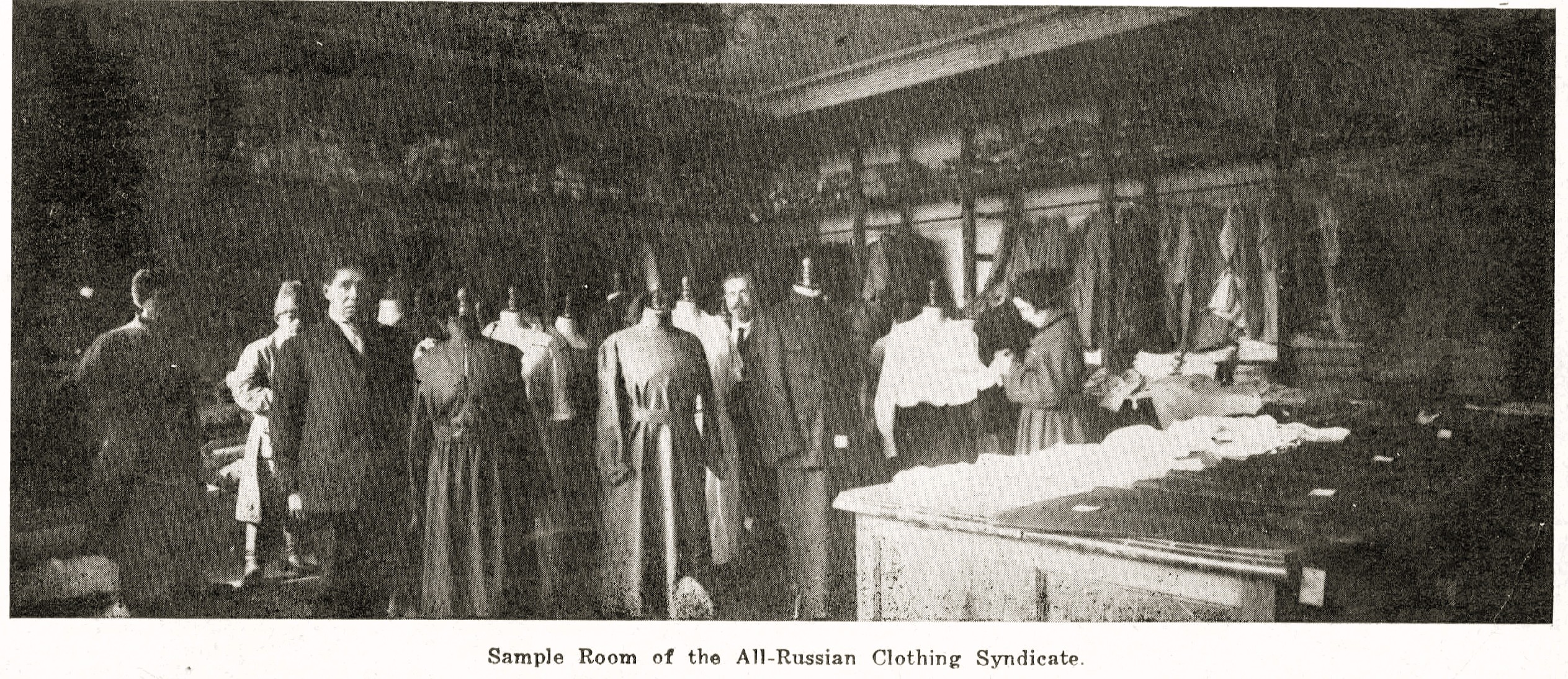
Comrade Widok, the Chairman of the Factory Committee of the Experimental Factory of Moscow, told me that in 1918 when he first came from America and when the Dom Communes were being organized, some of the workers opposed them and told the Communists they preferred to live where they were and not in houses given over to the clothing workers. The Moscow municipal administration was then distributing the old apartments of the bourgeoisie to the workers giving them almost rent free in return for a few repairs. It was on these terms that the Experimental organized its Dom Commune. Some of the workers, however, preferred to “live out.” Now, however, according to Widok, the song has changed. All the workers are begging to live in the communal house and there is an eager waiting list of applicants. For they see that the co-operative house and its central administration has succeeded and they are all demanding to move into it.
Managing the Communal Houses
The house is managed by a special committee appointed by the fabcom (factory committee.) This committee makes out the budget and allots the rents. It also inspects the rooms, fines delinquents not up to the standards of cleanliness, and supervises the kitchen and other communal departments of the house. On the top floor of the house is the Day Nursery, exceedingly well managed, while on the ground floor the children of kindergarten age are provided with teachers and equipment for developing their health and education.
Foreigners who have formed their opinions of Russian children’s institutions after inspecting a few children’s homes in the former famine areas, have changed their minds on the matter of the Russian’s ability to care for children, after visiting these communal houses, operated by the Russian Clothing Syndicate.
The educational, social and cultural work of the Moscow “Experimental,” for a period of six months was reviewed in the report of Comrade Widok speaking at the general membership meeting, which he attended one night in the factory club. He mentioned first the work of the hospital staff, the apothecary’s office, the rest house in the pines, the sanitoria, and even a vacation trip to Crimea and the shores of the Black Sea–all at the disposal of the sick or disabled worker from the shop.
Extensive Educational Work
In the intellectual field the chairman reported seventy-five lectures, on political, economic and industrial topics; eleven excursions to other factories; twelve plays and dramatic evenings, moving picture performances; twenty workers (out of the twenty-three illiterates in the factory) attending the class for the liquidation of Illiteracy; thirty-five members in a party school; nine in a Marxist class; ten in a dramatic studio; six receiving free lessons on the violin; twenty-nine in a singing society; thirty in a sports club–all these activities organized for and by the workers of the shop, the money being appropriated by the factory administration and going directly to the union to be used at its discretion.
And included in the work supported by this fund must not be forgotten the Woman’s League, the library and the technical school (supported jointly by this factory and the other units in the Moscow clothing trust) attended at present by over seventy-five students who give part of their time in the factory. At sixteen years of age the Soviet Law permits them to work six hours a day, but for this they are paid a full eight hours’ pay, while they are still attending school two hours each day.
The administration of this work is in the hands of a Kult Kommisia elected by the workers through the factory committee and holding office for six months. The factory committee consists of five members, three of whom are continuously employed in either the cultural work, the sanitary commission and the “workers’ protection,” or on the price and dispute committee. The other two members are at work in the shop and subject at any time to call and conference.
A Great Advance
These are the mechanics of the social life of the worker–a stimulating life closely associated with his factory and his fellow-workers. It’s a life that develops social interest quite unknown to the mass of the workers of countries where the continual struggle with the management makes harmony in the workshop out of the question and real cultural work impossible, where athletics and social life are synonymous with paternalism and even less subtle forms of exploitation. Russian factories are in no sense Utopian but in this respect they are decades in advance of America simply because they have had a change in industrial control and have taken advantage of the opportunities thrown open to them by the revolution.
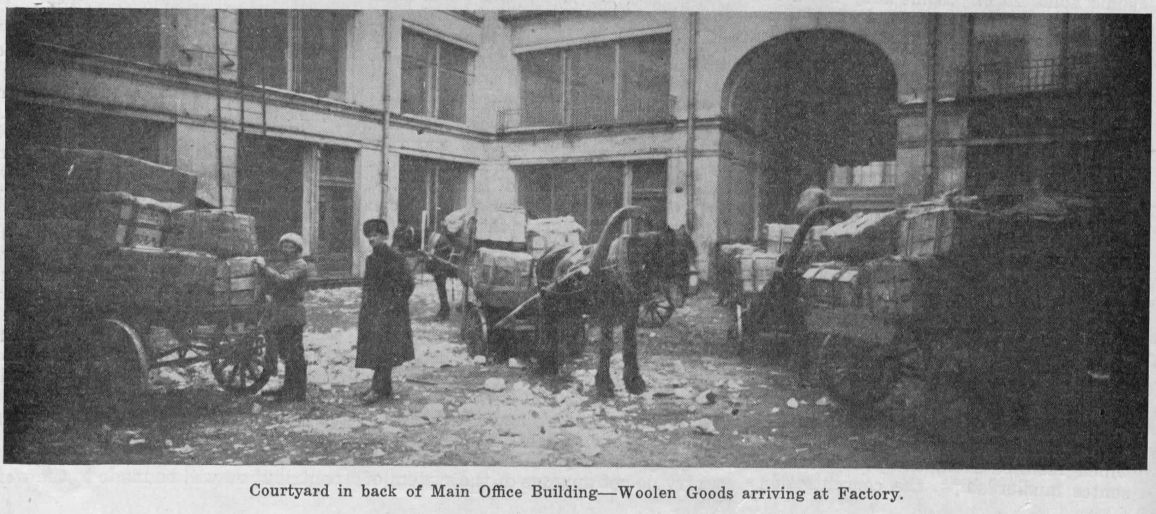
These facts would lead the reader who is not a hardened cynic or an incurable and disillusioned skeptic, to the conclusion that the clothing workers are not doing so badly in the industries to which the American workers are giving industrial credit through the agency of the Russian- American Industrial Corporation. The importance of this industrial credit cannot be overstated; without it many features of this “workers’ life” would not have been possible. One can truthfully say that the workers in America who have become stockholders in the R.A.I.C. have, besides helping to bring about the more abundant life for the Russian workers, become virtual stockholders in the first Workers’ Republic.
Writing in this vein makes one feel like a kept-press editor defending the established order. But the clothing workers of Russia feel very strongly about their kind of established order and they will continue to support this order because they, in fact, established it and like the looks of the thing they have built. And they continue to improve and remodel and experiment with it as they press on in the direction of their economic goal and a free workers’ state.
Soviet Russia began in the summer of 1919, published by the Bureau of Information of Soviet Russia and replaced The Weekly Bulletin of the Bureau of Information of Soviet Russia. In lieu of an Embassy the Russian Soviet Government Bureau was the official voice of the Soviets in the US. Soviet Russia was published as the official organ of the RSGB until February 1922 when Soviet Russia became to the official organ of The Friends of Soviet Russia, becoming Soviet Russia Pictorial in 1923. There is no better US-published source for information on the Soviet state at this time, and includes official statements, articles by prominent Bolsheviks, data on the Soviet economy, weekly reports on the wars for survival the Soviets were engaged in, as well as efforts to in the US to lift the blockade and begin trade with the emerging Soviet Union.
PDF of full issue: https://www.marxists.org/history/usa/pubs/srp/v8n11-nov-1923-sov-rus-pict.pdf
 Revolution's Newsstand