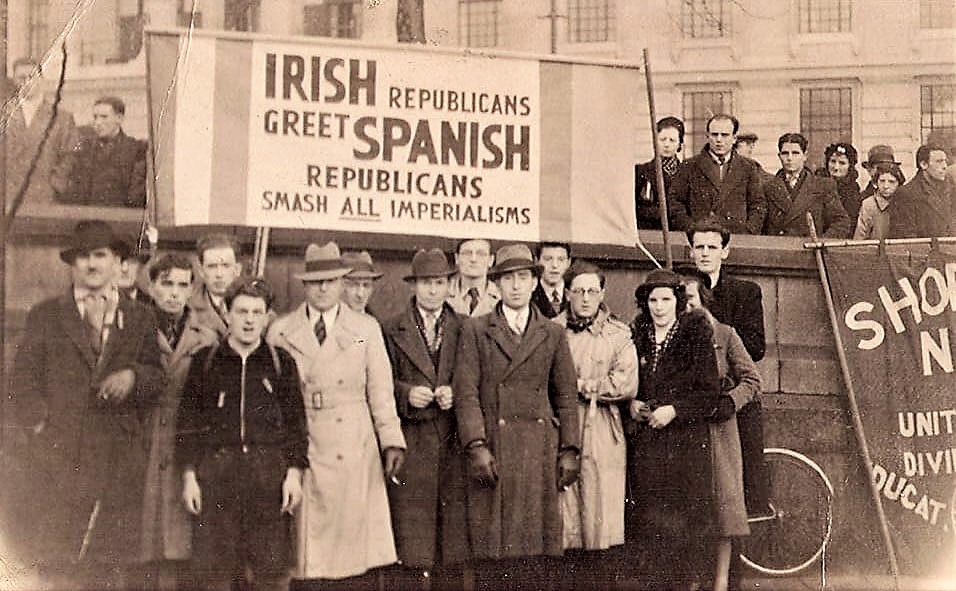
This obituary of Kit Conway, veteran of the Tipperary I.R.A. killed at the Battle of Jamara on February 12 1937 while fight fascism in Spain, includes his last letter.
‘Kit Conway, Irish Communist, Killed While Fighting in Spain’ from The Daily Worker. Vol. 15 No. 65. March 17, 1937.
Had Brilliant Record in Irish Revolutionary Movement
Fallen I.R.A. Leader Popular in Dublin Trade Unions
DUBLIN, March 16. The Irish Communist Party has suffered a big blow by the death of Comrade Christopher Conway, who was killed in the recent fighting at Mount Pingarron, Spain. Comrade Conway, better known to his many friends in Ireland as “Kit Ryan,” had a brilliant record of service in the Irish revolutionary movement, serving with the Irish Republican Army during the Black and Tan days in the Aherlow district of County Tipperary, where Dan Breen, the well-known leader, was in command.
Following the Irish Civil War of 1922 Comrade Conway went to America, there joining the United States Army. After a few years he returned to Ireland and again became associated with the revolutionary movement, taking up a post as instructor to several units of the Irish Republican Army. When the split took place in the I.R.A. in 1934, Comrade Conway joined with the left-wing, lead by Peadar O’Donnell, Frank Ryan and George Gilmore, who then formed the Irish Republican Congress.
DUBLIN C.P. LEADER
In 1935 Comrade Conway joined the ranks of the Irish Communist Party and was one of its most popular and active members in the Dublin district. A worker in the building trade, he was a member of the Irish Transport and General Workers’ Union, and played a leading role in the organizing of the laborers on Fearon’s House Building Scheme at Crumlin, County Dublin. He was very popular with the workers on his job, and on the day he left for Spain he sent the word around he was leaving; at knocking-off time the workers all gathered round him and asked him to make them a farewell speech, which he did, explaining why he was going to Spain, the issues involved in the war in Spain and exhorting them to organize their forces to prevent any attempt at Fascist uprising in Ireland.
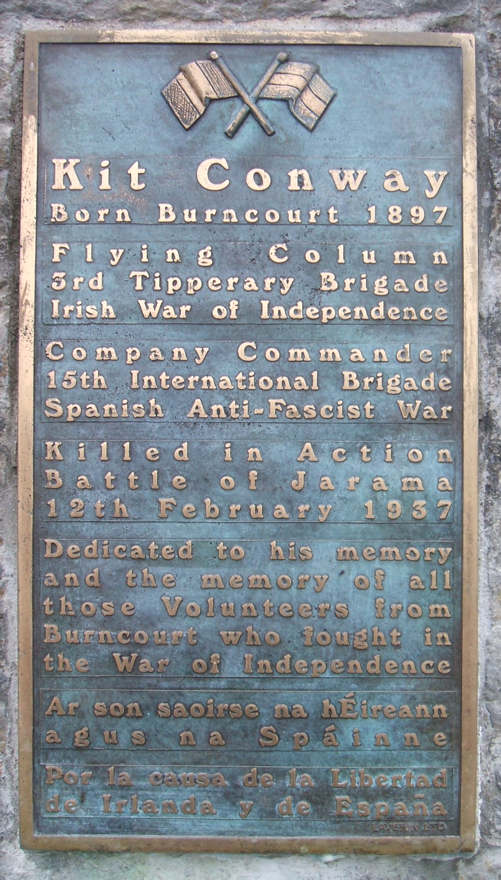
Conway was in the heavy fighting with the Irish section and the British Battalion on the Andalusian Front at the end of December. Being an expert in military matters. he had recently been promoted to the rank of captain in the Irish section of the International Brigade.
In the same battle at Mount Pingarron, Frank Ryan, the leader of the Irish section, was wounded, receiving a bullet through the left arm. In a letter to Sean Murray the leader of the Irish Communist Party, Frank Ryan says of Conway’ death: “I feel his loss more than anything in years. He had fought with reckless courage all the day.” Other Irish workers wounded in the same battle were: James Prendergast and Pat Duff, both from Dublin.
The Irish Communist Party and the whole revolutionary movement mourns the death of Comrade Con way, but with his blood he has saved the good name and revolutionary honor of the Irish nation. which O’Duffy and his Fascist dupes have endeavored to tarnish.
CONWAY’S LAST LETTER FROM SPANISH FRONT
Christopher Conway, heroic Irish fighter for the Spanish republic who died in the battle for Mt. Pingarron, in his last letter to the Irish Worker in Dublin, wrote:
“We are after having a good baptism in the Spanish War and we are waiting for the next call. The full story of what the first English speaking battalion of which we are a section, cannot yet be told; but when it is told it will be a powerful story of great deeds done against great odds. A day or two ago I heard that a certain little town had been captured by our Republican forces, and I started to remember the days we spent near it at Christmas and the good men we lost there.
“There was one mistake in the list of casualties Frank sent you from Madrid. W. Beattie of Belfast is not dead, only wounded and is getting along favorably. Between dead and missing our Irish Section lost six.
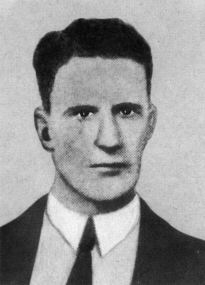
“Our news of Jack Nalty is that he is on the mend; so is Frank Edwards. I would pay a special tribute to Nalty and Edwards. Frank says he told you about them. Gerry Doran, I am told, is progressing nicely. All the others are almost completely recovered. I must say I never soldiered with a better crowd of lads than the young I.R.A. chaps.
“Bill Scott is coming down to us as soon as he can. Now that Nalty is out of action, Bill will be a great help.
“Letters often wander about the world before they reach us, but all the same folk should write us the news and send us news cuttings. We were delighted to read in your letter–which only came now–that things are bucking up at home. But your promised letter and weekly news has not arrived. The attached address should find all of us, except the lads who are with the Americans and whom we expect to have with us soon.
“Although I don’t write much be assured that we are all as full of spirit as ever. As the Spanish newspaper, ‘Politika,’ which I am enclosing, says, we have redeemed the honor of Ireland that O’Duffy tarnished. We’ll dine in Seville this Summer, or what’s left of us will. I’m sure of that. All the best to our pals at home and thanks to all who are rallying to our support.”
The Daily Worker began in 1924 and was published in New York City by the Communist Party US and its predecessor organizations. Among the most long-lasting and important left publications in US history, it had a circulation of 35,000 at its peak. The Daily Worker came from The Ohio Socialist, published by the Left Wing-dominated Socialist Party of Ohio in Cleveland from 1917 to November 1919, when it became became The Toiler, paper of the Communist Labor Party. In December 1921 the above-ground Workers Party of America merged the Toiler with the paper Workers Council to found The Worker, which became The Daily Worker beginning January 13, 1924. National and City (New York and environs) editions exist
PDF of full issue: https://dn721607.ca.archive.org/0/items/per_daily-worker_daily-worker_1937-03-17_14_65/per_daily-worker_daily-worker_1937-03-17_14_65.pdf
 Revolution's Newsstand