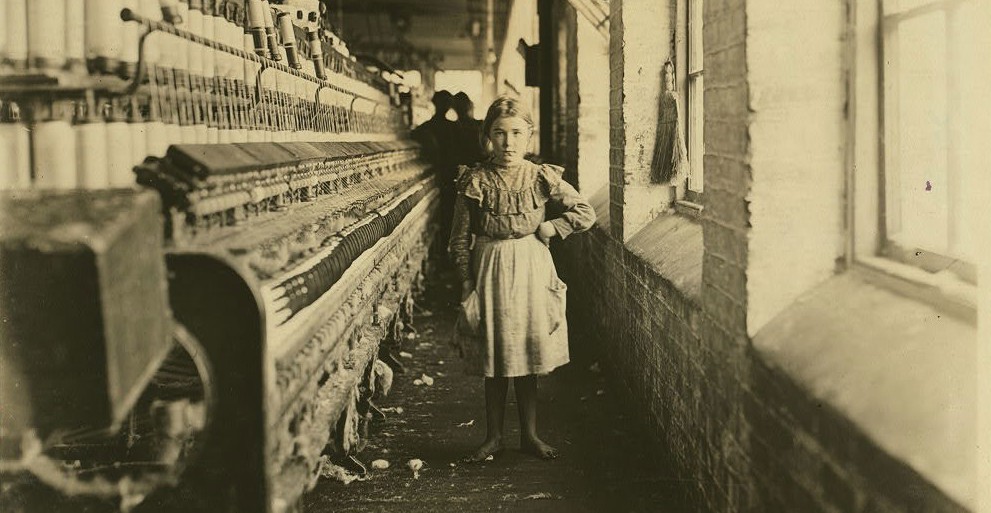
A look at the process of going from field to factory in Georgia’s emerging textile industry.
‘Textile Industry in the Southeast’ by C.D. Coutenay from Solidarity. Vol. 5 No. 227. May 16, 1914.
Griffin, Ga., May 8. Though I have been too much on the move for some time to keep in perfect touch with Solidarity, by the courtesy of friends I have read the Numbers containing the letters of your correspondent from the South Carolina cotton mills. The picture could not be made truer to life, except that your correspondent has not fully mastered the local vernacular. But this southern cotton mill industry extends far into the south. Augusta, Macon and Columbus, Ga., are considered as the extreme southern frontier of the district of greatest development. There is a large mill population at each of these Middle Georgia towns. In the rural districts surrounding them the negro population vastly predominates. But Chattanooga, Tenn. may be considered the gateway leading in to the lower southern mill district. The development begins in that city, and Rossville, its southern suburb, lying on both sides of the Georgia-Tennessee line has several cotton mills and woolen mills. Every railroad leading south, southeast and southwest from Chattanooga is a thread linking together a succession of cotton mill towns. Probably the Central of Ga. R.R. reaches more mill towns or a greater mill population than any ether road leading out of the city. Between Chattanooga and Griffin. Ga., a distance of 198 miles, this road passes through the following cotton mill towns: Rossville, Chicamauga, La Fayette, Trio, Summerville, Berryton, Rome, Lindale, Cedartown, Newman, Carrollton and Griffin. The mills at Chicamauga, Lindale and Trion are among the largest in the South. Several of these towns have a number of mills, and besides the mill towns directly on this line there are many others at points not far from the line and on both sides of it all the way to Griffin. These people know nothing of the true principles of the class conflict. Just recently at Rome a union was organized and a strike conducted with disastrous results upon the Federation of Labor principles. The chief demand was recognition of the union and the company did recognize it by firing every member of the union it could locate. Unlike the rural districts surrounding Augusta. Macon and Columbus, a population of white farm workers and small white farm tenants and farm owners predominates as far south as Carrollton. As the present great expansion of the industry represents a recent growth, the mill workers have had to be recruited and are still being recruited from the farm population in the rural districts surrounding the mill towns. The closest relations exist between the mill workers and their friends and kinsmen on the farms. Every attempt to organize the mill workers must take into consideration the relations between the rural and mill workers. There is a vast gulf of difference between the technical development of the farming industries and mill industries, here facing each other, and this difference is confusing to the ideas of workers who pass and repass from one to the other. The small middle class farm owners, whose own children also furnish recruits for the armies of mill workers do not understand their own relation to the mill industry.
The mechanical unit of production on the farms in this section is still small. It consists of a mule, a set of one horse plow tools, a hoe, an axe and one horse wagon. With such an equipment the rural inhabitant ceases to be a member of the wage working class and is admitted to the immense class of southern farm tenants, who are just one step below, and always striving to climb into the ranks of the small landowners. The one horse outfit may be acquired by any worker who has fifty dollars and a little credit or even no money at all. Every wage worker on the farms with life enough in him to be of any worth to a labor union, considers himself as merely a temporary sojourner in the wage class, and if he thinks of emancipation, it is one no wider than himself, because as soon as he can buy his mule, etc…he hopes to be able to find docile and cheap labor, himself being the master. A labor union might be launched under such conditions by the sheer force of agitation, but it would have no foundation upon which it could stand. Labor unions need not expect to benefit by organizing the farm workers of this region, as long as animals furnish the motive power of farm machinery. But the farmers, the small farm tenants and small farm owners do not understand these things, and think that a labor union, full blown, militant and everlasting can be established anywhere that the whim of an agitator might turn. And these petty employers of labor, who only pay out wages for a few weeks in a year, perhaps, or may be only for a few days, fear labor unions worse than the devil. It is true that although labor unions can not operate directly on these small farms, yet if they raise wages and shorten hours of labor in the towns, they will drain from the farms the surplus of cheap labor there, and in that way, indirectly raise wages on the farms. But these farms really produce a surplus of children for the labor market. The children of the small farm owners and of the tenants go to the field and work, and still, a surplus stream of them is always flowing towards the towns. What the labor union really means to these small farmers, more than any other thing is: First, that it multiplies the buying power of the urban communities who buy produce from the farmers, and the multiplication is in proportion to the militancy of the union. Second, the labor union prepares a place and assures opportunity to the children of the farm owners and tenants, who are all the time migrating to the wage class of the mills and towns.
As for the mill population itself, leaving out the large class of professional daddies, who breed children and marry, women for the labor market, and the class of petty patriots and petty politicians, is ready for the work of the organizer. The fire ought to be set out at as many different spots as possible at the same time. It terrifies and confuses the opposition, when it seems to be breaking out every where at once.
Hopefully,
C. D. COUTENAY.
The most widely read of I.W.W. newspapers, Solidarity was published by the Industrial Workers of the World from 1909 until 1917. First produced in New Castle, Pennsylvania, and born during the McKees Rocks strike, Solidarity later moved to Cleveland, Ohio until 1917 then spent its last months in Chicago. With a circulation of around 12,000 and a readership many times that, Solidarity was instrumental in defining the Wobbly world-view at the height of their influence in the working class. It was edited over its life by A.M. Stirton, H.A. Goff, Ben H. Williams, Ralph Chaplin who also provided much of the paper’s color, and others. Like nearly all the left press it fell victim to federal repression in 1917.
PDF of full issue: https://www.marxists.org/history/usa/pubs/solidarity-iww/1914/v05-w227-may-16-1914-solidarity.pdf
 Revolution's Newsstand